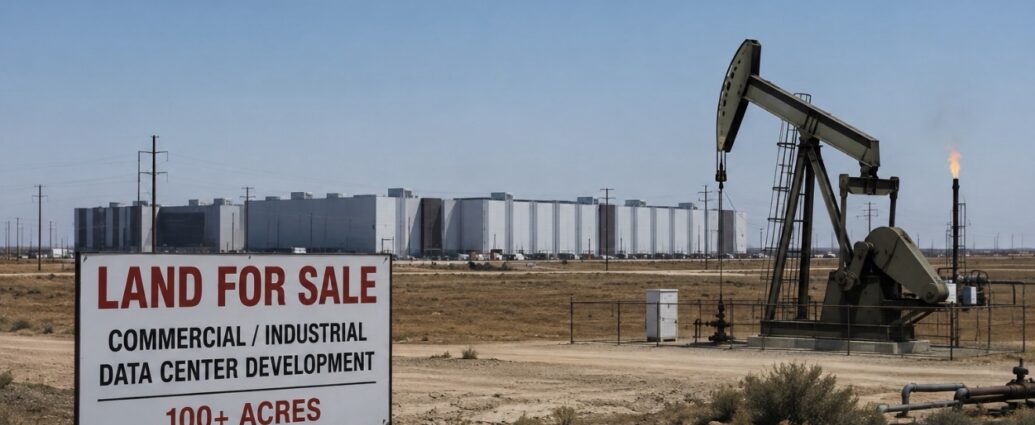
Across much of the country, the fastest way to kill a data center is to announce one. Residents pack zoning hearings, county commissioners impose moratoriums, and developers face months or years of delays. In West Texas, landowners have noticed — and they are selling the one thing suburban America cannot offer: nobody nearby to complain.
That is driving a new land rush across the Permian Basin. Large ranch and mineral owners are actively marketing acreage to artificial-intelligence developers, pitching isolation itself as an advantage. A massive computing campus built on thousands of acres of scrubland can avoid neighborhood opposition, reduce fights over power infrastructure and give developers room to build their own generation.
The backlash they are capitalizing on has become a major obstacle for the data-center industry. Communities across the U.S. are pushing back over electricity demand, water use, noise, transmission lines and the impact on local utility bills. Every zoning fight or lawsuit matters because AI companies are racing to secure power and bring new computing capacity online as quickly as possible.
The Permian Basin solves several of those problems at once. It sits on enormous natural-gas resources, giving developers access to fuel that can support around-the-clock electricity generation. Companies are increasingly considering building power plants directly beside data centers instead of waiting years for connections to the public grid.
West Texas also offers something increasingly difficult to find elsewhere: huge stretches of relatively inexpensive, contiguous land with few nearby residents.
Texas Pacific Land Corp. is one of the biggest beneficiaries. The company controls roughly 882,000 surface acres across 22 Permian Basin counties. For generations, its business centered on oil royalties, land and water. It is now positioning part of that enormous footprint for digital infrastructure and has invested in a partner focused on developing data-center projects.
LandBridge, another major Permian landholder, has also moved into the market. The company controls roughly 220,000 acres and signed an agreement giving developer PowerBridge the option to lease about 3,400 acres in Reeves County for a project capable of supporting up to two gigawatts of power generation.
Other projects being discussed across the region are even larger. A proposed Pecos County development has been sized at as much as 7.65 gigawatts, while CoreWeave and Poolside are developing AI infrastructure on more than 500 acres of Texas ranchland.
For ranch owners, the opportunity resembles the shale boom — but the contracts are different.
The value of a data-center lease can depend on who controls electricity interconnection rights, who pays for substations and transmission, what happens if promised power does not arrive and whether the agreement allows the tenant to dramatically increase its electricity needs later.
West Texas also has an unusual complication: surface rights and mineral rights are often owned separately. A landowner may lease acreage to a data-center developer while another company still retains the legal right to drill for oil or gas beneath the same property.
The isolation that makes the Permian attractive can also mean less public scrutiny. Large industrial projects capable of consuming enormous amounts of fuel, electricity and water may face considerably less organized opposition than similar developments near Dallas, Phoenix, Atlanta or Northern Virginia.
The bigger story is no longer simply that AI companies need more data centers.
It is that America’s growing resistance to those facilities is beginning to determine where the AI economy physically gets built — pushing billions of dollars in infrastructure toward places like West Texas that already have energy, land and a century-long history of welcoming heavy industry.
JBizNews Desk | Midland, Texas
© JBizNews.com All Rights Reserved. Reproduction or distribution without written permission is prohibited.