By JBizNews Desk
NEW YORK — June 1, 2026
Artificial intelligence has created the hottest trade on Wall Street, and it is centered on a product most consumers never see: semiconductor chips.
Chip stocks have surged to extraordinary heights in recent months as technology companies race to build the infrastructure powering the AI revolution. The gains have been so dramatic that investors, analysts, and fund managers are now openly debating whether the sector is experiencing the beginning of a long-term transformation—or the formation of another dangerous market bubble.
The numbers are difficult to ignore.
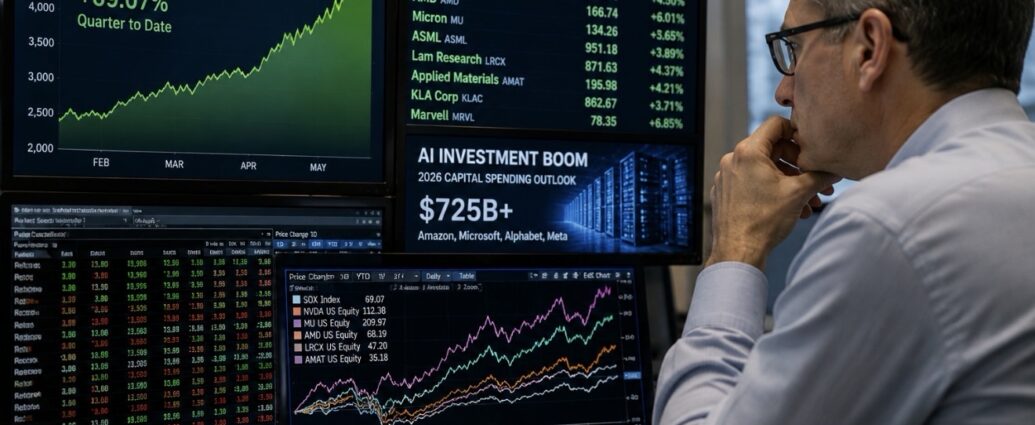
The Philadelphia Semiconductor Index (SOX), widely considered the benchmark for the chip industry, is on pace for one of the strongest rallies in its history. Semiconductor companies have become the best-performing segment of the stock market this year, significantly outpacing the broader S&P 500.
At the center of the rally is a surprising winner: memory chips.
For years, memory-chip makers were considered one of the most cyclical and volatile corners of the technology industry. Today, they have become critical suppliers to the artificial-intelligence boom. Demand for high-bandwidth memory, a key component used in AI servers and data centers, has exploded as companies rush to expand computing capacity.
Few companies illustrate the trend better than Micron Technology.
Shares of Micron have more than tripled this year as investors bet that AI demand will continue driving unprecedented growth. Analysts expect the company’s earnings to rise dramatically as hyperscale data-center operators continue purchasing massive quantities of memory products.
The spending behind the surge is coming from some of the world’s largest corporations.
Amazon, Microsoft, Alphabet, and Meta Platforms are collectively expected to invest hundreds of billions of dollars in AI infrastructure over the next two years. New data centers, advanced processors, networking equipment, and memory systems are all required to support increasingly powerful artificial-intelligence models.
Those investments have become the fuel powering the semiconductor rally.
As long as the spending continues, chip manufacturers stand to benefit.
Yet Wall Street remains deeply divided about how long the trend can last.
Kai Wu, Chief Investment Officer of Sparkline Capital, says the key question is whether AI infrastructure spending remains elevated for years or begins slowing once current projects are completed.
“If the AI buildout continues, chips will likely continue doing well,” Wu said. “But there’s also the possibility that investors are getting ahead of themselves.”
That concern has become increasingly common among market strategists.
One reason is valuation.
Chip-company profits are growing rapidly, but stock prices have risen even faster. Several analysts note that semiconductor shares now trade at levels that historically have preceded periods of significant volatility.
Jonathan Krinsky, chief market technician at BTIG, recently noted similarities between current semiconductor-market conditions and the technology boom that preceded the dot-com collapse in 2000.
By several technical measures, chip stocks are trading at some of their most extended levels in decades.
That does not necessarily mean a crash is imminent.
It does mean expectations have become extraordinarily high.
Another concern is the growing role of debt financing throughout the AI ecosystem. Many technology companies continue generating substantial cash flow, but some are increasingly relying on borrowing to help fund aggressive infrastructure expansion.
Investors generally welcome debt when it finances productive growth. However, when borrowing accelerates during periods of market euphoria, concerns about sustainability often follow.
Meanwhile, retail investors have poured into semiconductor stocks at record levels.
Historically, large inflows from individual investors often occur late in major market rallies. While that does not guarantee a downturn, it frequently increases volatility as momentum-driven trading intensifies.
The impact of the AI boom is also beginning to reach consumers.
As technology giants compete for advanced chips and memory components, prices throughout the supply chain are rising. Industry analysts warn that increased competition for memory products could eventually contribute to higher costs for smartphones, laptops, servers, and other electronic devices.
In other words, the battle to build artificial intelligence could ultimately affect the price of the technology consumers use every day.
Supporters of the rally argue that comparisons to the dot-com era miss an important distinction.
Unlike many internet companies during the late 1990s, today’s leading AI-related firms are generating substantial revenue and profits. Demand for AI computing resources is real, measurable, and growing rapidly.
Skeptics counter that strong earnings do not eliminate the possibility of a bubble. History shows that even great businesses can become poor investments if expectations become unrealistic.
For now, the AI spending wave remains intact, corporate profits continue rising, and semiconductor companies remain among the biggest beneficiaries.
That leaves investors confronting a difficult question.
Are today’s chip stocks pricing in a technological revolution that will transform the global economy for decades—or are they reflecting expectations so optimistic that reality will eventually struggle to keep pace?
Wall Street does not yet have an answer.
And that uncertainty may be the clearest sign of all that the AI boom is still in its early chapters.
New York — JBizNews Desk
© JBizNews.com All Rights Reserved. Reproduction or distribution without written permission is prohibited.
This article discusses investment-related topics and is intended for informational and journalistic purposes only. It does not constitute investment advice. Readers should consult a licensed financial professional before making investment decisions.