JBizNews Desk | Friday, May 8, 2026
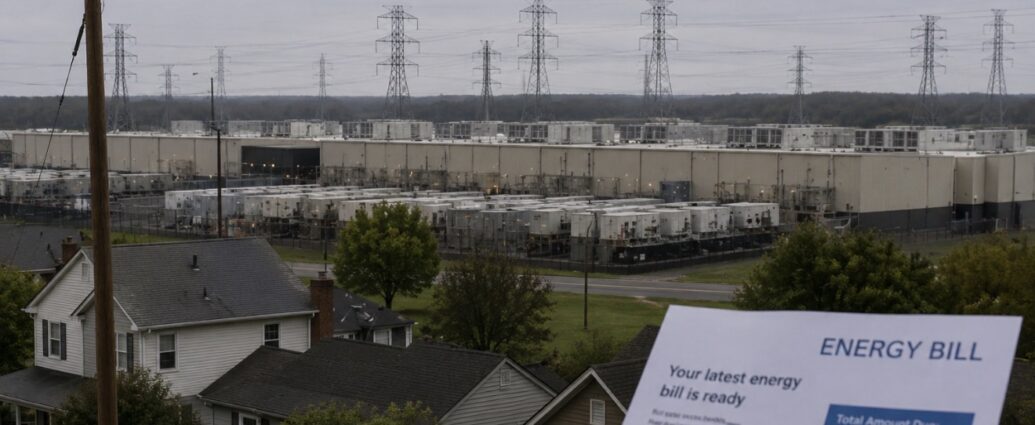
The artificial intelligence boom is rapidly transforming corporate America, fueling massive investments in data centers, cloud infrastructure, and power generation. But for millions of ordinary Americans, the costs of that expansion are increasingly arriving in a far more personal place: their monthly electric bill.
A new report released this week by Maryland’s Office of People’s Counsel warns that homeowners across the state could pay an additional $1.6 billion in electricity costs over the next decade to subsidize grid infrastructure tied largely to AI-driven data center demand outside Maryland’s borders.
The agency filed a formal complaint with the Federal Energy Regulatory Commission accusing PJM Interconnection — the nation’s largest regional power grid operator — of shifting transmission and reliability costs onto residential customers while technology companies rapidly expand energy-intensive AI operations across the Mid-Atlantic region.
The dispute highlights a growing national battle over who should bear the enormous infrastructure costs required to power the next generation of artificial intelligence systems.
The AI Electricity Surge
The numbers behind the energy boom are staggering.
PJM’s capacity auctions — which determine future electricity pricing and grid reliability payments across 13 states and Washington, D.C. — have exploded higher in just two years. Total auction costs surged from approximately $2 billion to nearly $15 billion during the 2024 auction cycle, before climbing again to more than $16 billion in the most recent 2026–2027 auction.
Independent energy market analysts say the overwhelming driver behind those increases is the unprecedented growth in electricity demand from AI-focused data centers.
Major technology firms including Microsoft, Meta, Amazon, Google, and OpenAI-linked infrastructure operators are racing to build massive computing campuses capable of supporting artificial intelligence models that require enormous amounts of electricity, cooling systems, and uninterrupted power supplies.
Industry forecasts now project that data centers’ share of electricity demand across the PJM grid region could triple between 2024 and 2029.
That growth has become so aggressive that older fossil fuel plants previously scheduled for retirement are now being kept online to prevent shortages and potential reliability problems.
Two power plants operated by Talen Energy near Baltimore had originally been slated to close in May 2025. Instead, the facilities will remain operational through at least 2029 after regulators concluded the grid could not reliably handle surging demand without them. Consumers are expected to pay approximately $629 million to support those extensions.
A National Infrastructure Buildout
The Maryland dispute reflects a much broader national transformation underway across America’s energy system.
Investor-owned utility companies across the United States have now announced approximately $1.4 trillion in planned capital spending through 2030, according to industry estimates — a figure driven largely by AI infrastructure expansion and sharply higher electricity demand forecasts.
That spending projection represents roughly a 27% increase from prior forecasts and nearly double the total amount utilities invested over the previous decade.
Among the largest planned spenders are Duke Energy, which has outlined approximately $102.2 billion in infrastructure investments, and Southern Company, which plans roughly $81.2 billion in grid upgrades and generation projects. Many of those projects are tied directly to supporting large-scale data centers operated by companies including Meta and Microsoft.
Consumers are already feeling the effects.
Residential electricity prices are projected to rise another 5.1% nationwide in 2026 alone, according to utility industry estimates, adding to cumulative increases approaching 40% since 2021.
Congress Steps In
The issue has now moved into federal politics.
Lawmakers from both parties in Maryland’s congressional delegation have backed proposed legislation known as the Power for the People Act, which would require large AI and data center operators to directly absorb more of the infrastructure and transmission costs associated with their facilities rather than spreading those expenses across ordinary utility customers.
Supporters argue it is unfair for households already struggling with elevated housing costs, inflation, and higher interest rates to subsidize some of the world’s largest and most profitable technology companies.
“Utility bills are going up a lot to subsidize the ten richest companies in the world,” one Maryland resident opposing a major data center expansion told state officials during recent hearings.
Technology companies and developers counter that data centers generate jobs, tax revenue, and long-term economic development. A proposed $1.2 billion data center campus currently under development in Frederick, Maryland is projected to generate roughly $40 million annually in local tax revenue once fully operational.
Still, critics argue the broader financial burden increasingly falls on ordinary ratepayers rather than the corporations consuming the majority of the new electricity demand.
The Next Front in the AI Economy
The debate underscores how artificial intelligence is beginning to reshape not only technology and finance, but also physical infrastructure, public utilities, and household budgets.
What began as a race to build smarter AI systems has now evolved into a national competition for electricity, transmission lines, substations, and generating capacity.
For consumers, the consequences are becoming increasingly tangible.
The cost of artificial intelligence is no longer confined to Silicon Valley balance sheets or Wall Street valuations. It is beginning to appear on kitchen tables, monthly utility statements, and household budgets across America.
© JBizNews.com. All rights reserved. This article is original reporting by JBizNews Desk. Unauthorized reproduction or redistribution is strictly prohibited.