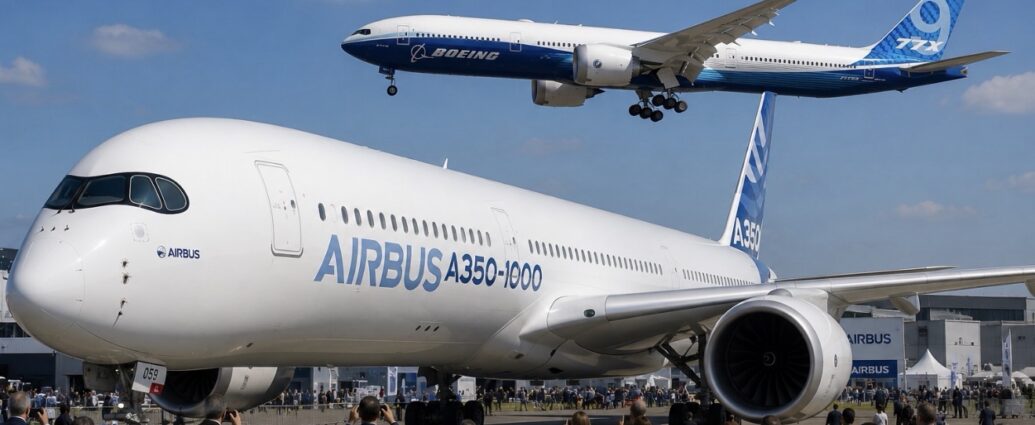
The European planemaker is considering a larger A350, a move that could challenge Boeing’s long-held dominance of the world’s largest twin-engine passenger jets.
TOULOUSE, France — Tuesday, July 21, 2026 — Airbus executives, together with engine partner Rolls-Royce, confirmed this week they are evaluating a stretched version of the A350, signaling the strongest indication yet that Europe’s largest aerospace company is preparing to challenge Boeing’s delayed 777X in one of commercial aviation’s most lucrative markets.
For years, Boeing appeared to have the segment largely to itself.
The 777X was designed to become the successor to the iconic 777, carrying hundreds of passengers farther and more efficiently than previous generations of long-haul aircraft. Airlines around the world placed hundreds of orders expecting deliveries years ago. Instead, certification delays, manufacturing setbacks and heightened regulatory scrutiny have repeatedly pushed the program further into the future.
That has created an opportunity Airbus no longer seems willing to ignore.
Rather than investing tens of billions of dollars in an entirely new airplane, Airbus is studying whether it can stretch its successful A350 platform into a larger aircraft capable of competing directly for the same customers. Industry executives say leveraging an existing design would reduce development costs, shorten certification timelines and allow airlines to introduce the aircraft sooner than launching a clean-sheet program.
The proposal reflects a changing aviation market.
International travel has largely recovered from the pandemic, while airlines increasingly favor larger aircraft on high-demand routes linking global business centers. Carriers want to move more passengers with fewer flights, lowering fuel consumption, airport fees and crew costs while maximizing revenue on routes where takeoff and landing slots remain scarce.
Those economics have become even more compelling as fuel prices remain volatile and labor costs continue climbing.
A larger A350 would target airlines serving destinations such as New York, London, Dubai, Singapore, Hong Kong and Sydney, where consistently high passenger demand often makes larger aircraft more profitable than adding additional frequencies. The aircraft could also appeal to carriers replacing older Boeing 777s and Airbus A380 superjumbos that are approaching retirement.
Technology may determine whether the project moves forward.
Rolls-Royce, which exclusively powers the A350 family, confirmed discussions are underway regarding the engine technology needed for a stretched aircraft. Engineers are evaluating whether the existing Trent XWB can be upgraded or whether a more powerful derivative would be required to support additional passenger capacity and extended range.
Executives indicated Airbus expects to decide within roughly the next year whether the business case justifies launching the program.
The stakes extend well beyond Airbus.
For Boeing, the 777X remains one of its most important commercial programs. The aircraft is expected to anchor the company’s long-haul strategy for decades, making a successful entry into service critical after years marked by production disruptions and regulatory challenges. Additional competition from Airbus would intensify pressure just as Boeing works to restore customer confidence and accelerate deliveries.
Airlines, meanwhile, stand to benefit from renewed competition.
Historically, direct rivalry between Airbus and Boeing has driven technological innovation, improved fuel efficiency and given carriers greater leverage during aircraft negotiations. A second competitor in the large twin-engine market could provide airlines with more flexibility while encouraging both manufacturers to continue investing in lower operating costs and improved environmental performance.
Investors will also be watching closely.
Launching a new aircraft—even one based on an existing platform—requires billions of dollars in engineering, manufacturing and supplier investments. Airbus must balance the opportunity to capture additional market share against the financial discipline that has helped strengthen its position in recent years.
The decision ultimately comes down to confidence.
If Airbus believes global demand for large long-haul aircraft will continue expanding through the 2030s, stretching the A350 could become one of the industry’s defining aerospace projects. If approved, it would also mark the first time in years that Boeing’s flagship wide-body strategy faces a direct challenge from a newly developed European competitor.
Regardless of the outcome, one message from this week’s discussions is already clear: the battle for the future of long-haul aviation is entering a new phase.
JBizNews Desk | Wall Street
© JBizNews.com. All Rights Reserved. Reproduction or distribution without written permission is prohibited.