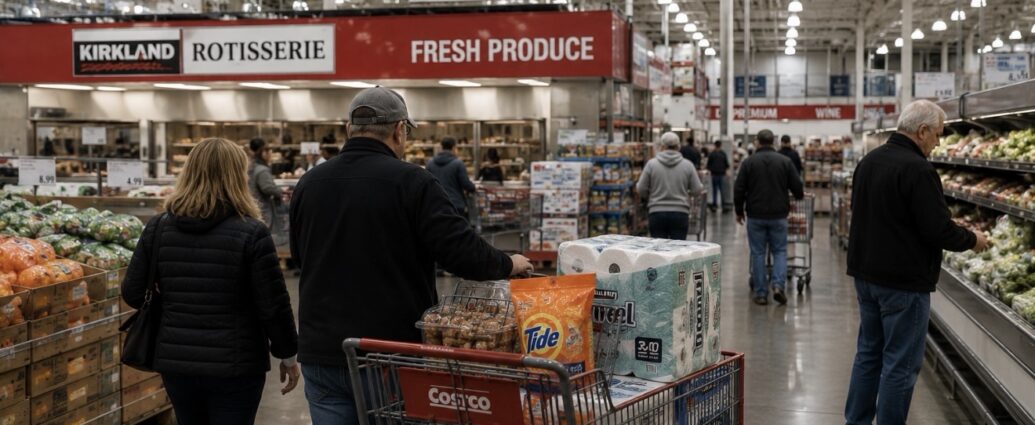
NEW YORK — America’s grocery map is being redrawn in real time — and traditional supermarkets are losing ground.
After years of elevated food prices and mounting pressure on household budgets, millions of Americans are increasingly abandoning conventional grocery chains in favor of discount retailers and warehouse clubs, fueling rapid growth at Aldi, Costco, and Sam’s Club while reshaping one of the largest sectors of the U.S. economy.
The shift, highlighted Monday in reporting by NPR and reinforced by new retail analytics data, reflects a consumer base that has fundamentally changed its shopping behavior after several years of inflation, economic uncertainty, and rising living costs.
Instead of relying on one weekly trip to a neighborhood supermarket, consumers are now spreading purchases across multiple stores, aggressively comparing prices, buying in bulk when possible, and showing far less loyalty to traditional grocery brands than in previous decades.
The result has been a powerful migration toward lower-cost formats.
Aldi, the German discount grocery chain known for its stripped-down store model and aggressively low pricing, has emerged as one of the clearest winners of the transformation. The company said it added roughly 17 million new U.S. customers during 2025 and opened nearly 200 new stores nationwide.
That expansion is accelerating.
Aldi plans to open another 180 stores in 2026, targeting dense urban corridors, suburban communities, and underserved markets where consumers have become increasingly sensitive to food prices.
A recent Consumer Reports analysis found Aldi and competitor Lidl were pricing many grocery items more than 8% below Walmart, a difference meaningful enough to reshape shopping patterns for middle- and working-class households already facing elevated costs for housing, insurance, healthcare, and utilities.
Warehouse clubs are experiencing similar momentum.
Costco reported net sales of $28.41 billion for its March retail month alone, representing an 11.3% increase year-over-year, while Sam’s Club, owned by Walmart, announced plans to open roughly 15 additional locations annually as it pushes to significantly expand profits over the next decade.
The economics behind the trend are straightforward.
Consumers increasingly believe bulk buying, store-brand purchases, and value-focused shopping are no longer optional strategies for saving money — but necessary responses to an economy where grocery bills remain stubbornly elevated even as broader inflation pressures have moderated.
According to consulting firm AlixPartners, a majority of consumers surveyed late last year said they expected to spend as much or more on food in 2026 but planned to actively seek cheaper alternatives, reduce impulse purchases, and prioritize value over convenience.
That behavioral shift is changing the balance of power across the grocery industry.
Research firm Placer.ai found that many consumers are now making multiple grocery trips each week across different retailers in pursuit of better prices, a pattern benefiting warehouse clubs, discount banners, and smaller specialty chains while weakening the dominance of traditional supermarkets built around one-stop shopping models.
Private-label products are also gaining significant ground.
According to the Private Label Manufacturers Association, sales growth for store-brand products last year expanded nearly three times faster than national branded goods — evidence that consumers are not simply bargain hunting temporarily, but permanently rethinking purchasing habits and brand loyalty.
Industry analysts increasingly believe the changes may outlast the current inflation cycle entirely.
Sujeet Naik, an analyst at Coresight Research, projects the U.S. grocery retail market will grow roughly 3.2% in 2026 to approximately $1.59 trillion, driven largely by higher prices rather than meaningful increases in purchasing volume.
That distinction matters.
Consumers are still spending heavily on food — but they are becoming far more selective about where that money goes.
Not every discount chain is benefiting equally.
Grocery Outlet, which expanded aggressively in recent years, announced plans to close 36 stores after company leadership acknowledged the business had grown too quickly and struggled operationally. Meanwhile, conventional supermarket chains are increasingly squeezed from multiple directions simultaneously: warehouse clubs, discount grocers, dollar stores, and Amazon’s expanding grocery delivery ecosystem are all competing for the same consumer dollars.
The psychological shift may be just as important as the economic one.
For decades, discount grocery shopping often carried a stigma for many consumers, associated more with financial hardship than financial discipline. That perception is fading rapidly. In its place, a new culture of cost-conscious shopping is emerging — one where consumers increasingly view bargain hunting, bulk buying, and private-label purchasing not as compromise, but as smart financial management.
For the traditional supermarket industry, the danger is that many of these new shopping habits may prove permanent.
And for retailers like Aldi, Costco, and Sam’s Club, America’s long inflation era is becoming one of the greatest customer acquisition opportunities in modern grocery history.
JBizNews Desk
© JBizNews.com. All rights reserved. This article is original reporting by JBizNews Desk. Unauthorized reproduction or redistribution is strictly prohibited.