By JBizNews Desk
May 11, 2026
Alphabet told investors in its official first-quarter 2026 earnings filing with the Securities and Exchange Commission that revenue rose to $109.9 billion, operating income climbed to $39.7 billion, and Google Cloud revenue surged 63% to $20 billion, as the company accelerated its artificial intelligence expansion across search, enterprise software, cloud infrastructure, subscriptions, and consumer products. In the company’s earnings release, CEO Sundar Pichai declared that “our AI investments and full stack approach are lighting up every part of the business” — results that helped push Alphabet’s market value to approximately $4.81 trillion, rapidly narrowing the gap with Nvidia, now valued near $5.05 trillion.
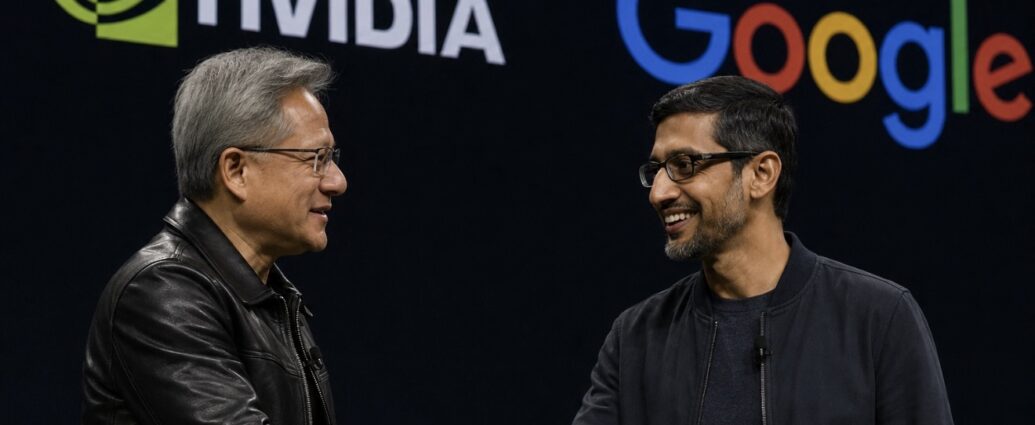
The shrinking distance between the two technology giants has become one of Wall Street’s defining market battles of 2026, reflecting investor uncertainty over where the long-term economic value of artificial intelligence will ultimately concentrate: in the infrastructure layer dominated by Nvidia, or in the application and platform ecosystems controlled by companies such as Alphabet.
According to Alphabet’s SEC Form 8-K filed April 29, the company delivered its eleventh consecutive quarter of double-digit growth, with consolidated revenue rising 22% year over year. Investors focused particularly on the extraordinary acceleration inside Google Cloud, where AI demand from enterprises drove backlog to more than $460 billion, nearly doubling quarter over quarter and giving the company unusually strong long-duration revenue visibility.
The earnings report also showed that Google Search revenue rose 19%, while YouTube advertising revenue increased 11% to $9.88 billion. Net income surged to $62.6 billion, and earnings per share climbed 82% to $5.11, easing investor fears that massive AI spending would materially pressure margins.
Operating margin expanded to 36.1%, a critical metric closely watched by institutional investors as nearly every major technology company races to deploy capital into AI infrastructure at historic levels.
Sundar Pichai, CEO of Alphabet and Google, told investors that AI-powered search experiences are driving record user engagement and query volume while strengthening monetization across the company’s ecosystem. He also highlighted accelerating adoption of Gemini Enterprise, which saw 40% quarter-over-quarter growth in paid monthly active users.
The company disclosed that total paid subscriptions across services including YouTube and Google One have now reached 350 million globally, reinforcing investor confidence that Alphabet’s AI strategy is extending beyond infrastructure and into recurring consumer and enterprise monetization.
At the same time, Waymo, Alphabet’s autonomous driving division, surpassed 500,000 fully autonomous rides per week, signaling that AI-related growth is beginning to contribute operationally across multiple business segments beyond cloud computing.
Wall Street’s attention is now increasingly centered on the sheer scale of capital being deployed into the AI arms race. Alphabet reported quarterly capital expenditures of $35.7 billion, more than double the prior year, driven largely by investments in servers, networking systems, technical infrastructure, AI data centers, and internally designed Tensor Processing Unit chips.
The company raised full-year 2026 capital expenditure guidance to between $180 billion and $190 billion, placing Alphabet among the world’s largest AI infrastructure investors while simultaneously positioning the company as a direct competitive force against some of the very hardware suppliers powering the broader AI economy.
That dynamic increasingly places Alphabet in two separate roles simultaneously: one of the world’s largest buyers of advanced AI computing infrastructure and one of the largest emerging competitors to traditional semiconductor suppliers through its vertically integrated AI stack.
Still, Nvidia remains at the center of the infrastructure layer powering the global AI buildout.
In its own SEC Form 8-K filed February 25, Nvidia reported record quarterly revenue of $68.1 billion, up 73% year over year, while data center revenue surged to $62.3 billion, accounting for more than 91% of total company revenue. Full-year fiscal 2026 revenue reached a record $215.9 billion, up 65%, underscoring the unprecedented demand for AI chips and networking systems.
Jensen Huang, founder and CEO of Nvidia, said in the company’s official earnings release that “enterprise adoption of agents is skyrocketing” and described AI compute infrastructure as the foundation of a new industrial era. Nvidia also guided fiscal first-quarter 2027 revenue to approximately $78 billion, a forecast now viewed by investors as one of the most important indicators of global AI infrastructure demand.
For institutional investors, the race between Alphabet and Nvidia increasingly represents two distinct theories of AI monetization.
Nvidia’s valuation remains tied heavily to continued acceleration in AI infrastructure spending by hyperscalers, governments, and enterprises building massive AI clusters. Alphabet, by contrast, offers exposure to AI integrated directly into products and services used daily by billions of consumers and businesses worldwide — spanning search, cloud computing, advertising, subscriptions, enterprise software, and autonomous transportation.
Many analysts believe both companies can continue growing simultaneously. Others increasingly argue that while infrastructure providers may dominate the early phase of the AI cycle, long-term economic value could migrate toward companies controlling user distribution, proprietary ecosystems, and recurring software monetization.
At the same time, Alphabet’s extraordinary spending plans demonstrate that even the largest AI application platforms remain deeply dependent on computing infrastructure supplied by companies such as Nvidia.
The next major test in the market-cap race arrives May 20, when Nvidia reports fiscal first-quarter 2027 earnings. A clean beat above the company’s projected $78 billion revenue target would likely strengthen Nvidia’s hold atop the global rankings. A softer report, combined with continued momentum in Google Cloud and Gemini monetization, could rapidly narrow — or potentially erase — the remaining valuation gap.
With only about $240 billion separating the two companies, and daily stock swings frequently moving market values by hundreds of billions of dollars, Wall Street increasingly believes the title of the world’s most valuable company may continue changing hands throughout 2026.
JBizNews Desk