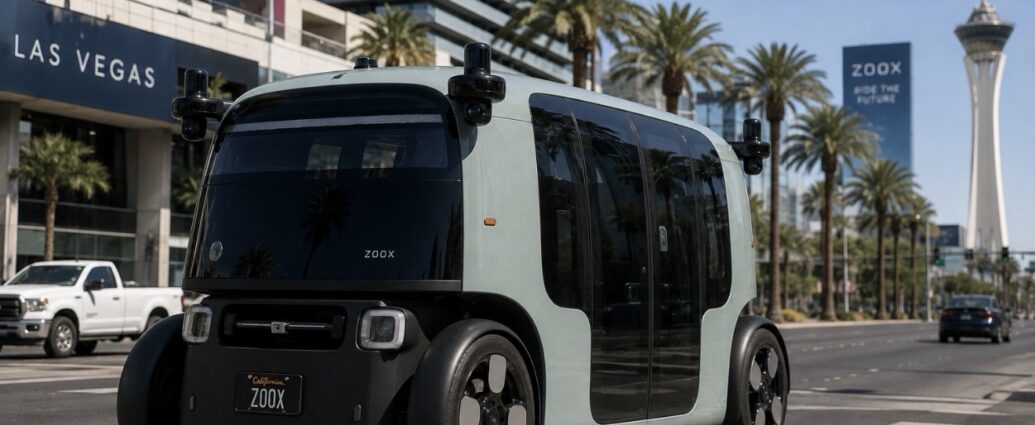
Zoox, the self-driving unit owned by Amazon, unveiled what it called a “production-intent” version of its cube-shaped robotaxi on Wednesday and said it plans to begin charging passengers for rides later this year, according to the company, marking a major step toward turning a long-running experiment into a real business. The redesign adds higher-quality touch screens, more comfortable seats and headrests, and small interior tweaks to help riders spot forgotten items like keys and phones.
The vehicle remains unlike anything most riders have used. The robotaxi is a cube-shaped, bidirectional electric pod with four-wheel steering, no steering wheel, no brake pedal and no front seat for a human driver, capable of carrying four passengers at up to 75 miles per hour. Zoox also enlarged and relocated the bidirectional reflectors that help riders and others tell the vehicle’s front from its rear.
The redesign is built for volume. Zoox said the production-intent vehicle will join its existing fleet later this year, and that it will soon begin large-scale production at its San Francisco Bay Area manufacturing hub, which opened last June and will eventually produce 10,000 vehicles a year at full scale. The line could ramp up to 100 vehicles a week to support expansion, subject to regulatory approval.
That regulatory approval is the gating factor for the whole plan. Zoox cannot charge a single rider until the National Highway Traffic Safety Administration says it can, and its petition has been in review since a public comment period closed in April. The company is seeking clearance to deploy up to 2,500 driverless vehicles for commercial operations on public roads, a step complicated by federal rules that generally require vehicles to have standard driver controls.
Zoox has built a sizable base of riders despite charging nothing so far. The company said it has served more than 500,000 riders since opening service in Las Vegas last September, and currently offers free rides in parts of Las Vegas and San Francisco while letting select users hail its robotaxis in small areas of Miami and Austin. It has also partnered with Uber to make its robotaxis available through the ride-hailing app in Las Vegas.
Even so, Zoox trails the clear market leader. Amazon acquired Zoox for $1.3 billion in 2020, but the unit is well behind Alphabet’s Waymo, which recently surpassed 500,000 weekly paid rides across 10 U.S. cities and plans to launch in London and Tokyo, its first international markets. Waymo operates a fleet of more than 3,700 robotaxis that have logged over 200 million autonomous miles. The gap between 500,000 total riders and 500,000 paid rides every week shows how much ground Zoox has to make up.
Safety remains a live question for the entire industry, and for Zoox specifically. NHTSA had logged 123 accidents involving Zoox vehicles in autonomous mode as of March 2026, and the company issued three voluntary software recalls between March and December 2025 affecting about 860 vehicles, addressing unexpected hard braking, collision-prediction failures and lane-crossing behavior near intersections. Those incidents are a factor in the agency’s ongoing review.
The business logic behind the push is straightforward. A robotaxi that gives free rides is a research project; one that charges fares is a transportation company. Zoox’s move to a production vehicle, a factory that can build at scale and a plan to start billing riders signals that Amazon intends to compete for a slice of the urban-mobility market that Waymo has been steadily commercializing. The prize is a recurring-revenue ride-hailing business with no driver to pay, the economics that have made autonomous vehicles one of the most expensive bets in technology.
For everyday riders, the practical question is when and where these vehicles will actually show up as a paid option. The production-intent vehicles will join the free-ride fleet later in 2026 as they roll off the Hayward line, with paid rides contingent on a federal ruling that NHTSA has not yet scheduled. Until that decision comes, Zoox can build cars, refine the cabin and sign up riders, but it cannot turn the meter on. The redesign unveiled this week is the company’s clearest statement yet that it intends to be ready the moment Washington gives the word.
JBizNews Desk
© JBizNews.com All Rights Reserved. Reproduction or distribution without written permission is prohibited.