
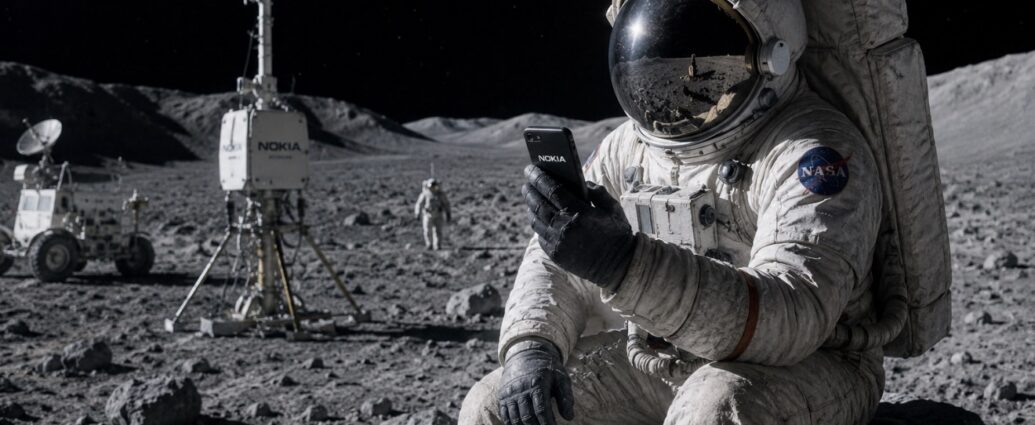
NASA is buying phone service for the Moon, and the contracts are going to American companies.
The agency published its latest Moon Base progress update this week, walking through the landers being built by five firms — Firefly Aerospace, Voyager, Blue Origin, Intuitive Machines and Northrop Grumman. Underneath all that hardware is a quieter build-out that gets far less attention: the communications backbone every one of those missions will have to plug into once it reaches the lunar south pole.
Start with the problem. The south pole is where NASA wants to go because there is water ice sitting in craters that never see sunlight, and water can be turned into drinking supply, breathable oxygen and rocket fuel. But a machine parked inside a permanently shadowed crater has no clear line of sight back to Earth and no sunlight to recharge on. It cannot phone home, and it cannot power itself. Everything NASA is now paying for is aimed at those two problems.
Northrop Grumman, based in McLean, Virginia, announced on Aug. 4 a run of missions it calls Lunar Infrastructure Demos — three flights meant to prove out power, heat management and data links that can survive the lunar night. That last part is the hard one. A night at the south pole runs about two weeks and drops far below anything commercial equipment on Earth is built to withstand. Hardware that works beautifully for fourteen days and then freezes solid is not infrastructure. It is a demonstration.
Houston-based Intuitive Machines is handling the orbit side. NASA handed the company a compact navigation payload on July 13 to fly on Altus-1, the first of its relay satellites, built under a services contract with the agency. The job is simple to describe: park spacecraft above the Moon so a rover sitting in a dark crater can bounce its data off something overhead and reach Earth that way. The same satellites carry navigation signals, which is how a rover or a suited astronaut knows where it actually is on a surface with no roads, no landmarks and no global positioning system.
The surface piece has already had its test, and it half worked. On March 6, 2025, Nokia Bell Labs put a functioning cell network on the Moon — a shoebox-sized unit built in Murray Hill, New Jersey, holding the radio, the base station and the network core of an ordinary cell site, assembled largely from off-the-shelf commercial parts on a $14.1 million NASA grant awarded back in 2020. It rode down on Intuitive Machines’ Athena lander, which came to rest on its side inside a crater roughly 250 meters off target. With the solar panels pointing the wrong way, the lander could never recharge.
Nokia got one 25-minute window of power. In it, the network switched on, reported itself live and traded commands and data with mission control in Sunnyvale, California, and the ground station in Houston. Base station, radio and core all checked out healthy and ran without interruption for the full window. What it never got to do was place a call — the handset-side modules on the rover and hopper had gone too cold to connect. The mission had been designed for roughly ten days of surface work and got less than half an hour of it. Intuitive Machines shares lost more than half their value in the days that followed.
The engineering read on that outcome matters more than the headline did. The failure was electricity and cold, not radio. Ordinary cellular technology, the same standard behind billions of phones, survived launch, survived a 239,000-mile trip and worked on the lunar surface. That is why the money kept flowing instead of drying up.
NASA has since put $57.5 million into Axiom Space, also in Houston, to build the same 4G link directly into the backpack of the moon suit, giving astronauts high-definition video and voice out to roughly a mile and a quarter from their lander. That sits on top of a first suit contract worth $228 million. NASA’s Glenn Research Center in Cleveland is separately running lab work on how 4G and 5G behave in lunar conditions, and engineers at Johnson have been walking the Nevada desert with radio backpacks to simulate spacewalk connectivity.
The timeline has stretched. Artemis II flew around the Moon in April. In February, NASA rewrote Artemis III into a test of the SpaceX and Blue Origin landers in Earth orbit, now targeted for late 2027, and moved the landing itself to Artemis IV in 2028. The four Artemis III astronauts were introduced on June 9.
NASA’s build order runs in stages: a five-satellite relay constellation first, a second provider added for coverage and redundancy, then equipment on the ground, then a coordinated network with navigation and timing woven in. Satellites first, towers later.
The commercial logic underneath it is straightforward. Every drill, rover, habitat and mining rig anyone lands up there is going to need bandwidth, and none of them will build their own system for it — the economics of each mission carrying private radios make no sense. Whoever owns the relay satellites and the base stations gets paid by everyone who arrives afterward. That is the business NASA is currently underwriting, and for now the companies at the front of the line are all American.
JBizNews Desk | New York
© JBizNews.com All Rights Reserved. Reproduction or distribution without written permission is prohibited.




