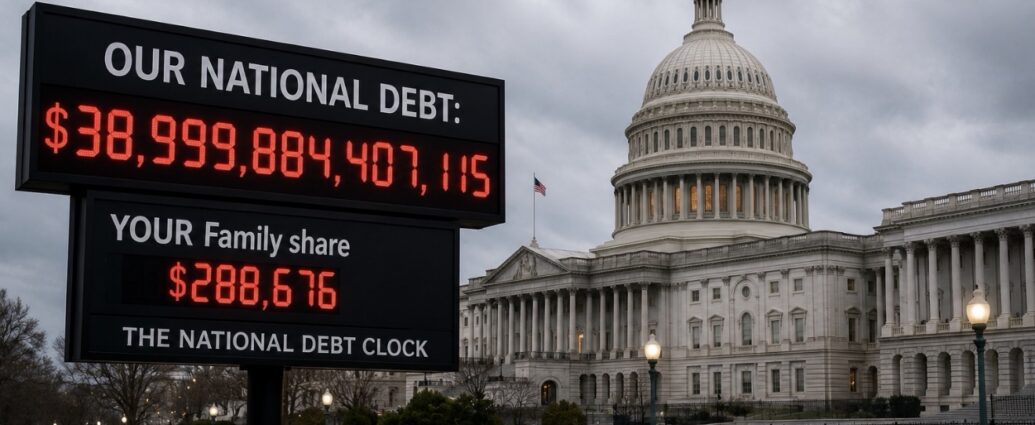
Sometime Monday morning, while Americans commute to work, buy coffee, scroll headlines, or fill up gas tanks already strained by rising energy prices, the federal government will quietly cross another line that once sounded unthinkable.
The national debt is set to surpass $39 trillion for the first time in U.S. history.
That number is so large it barely registers anymore in political debate. But broken down into household terms, it becomes harder to ignore.
According to Treasury Department data compiled by the Joint Economic Committee of Congress, every American household now effectively carries $288,676 in federal debt. Every man, woman, and child carries roughly $113,792.
No one signed paperwork for it. No bank approved it. But it sits there all the same — the accumulated cost of decades of wars, stimulus packages, entitlement growth, tax cuts, recessions, interest payments, and a political system that has steadily grown more comfortable borrowing than balancing.
The scale of the borrowing has accelerated dramatically.
The federal government is now adding debt at a pace of roughly $85,550 every second.
That translates into approximately:
- $5.1 million every minute,
- $308 million every hour,
- and roughly $7.4 billion every single day.
Over the past year alone, Washington added approximately $2.7 trillion in new debt.
The five-year increase now exceeds $10.7 trillion.
For perspective, it took the United States from the presidency of George Washington through the aftermath of the 2008 financial crisis — more than two centuries — to accumulate its first $10 trillion in debt.
The country has now added that much in roughly five years.
The deeper concern inside financial markets is no longer simply the debt itself.
It is the interest.
For decades, low interest rates allowed Washington to borrow enormous sums relatively cheaply. That era has changed quickly.
According to Treasury figures, the federal government spent roughly $970 billion last year purely on interest payments tied to existing debt — nearly a trillion dollars that funded no military equipment, no roads, no schools, no healthcare services, and no infrastructure projects.
It simply paid lenders.
Interest on the national debt has now surpassed annual spending on Medicare and exceeds what the United States spends on national defense.
Roughly fifteen cents of every federal tax dollar collected now goes directly toward servicing debt before the government funds virtually anything else.
And the bill is still climbing.
The average interest rate Washington pays on its debt has risen from roughly 1.5% five years ago to approximately 3.4% today as the Federal Reserve aggressively raised rates to combat inflation.
That shift matters because the Treasury must continuously refinance maturing debt at current market rates.
Every time Treasury yields rise, taxpayers inherit a larger future interest burden.
The government is essentially rolling over trillions of dollars from yesterday’s cheap-money environment into today’s expensive-money environment.
That refinancing cycle is becoming increasingly visible across the federal budget.
The Congressional Budget Office projects this year’s federal deficit — the gap between government spending and tax revenue — will approach $1.9 trillion.
That deficit arrives during a period when unemployment remains relatively low and the economy is still expanding modestly, a combination that historically would not produce borrowing at this scale.
Meanwhile, major spending pressures continue building simultaneously.
Congress remains locked in recurring fights over healthcare subsidies, government funding packages, and entitlement spending. The administration has proposed additional increases in defense expenditures. Discussions surrounding tariff rebate checks and industrial-policy spending continue circulating through Washington.
None of the major political factions currently operating in Congress has proposed a fully developed long-term fiscal stabilization plan capable of materially slowing debt growth over the coming decade.
That reality has started attracting more attention globally.
In May 2025, Moody’s Investors Service removed the United States’ last remaining top-tier AAA credit rating, citing long-term concerns surrounding fiscal sustainability and debt growth.
The downgrade carried symbolic weight because U.S. Treasury debt has historically functioned as the foundation of the global financial system — the benchmark asset against which virtually all other borrowing is priced.
Foreign governments and international investors currently hold roughly one-third of all U.S. federal debt, or approximately $9.3 trillion.
Japan remains America’s largest foreign creditor, followed by the United Kingdom and China.
Every Treasury auction effectively becomes a global referendum on how much confidence investors still place in Washington’s long-term fiscal trajectory.
So far, demand has remained strong.
But rising yields increasingly suggest investors are demanding higher compensation to continue financing America’s expanding debt load.
That tension is now feeding directly into household economics.
Higher Treasury yields influence mortgage rates, credit-card borrowing costs, auto loans, and corporate financing across the broader economy. As federal borrowing expands, competition for capital can place upward pressure on interest rates throughout the financial system.
At the same time, the long-term math surrounding major federal trust funds continues deteriorating.
Social Security and Medicare face projected funding shortfalls within the coming decade absent legislative changes, according to multiple federal trustees’ reports. Without reforms, benefit reductions or additional borrowing eventually become mathematically unavoidable.
Maya MacGuineas, president of the Committee for a Responsible Federal Budget, warned recently that the United States is moving steadily toward a point where debt servicing itself begins crowding out large portions of government flexibility.
“Interest costs are exceeding what we spend on nearly every line item in the budget,” she said. “And our trust funds are heading toward insolvency and automatic benefit cuts, all because of our inaction.”
For most Americans, the debt remains abstract until inflation rises, borrowing costs climb, or economic growth slows.
But the arithmetic is becoming harder to separate from everyday life.
The government is now borrowing more in a single day than many countries spend in an entire year.
And sometime Monday morning, the United States will officially owe more than the total value of everything the American economy produces annually.
The next trillion dollars, at the current pace, is expected to arrive before Halloween.
JBizNews Desk
© JBizNews.com. All rights reserved. This article is original reporting by JBizNews Desk. Unauthorized reproduction or redistribution is strictly prohibited.