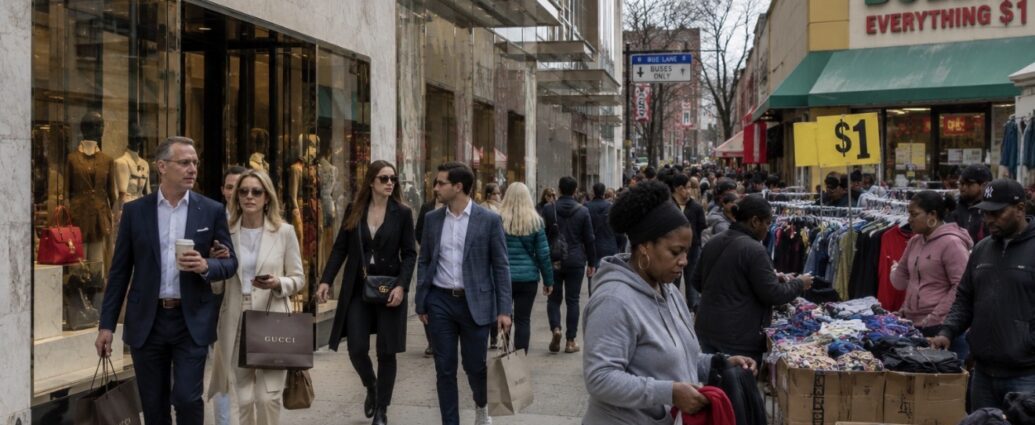
In some parts of America, the economy still feels surprisingly strong.
Luxury hotels are full. High-end restaurants remain booked. Ferrari dealerships are moving inventory. Wealthy travelers continue filling resorts in Aspen, Palm Beach, and Miami. Premium beauty brands, designer retailers, and luxury cruise operators are still reporting healthy demand from affluent consumers who, for now, continue spending aggressively.
But travel a few miles in another direction and the picture changes quickly.
Dollar stores are seeing more budget-conscious shoppers buying smaller quantities. Used-car buyers are stretching loans longer than ever. Families are pulling back on discretionary purchases, delaying vacations, cutting restaurant spending, and struggling with rising utility bills, insurance costs, groceries, rent, and debt payments.
The divide between those two economies — one relatively comfortable, the other increasingly strained — has quietly become one of the defining features of the American recovery.
And according to a growing body of research from the Federal Reserve, Moody’s Analytics, and major financial institutions, the U.S. economy is becoming more dependent than ever on wealthy households continuing to spend.
The clearest evidence arrived earlier this month from the Federal Reserve Bank of New York, which published new research through its Liberty Street Economics platform analyzing consumer spending patterns across income groups.
The findings revealed a widening gap.
According to Fed economists Rajashri Chakrabarti, Thu Pham, Beck Pierce, and Maxim Pinkovskiy, households earning more than $125,000 annually posted cumulative real spending growth of roughly 7.6% through March 2026. Middle-income households saw spending growth closer to 3%. Lower-income households earning under $40,000 annually managed only about 1% growth.
The researchers warned that relying heavily on one segment of consumers creates growing economic fragility.
The numbers from Moody’s Analytics are even more striking.
Chief economist Mark Zandi estimates that the top 10% of earners now account for roughly 49.2% of all U.S. consumer spending, the highest share recorded in data going back to 1989. In the early 1990s, that figure stood closer to 35%.
According to Moody’s, spending by the top 10% of households surged approximately 62% between 2020 and 2025, dramatically outpacing every other income group. Meanwhile, the bottom 60% of American households now account for only about 23% of total consumer spending.
“As long as they keep spending, the economy should avoid recession,” Zandi said recently. “But if they turn more cautious, for whatever reason, the economy has a big problem.”
What makes the divide especially important is that it is increasingly being driven not by wages, but by wealth.
The New York Fed researchers found that gains in financial assets — particularly stocks and investment portfolios — have become the dominant driver of upper-income consumer spending. Rising equity markets through 2024 and 2025 significantly boosted the balance sheets of wealthier households, allowing them to continue spending despite higher interest rates and inflation.
For lower-income Americans, the experience has been very different.
Inflation continues consuming a larger share of household budgets among lower-income families, particularly for essentials such as food, transportation, utilities, insurance, and housing. Many households that built savings during the pandemic have now largely exhausted them.
According to TD Economics, the wealthiest 20% of American households now control roughly 72% of total household wealth, a concentration that has continued widening over the past several years.
The effects are increasingly visible across the broader economy.
Companies that depend heavily on middle-income and lower-income consumers are beginning to report softer demand, while luxury-oriented businesses continue outperforming.
Beth Ann Bovino, chief economist at U.S. Bank, said businesses are increasingly planning around the assumption that economic growth is now disproportionately dependent on wealthier consumers. “There’s a clear slowdown in spending among lower-income levels, and that’s starting to affect middle-income households as well,” Bovino said.
Retailers, restaurants, automakers, hospitality companies, and consumer brands are now adapting pricing strategies and marketing plans around a more financially divided customer base.
Even the car market increasingly reflects the shift. The average price of a new vehicle in the United States now sits near $50,000, effectively pushing millions of middle-class consumers out of the traditional new-car market altogether.
Not all economists agree the trend is entirely new.
Researchers at Pantheon Macroeconomics argue that wealthy Americans have represented an outsized share of total consumer spending for decades, suggesting today’s “K-shaped economy” may simply reflect a long-running imbalance becoming more visible after inflation and pandemic disruptions intensified financial pressures on lower-income households.
Still, even skeptics acknowledge the underlying vulnerability now facing the broader economy.
If affluent households slow spending meaningfully, overall growth could weaken quickly.
Recent consumer-credit data from TransUnion showed financially secure “superprime” borrowers with credit scores above 780 remain relatively stable, while lower-income borrowers are experiencing rising debt burdens and growing delinquency rates, particularly on auto loans and credit cards.
The concern for economists is that the American economy now increasingly resembles a structure balanced on a narrow foundation.
At the same time, additional pressures continue building. Rising oil prices tied to the Iran conflict are pushing transportation and household costs higher. Tariffs have raised import costs across multiple industries. The labor market, while still relatively stable overall, is showing signs of slowing momentum in several sectors.
Goldman Sachs still forecasts U.S. GDP growth around 2.5% for 2026, above broader consensus expectations. But increasingly, much of that growth depends on one question: whether affluent households continue spending aggressively enough to offset growing financial strain across everyone else.
For now, they are.
But the gap between the Americans carrying the economy and the Americans struggling to keep up is becoming harder to ignore — and far more central to the country’s economic future.
JBizNews Desk
© JBizNews.com. All rights reserved. This article is original reporting by JBizNews Desk. Unauthorized reproduction or redistribution is strictly prohibited.