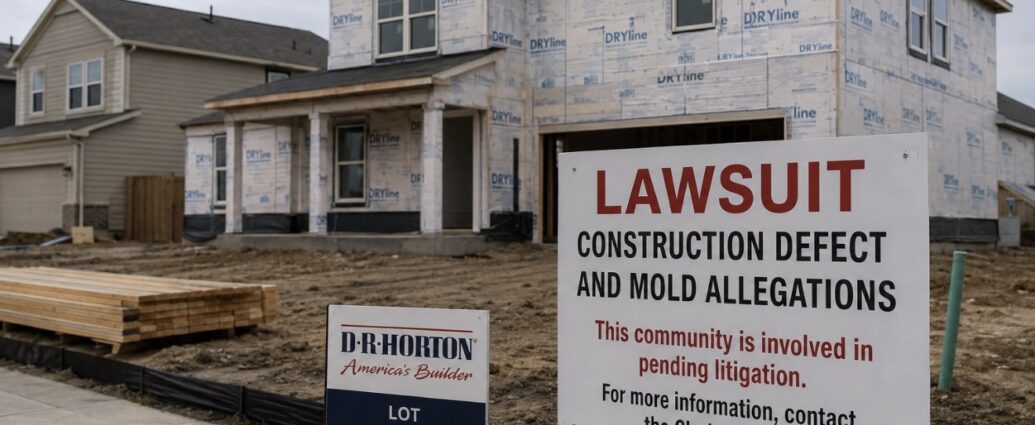
America’s biggest home builders are quietly setting aside hundreds of millions — and in some cases more than a billion dollars — to prepare for a growing wave of lawsuits tied to allegedly defective homes, sinking foundations, mold damage, water intrusion, and disputed lending practices, as mounting legal pressure begins reshaping the economics of the U.S. housing industry.
According to annual filings with the U.S. Securities and Exchange Commission, legal-liability reserves at several of the nation’s largest builders have climbed sharply over the past several years, reflecting growing exposure to construction-defect litigation spreading across at least 16 states.
The underlying complaints vary from case to case, but many revolve around a similar pattern: homes built rapidly during the post-pandemic housing boom that later developed moisture intrusion, structural movement, drainage failures, or ventilation issues that allegedly allowed mold and water damage to spread behind walls, beneath floors, and inside foundations.
Builders strongly dispute many of the claims and argue plaintiffs’ attorneys are aggressively encouraging litigation over isolated defects. But the rising reserve numbers, expanding court dockets, and retreat of insurance coverage are increasingly becoming impossible for investors to ignore.
Lennar Corp. increased its self-insurance reserve — funds set aside for liabilities not fully covered by insurers — roughly 21% in fiscal 2025 to $336.9 million. Meanwhile, D.R. Horton, the nation’s largest home builder by volume, raised its legal-claims reserve approximately 57% over three years, reaching roughly $1.1 billion by the end of fiscal 2025.
The issue is unfolding house by house.
For Blake and Beth Horio, the problem began shortly after purchasing a newly built PulteGroup home in Henderson, Nevada, in 2022. According to allegations in an ongoing dispute, cracks spread across ceilings, sliding doors stopped functioning properly, and portions of the home allegedly began sinking because of shifting soil beneath the property.
When an engineer later inspected the house and rolled a marble across the kitchen floor, the marble reportedly drifted toward one corner.
“Your home is sinking,” the engineer told them, according to the homeowners.
“We worked hard to get here and we can’t enjoy our home,” Beth Horio said. “I can’t even have coffee outside. I can’t get outside.”
PulteGroup acknowledged that approximately 5% of homes in the community may have experienced what it described as “compression of native soils in isolated areas,” while emphasizing the company follows strict construction standards and remains committed to repairs where necessary.
The Nevada dispute is only one example inside a much broader national litigation wave.
In Florida, Lennar is defending one of the industry’s most closely watched construction-defect lawsuits after the Seminole Tribe of Florida alleged the company built more than 450 defective homes with improperly installed roofs, mold-related damage, and significant structural failures that plaintiffs claim contributed to health concerns among residents.
Additional Lennar-related litigation involving water intrusion, alleged code violations, and structural concerns is also moving through courts in North Naples and Homestead, Florida.
Meanwhile, D.R. Horton faces lawsuits tied both to construction defects and mortgage-related allegations.
In Louisiana, thousands of homeowners have alleged moisture-related failures in Horton-built homes. Separately, a federal class-action lawsuit filed in Nevada in late 2025 accuses D.R. Horton and its mortgage arm, DHI Mortgage, of improperly calculating escrow payments using lower pre-construction tax assessments rather than final occupied-home valuations — allegedly leading to large surprise increases in homeowners’ monthly mortgage payments after closing.
The lawsuit invokes the federal Racketeer Influenced and Corrupt Organizations Act (RICO), sharply escalating the legal stakes.
D.R. Horton has denied wrongdoing and moved earlier this year to dismiss the complaint, arguing buyers received multiple disclosures before closing.
The broader industry insists the litigation surge does not necessarily reflect collapsing construction quality.
Builders argue many problems originate with subcontractors rather than the companies themselves and note they collectively deliver hundreds of thousands of homes annually across the country.
Still, the broader economics surrounding home construction have changed dramatically since the pandemic-era housing boom.
Large builders faced enormous pressure between 2020 and 2024 to rapidly deliver homes amid soaring demand, labor shortages, supply-chain disruptions, and surging material costs. Industry groups estimate the construction sector still faces a labor shortage exceeding 500,000 workers nationally, while tariffs and inflation continue driving up costs for steel, aluminum, appliances, and other inputs.
At the same time, builders have openly discussed aggressive cost-management efforts.
Lennar Executive Chairman Stuart Miller previously told investors the company had begun “value-engineering every component of the home,” while emphasizing quality was not being compromised.
D.R. Horton similarly discussed replacing certain fixtures and finishes with lower-cost alternatives while maintaining what it described as acceptable standards.
Critics argue those pressures may have contributed to weaker quality control during the housing boom, especially as builders increasingly relied on subcontractors working under compressed timelines.
The insurance market is also shifting rapidly.
Many insurers have retreated from broad post-construction defect coverage, forcing builders to self-insure larger portions of potential liabilities — one major reason reserve balances continue climbing sharply across the sector.
Meanwhile, courts in multiple states have increasingly challenged mandatory arbitration clauses in builder contracts, potentially opening broader pathways for homeowner lawsuits.
The National Association of Home Builders has pushed for stronger state-level “right-to-cure” laws requiring builders receive opportunities to repair defects before lawsuits proceed. Industry groups argue some plaintiff firms now actively target entire developments in search of settlement leverage.
Wall Street is beginning to factor the issue into the sector’s long-term outlook.
Although shares of D.R. Horton, Lennar, and PulteGroup traded modestly higher Monday, analysts increasingly view rising litigation costs, insurance exposure, and margin pressure as structural risks for the industry.
The timing is especially difficult.
Existing-home sales remain historically weak, mortgage affordability remains near multi-decade lows, and broader parts of the housing supply chain — including the appliance industry — are already showing recession-like conditions.
Now, America’s largest home builders face another challenge: growing legal scrutiny over what exactly was delivered during one of the fastest and most profitable housing booms in modern U.S. history.
The cases now unfolding across Nevada, Florida, Louisiana, and elsewhere may ultimately shape not only the future cost of construction litigation, but also how aggressively builders balance speed, affordability, labor constraints, and quality in the next phase of America’s housing market.
JBizNews Desk
© JBizNews.com. All rights reserved. This article is original reporting by JBizNews Desk. Unauthorized reproduction or redistribution is strictly prohibited.