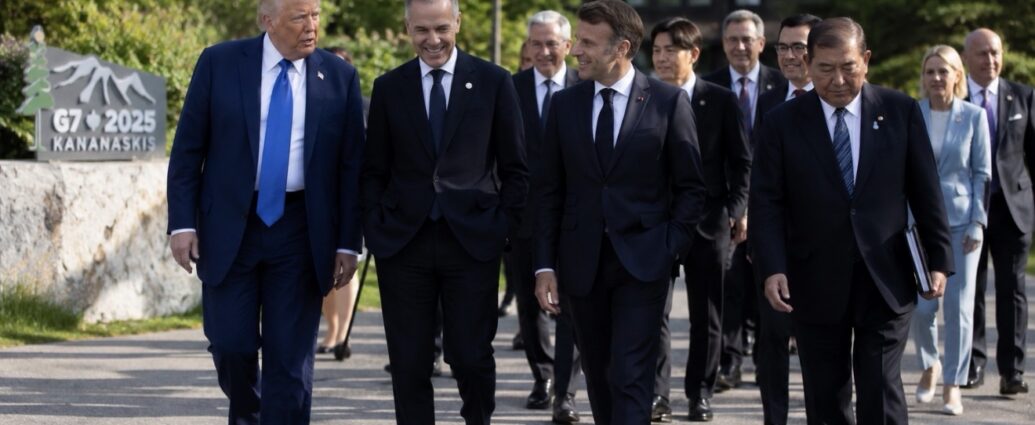
The leaders of two of the world’s most influential artificial intelligence companies used a private session at the Group of Seven (G7) summit on Wednesday to advocate for a United States-led alliance that would help shape global rules and standards for artificial intelligence.
According to people familiar with the discussions, Anthropic Chief Executive Dario Amodei and Google DeepMind Chief Executive Demis Hassabis made the case during a closed-door working lunch in Évian-les-Bains, France, on the final day of the summit. Their message was straightforward: as AI becomes more powerful and strategically important, democratic nations should coordinate their efforts through a framework led by Washington.
The gathering brought together some of the world’s most prominent AI executives and political leaders. President Donald Trump attended alongside Treasury Secretary Scott Bessent, Commerce Secretary Howard Lutnick, and Secretary of State Marco Rubio. OpenAI Chief Executive Sam Altman also participated, placing the leaders of America’s three most prominent AI companies in the same room with G7 heads of government.
According to attendees familiar with the discussion, Canadian Prime Minister Mark Carney expressed support for the idea that the United States could play a leading role in organizing such a coalition.
Amodei reportedly focused on national security concerns and the risks associated with increasingly capable AI systems. He argued that allied nations should coordinate access to the most advanced frontier AI models and align policies governing the export of advanced semiconductors and critical computing hardware. According to people familiar with the meeting, he also advocated limiting China’s access to certain technologies and expanding cooperation on threats such as cyberattacks, bioterrorism, and intelligence operations involving artificial intelligence.
Hassabis took a broader approach, emphasizing the scientific and economic opportunities AI could create if governments establish a stable framework for cooperation. He highlighted the technology’s potential applications in areas such as healthcare, scientific discovery, and climate research.
Altman offered a different perspective. Rather than emphasizing leadership by any single country, the OpenAI chief reportedly supported the creation of a neutral international forum responsible for developing globally accepted standards for evaluating and testing advanced AI systems.
The discussion comes at a complicated moment for the AI industry. Governments around the world are struggling to balance innovation, economic competitiveness, and national security concerns. At the same time, AI companies increasingly view themselves not simply as technology providers but as participants in shaping the regulatory frameworks that will govern the industry.
For Anthropic, the timing is especially notable. The company has recently been engaged in discussions with the Trump administration regarding export restrictions affecting some advanced AI technologies. The situation highlights the increasingly complex relationship between AI developers and governments: companies seek government support and international coordination while also facing regulations that can directly affect their products and growth strategies.
The guest list reflected France’s effort to broaden the conversation beyond the United States. Attendees included Mistral Chief Executive Arthur Mensch, representing Europe’s leading AI startup, as well as executives from Cohere, Black Forest Labs, Synthesia, Salesforce, and Meta. Representatives from AI companies in Italy, India, and Japan also participated.
No formal agreements, commitments, or timelines emerged from the meeting. The discussions remained private, and details surfaced only through people familiar with the gathering.
Still, the conversation underscored a growing reality: the executives building the world’s most advanced AI systems increasingly want a role in determining how those systems are governed. Whether governments ultimately embrace a U.S.-led framework, pursue regional approaches, or establish a broader international model remains unresolved.
What appears increasingly clear is that the debate over artificial intelligence is no longer limited to technology. It has become a question of economics, national security, global competitiveness, and geopolitical influence—and the companies creating the technology want a seat at the table as those decisions are made.
JBizNews Desk
Évian-les-Bains, France
© JBizNews.com All Rights Reserved. Reproduction or distribution without written permission is prohibited.