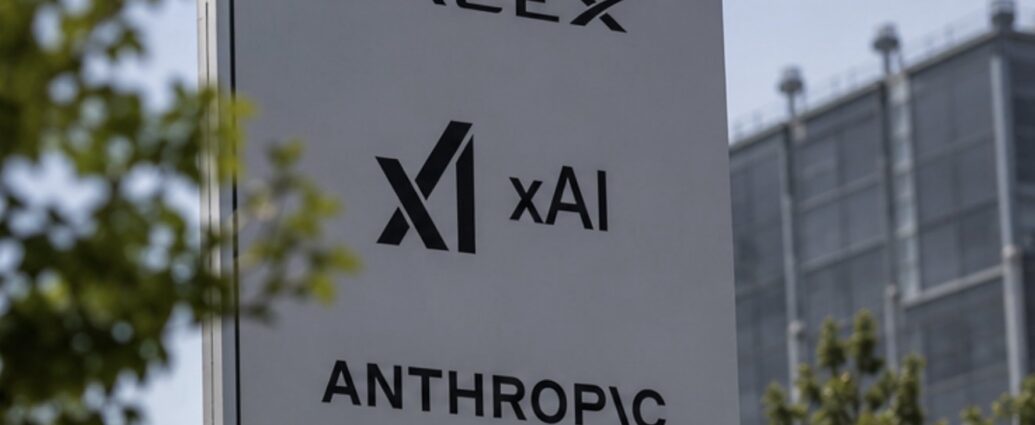
The cost of building artificial intelligence has reached a scale that is hard to fathom, and a single number buried in a regulatory filing has laid it bare: Anthropic is paying Elon Musk’s xAI $1.25 billion every month just to rent the computers it needs to train and run its AI models.
The figure surfaced in SpaceX’s initial public offering paperwork. When Elon Musk’s company filed its S-1 with the Securities and Exchange Commission on May 20, it disclosed that Anthropic, the maker of the Claude chatbot, will pay $1.25 billion a month for access to the Colossus and Colossus II data centers through May 2029. Over the full term, the contract could deliver up to $45 billion in revenue, or roughly $15 billion a year, with either side able to terminate the agreement with 90 days’ notice.
The Colossus clusters were built by xAI, Musk’s artificial intelligence venture, and the arrangement effectively turns the company’s computing infrastructure into a rental business. Rather than using every processor for its own models, xAI is leasing excess capacity to another major AI developer. The filing also indicated that the company expects to pursue additional agreements of this type, creating a future in which AI firms increasingly become landlords for one another’s computing needs.
What Anthropic is buying is enormous.
According to the filing, xAI is providing approximately 300 megawatts of data-center capacity, supported by more than 200,000 Nvidia processors. The payments will ramp up over time, with reduced charges during the first two months as the infrastructure comes fully online.
The reason Anthropic would commit to such a staggering bill is simple: it needed the capacity.
The company has spent months battling computing constraints as demand for Claude has grown. In today’s AI race, the primary bottleneck is no longer engineering talent or software innovation. It is access to enough computing power to train and operate increasingly sophisticated models. The companies that secure the most compute often gain the biggest advantage.
The size of the contract becomes even more striking when compared with the businesses involved.
Anthropic recently reported approximately $10.9 billion in quarterly revenue, meaning this single infrastructure agreement consumes an amount equal to nearly half that figure. On the other side of the transaction, the payments represent a major boost for SpaceX and Musk’s broader ecosystem. With SpaceX generating roughly $18 billion in annual revenue, the AI infrastructure agreement alone adds revenue approaching the scale of the rocket company’s existing business.
The disclosure also changes how investors may view Musk’s empire.
SpaceX has long been associated with rockets, satellites, and space launches. Yet the IPO filing reveals that some of the company’s most valuable assets may increasingly be tied to artificial intelligence infrastructure. The prospectus argues that the greatest constraints on AI growth are no longer software-related but physical: electricity, cooling systems, computer chips, and the facilities needed to house them.
In that world, ownership of infrastructure becomes just as important as ownership of algorithms.
The implications extend far beyond Silicon Valley.
When the foundational cost of artificial intelligence reaches billions of dollars per month, those expenses eventually flow downstream. Businesses encounter them through API fees, enterprise software contracts, subscription pricing, and usage limits. Smaller AI companies must compete against firms with access to vastly greater computing resources, while customers ultimately absorb some of those costs through higher prices.
The agreement also highlights a broader truth about the AI boom.
Artificial intelligence is often discussed as software, machine learning, and digital intelligence. But the largest checks being written today are for industrial infrastructure: data centers, power generation, cooling systems, networking equipment, and hundreds of thousands of advanced processors.
The $1.25 billion monthly payment is, in essence, rent on the physical machinery powering the AI revolution.
As long as demand for computing continues to exceed supply, those rents are likely to keep rising. The AI boom may be built on code, but increasingly it is being financed by concrete, steel, electricity, and silicon. And those costs ultimately reach every business and consumer that relies on artificial intelligence.
JBizNews Desk — Artificial Intelligence
© JBizNews.com All Rights Reserved. Reproduction or distribution without written permission is prohibited.