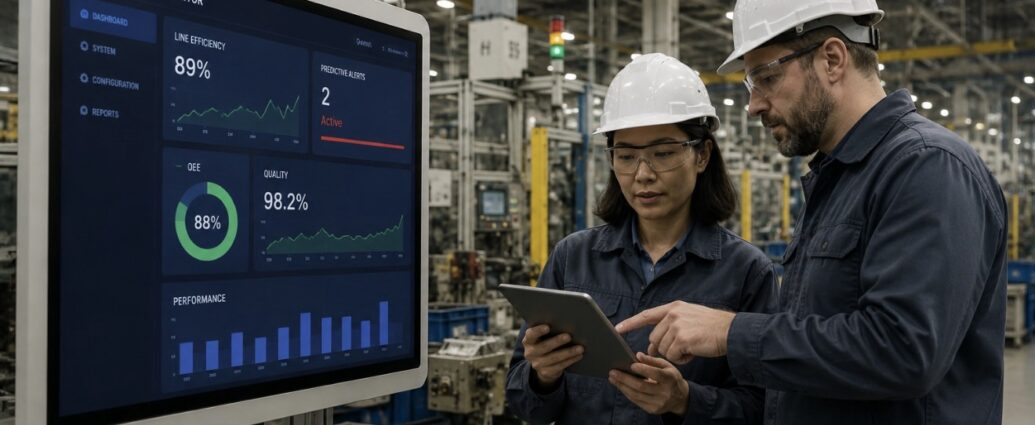
SAN FRANCISCO — Silicon Valley’s AI boom is beginning to move beyond chatbots, coding assistants, and media tools — and into the factories, warehouses, trucking routes, and industrial businesses that power the broader American economy.
A startup founded by former executives and operators from Apple and venture capital giant Andreessen Horowitz has raised $20 million to develop artificial intelligence tools specifically for what its founders describe as “real economy” businesses: manufacturers, distributors, logistics companies, and industrial operators that have largely been left behind during the first wave of AI investment.
The funding round, first reported Monday by Fortune, reflects a growing belief among investors that the next major AI opportunity may not come from another consumer app or large language model — but from bringing automation and AI-driven productivity into the physical industries that collectively represent trillions of dollars in economic activity.
Unlike technology firms, financial institutions, and digital-native companies that rapidly embraced AI tools over the past several years, many industrial and operational businesses remain early in the adoption curve.
That gap is increasingly viewed inside venture capital circles as one of the largest untapped markets in artificial intelligence.
The founders’ backgrounds are central to the company’s pitch.
Apple built its reputation on simplifying highly complex technology into products ordinary consumers could use intuitively at massive scale. Andreessen Horowitz, meanwhile, has become one of Silicon Valley’s most aggressive investors in AI infrastructure, applications, and enterprise software.
The startup appears to be attempting to merge those two philosophies: sophisticated AI systems packaged in ways that operational businesses without large engineering teams can realistically deploy and use.
That challenge has historically proven difficult.
Many small and mid-sized industrial companies have struggled with enterprise software systems that were overly expensive, difficult to integrate, disconnected from day-to-day workflows, or dependent on technical expertise most operational businesses simply do not possess internally.
Artificial intelligence could dramatically improve efficiency in areas such as inventory management, predictive maintenance, supply chain coordination, freight routing, procurement, staffing, quality control, and regulatory compliance.
But deploying those systems effectively inside real-world operational environments is significantly more complicated than deploying AI into purely digital businesses.
Factories, warehouses, transportation fleets, and supply chains generate messy, fragmented, and highly variable data. Many also operate on older legacy software systems or manual workflows that are difficult to modernize quickly.
That complexity is precisely what the startup is betting it can solve.
The company has not yet publicly disclosed which specific sectors it plans to target first or exactly what AI applications it intends to commercialize. But its focus on manufacturers, logistics firms, and industrial operators points toward a portion of the economy many analysts believe could eventually become one of AI’s largest long-term growth markets.
The timing is significant.
The conversation surrounding artificial intelligence has increasingly shifted from theoretical future capability to immediate operational deployment.
Economists at Anthropic, one of the world’s leading AI companies, recently warned that current-generation AI systems are already capable of performing substantial portions of many existing jobs — not only in white-collar office work, but across broader categories of business operations and administration.
For smaller companies outside Silicon Valley, however, the challenge is often less about whether AI could improve their business and more about whether they possess the technical infrastructure, talent, and financial resources necessary to adopt it competitively.
That gap may create one of the defining economic divides of the next decade.
Large corporations can spend billions building custom AI systems internally. Smaller businesses — including many family-owned manufacturers, regional distributors, and logistics operators — generally cannot.
The startup’s broader thesis is that whoever successfully delivers practical, easy-to-use AI tools for those businesses could unlock one of the largest commercial opportunities in the technology industry.
And the addressable market is enormous.
The so-called “real economy” — businesses involved in manufacturing, transportation, construction, distribution, warehousing, industrial services, and physical operations — represents a vastly larger share of total economic output than the digital services sector that has dominated much of Silicon Valley’s attention over the past decade.
Yet much of that economy remains only lightly touched by AI adoption.
Investors increasingly believe that will not remain true for long.
As competitive pressure intensifies and labor costs continue rising, operational businesses are expected to face growing urgency to automate routine functions, improve productivity, and optimize increasingly fragile supply chains.
The companies that successfully bring AI into those environments in a practical and affordable form may ultimately shape the next phase of the American economy far more than the chatbot boom that first introduced artificial intelligence to the public.
For now, Silicon Valley’s AI gold rush is beginning to move beyond software screens and into the warehouses, trucking corridors, factories, and industrial systems that still quietly underpin much of American economic life.
JBizNews Desk
© JBizNews.com. All rights reserved. This article is original reporting by JBizNews Desk. Unauthorized reproduction or redistribution is strictly prohibited.