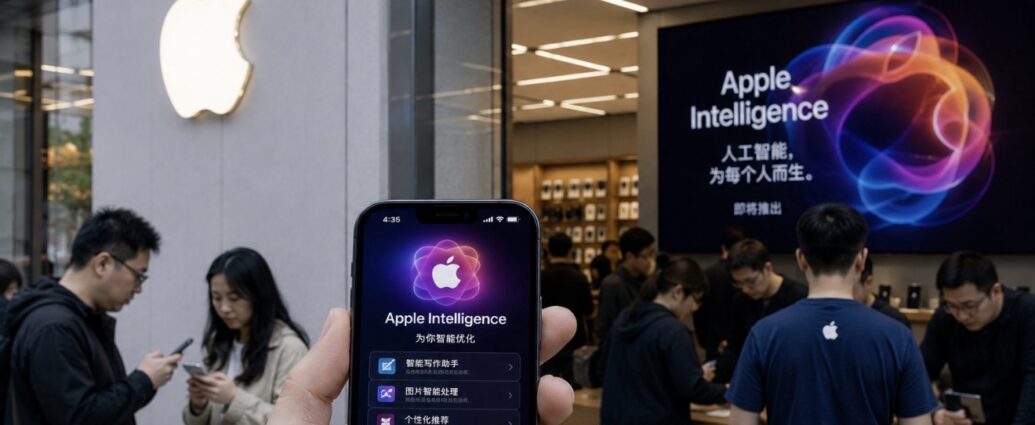
Apple is taking a much more direct approach to artificial intelligence in China, developing its own large-language model specifically for the Chinese market with technical support from Alibaba as it prepares to bring Apple Intelligence to one of its most important overseas markets.
The move represents a significant change in strategy.
Apple had previously been expected to rely primarily on Chinese partners to provide the underlying AI models required to operate inside China. Instead, the company has now trained a proprietary model designed specifically for Chinese users while continuing to incorporate technology from local partners including Alibaba.
Alibaba’s Qwen model is also expected to be integrated into Apple Intelligence across iPhones, iPads, Macs and Vision Pro devices sold in mainland China.
The arrangement gives Apple considerably more control over the final AI experience while still complying with China’s requirement that generative-AI services operating in the country meet local regulatory standards.
That regulatory barrier has been one of Apple’s biggest problems in China.
Major U.S.-developed AI systems including ChatGPT are not freely available there, leaving Apple unable simply to replicate the version of Apple Intelligence offered in other countries.
Instead, it has had to build a separate technology stack for China.
China’s cyberspace regulator already registered Apple Intelligence for use in the country in July, clearing one of the most important regulatory hurdles before launch.
Apple’s own China-specific model now gives the company another tool for competing against domestic smartphone makers that have been moving aggressively into AI.
Huawei, Xiaomi and other Chinese manufacturers have increasingly marketed artificial intelligence as a central feature of their newest devices, while Chinese consumers buying iPhones have so far received a more limited AI experience than customers in many other markets.
That puts Apple in an unusual position.
China remains both a major consumer market and a critical part of Apple’s manufacturing and supply chain, but it is also one of the few large markets where the company cannot simply deploy the same AI products it develops at home.
Building a separate model shows how important Apple considers the market.
It also underscores Alibaba’s growing role in the global AI industry.
Alibaba is not merely supplying Apple with access to Qwen. It has reportedly helped Apple train the proprietary model itself, giving the Chinese technology company a significant role inside one of the world’s largest consumer-electronics ecosystems.
Apple is expected to use a combination of its own model and Chinese partner technology rather than handing the entire AI experience to one outside provider.
That hybrid approach could eventually become a template for how Western technology companies operate in markets where governments impose local AI requirements.
For Apple, however, the immediate objective is simpler.
The company needs to close the AI gap between iPhones sold in China and increasingly sophisticated devices from domestic competitors.
The company has already cleared a major regulatory hurdle.
Now it is building the technology specifically for the market rather than waiting for someone else to provide it.
JBizNews Desk | Cupertino, California
© JBizNews.com All Rights Reserved. Reproduction or distribution without written permission is prohibited.