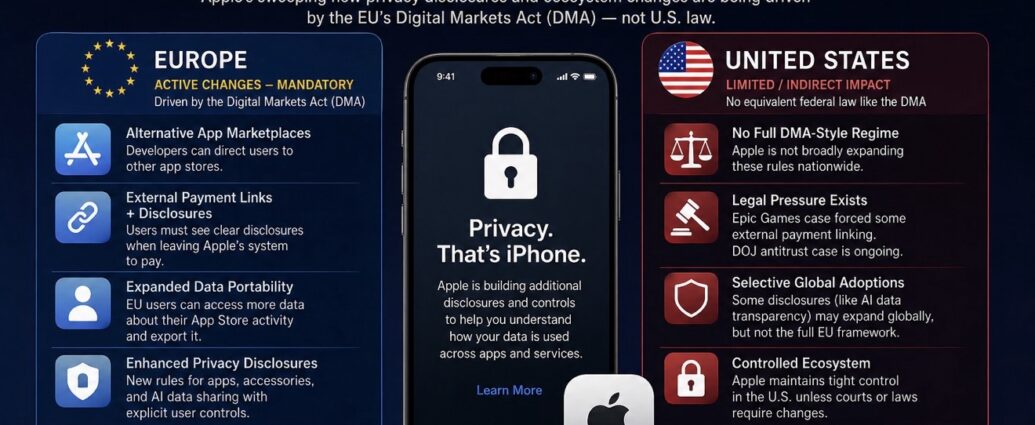
Apple is tightening its grip on how user data is handled across its ecosystem in Europe, rolling out a sweeping set of enhanced app privacy disclosures as regulatory pressure from Brussels intensifies under the Digital Markets Act (DMA). The latest changes reflect a broader strategy by the iPhone maker: comply with mandates to open its platform, while reinforcing its long-standing position as a privacy-first gatekeeper.
The newest layer of rules stems from updates to Apple’s Developer Program License Agreement, introduced in late March, which impose binding standards on how third-party developers — particularly accessory makers — manage sensitive data such as forwarded notifications and Live Activities. The changes coincide with new code in the iOS 26.5 beta, signaling that Live Activities support will soon extend to third-party accessories in the European Union. Notably, this functionality is being introduced exclusively in the EU to meet interoperability requirements imposed by the DMA.
Apple has framed these guardrails as essential. The company has consistently argued that expanding access to its ecosystem — particularly under regulatory compulsion — increases the risk of invasive data collection. Apple executives have warned that some large technology firms continue pushing for broader access to user data, creating what they describe as heightened risks of surveillance and tracking. According to Apple, these risks have not been adequately addressed by European regulators.
The disclosure framework now touches nearly every corner of the App Store experience in the EU. Developers using alternative payment systems must clearly label product pages, alerting users when transactions occur outside Apple’s infrastructure. In-app disclosure sheets are also required to notify users at the moment they leave Apple’s payment environment. At the same time, Apple has expanded its App Review process to ensure developers accurately communicate billing terms and transaction flows.
Beyond payments, Apple is also widening user control over personal data. European users can now access more detailed information about their App Store activity and export it through Apple’s Data & Privacy portal to authorized third parties — a move aligned with the DMA’s emphasis on data portability.
The company is also moving aggressively into AI-related transparency. Updated App Review Guidelines now require any application that shares user data with external artificial intelligence systems to provide explicit disclosures and user controls. Industry analysts say this positions Apple ahead of likely regulatory expansions in both Europe and Asia, where scrutiny of AI data practices is accelerating.
At the same time, Apple’s regulatory battle with the European Commission is far from settled. In April 2025, the Commission issued its first formal non-compliance ruling under the DMA, concluding that Apple’s App Store policies restricted developers from steering users to external purchasing options. The decision targeted multiple business models — including Apple’s Original, New, and Music Streaming terms — and resulted in financial penalties along with an order for Apple to revise its practices within 60 days.
Apple responded in June 2025 with updated policies, but developers remain dissatisfied. A coalition of app developers has since accused the company of failing to deliver meaningful change, arguing in a formal appeal to European Commission President Ursula von der Leyen that Apple continues to impose commissions — in some cases up to 20% — on transactions that should fall outside its ecosystem under DMA rules.
At the center of the dispute is Apple’s evolving fee structure. Beginning January 1, 2026, the company introduced a unified EU business model anchored by a “Core Technology Commission” (CTC), replacing its earlier Core Technology Fee. The CTC applies broadly across App Store purchases, web-based transactions, and alternative marketplaces. Developers who direct users to external payment links are now subject to a 5% commission, alongside mandatory system-generated disclosures informing users when they leave Apple’s platform.
Critics, including the Coalition for App Fairness, say Apple’s approach lacks clarity and creates operational uncertainty. Developers argue that vague implementation details around the new model make it difficult to forecast costs or design compliant business strategies. The group has also urged EU regulators to take a more aggressive stance, pointing to U.S. legal precedent — particularly the Epic Games antitrust case — where courts forced Apple to loosen restrictions on external payments.
Apple, for its part, continues to push back on the broader premise of the DMA. The company maintains that the regulation has not delivered the competitive or consumer benefits policymakers promised. Apple has pointed to delayed or withheld feature rollouts in Europe — including iPhone Mirroring and AirPods Pro Live Translation — as evidence that regulatory burdens are limiting innovation and reducing product availability for EU consumers.
Supporting its argument, Apple has cited internal and third-party analyses suggesting that reductions in developer fees under DMA pressure have not translated into lower prices for end users. The company argues this undermines one of the central justifications for the legislation.
As appeals continue and enforcement actions evolve, Apple’s EU operations are becoming a test case for the global future of digital platform regulation. The company is simultaneously adapting to — and challenging — a framework that could reshape how technology ecosystems operate worldwide.
What emerges is a complex balancing act: Apple opening its platform under legal mandate, while building an increasingly sophisticated privacy and disclosure infrastructure to retain control over how data flows within it. For developers, regulators, and competitors alike, the outcome of this standoff will define the next phase of the digital economy.
JBizNews Desk- Europe