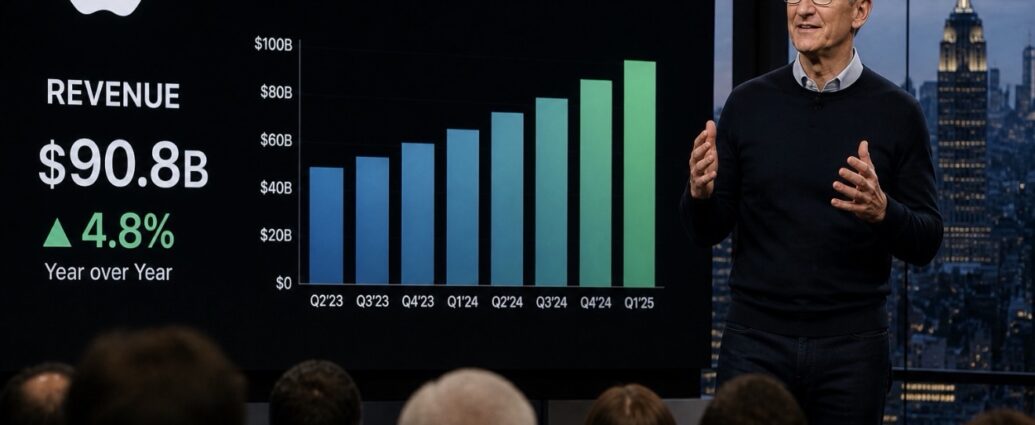
Apple delivered a stronger-than-expected quarter and paired it with a closely watched leadership transition, giving investors a clearer view of how the world’s most valuable consumer-technology company plans to manage its next phase of growth. In results released Thursday, Apple said revenue reached $111.2 billion, up 17% from a year earlier, while Reuters reported the figure topped analyst expectations of $109.46 billion, underscoring continued resilience in the company’s hardware-and-services model.
On the earnings call, Tim Cook told investors, “Our focus remains on delivering the best products and services to our customers worldwide,” according to Apple’s prepared remarks and reporting from Bloomberg, framing the quarter as both an operational win and a handoff moment. The leadership update carried unusual weight because Cook, who has led Apple for more than a decade, signaled that John Ternus is preparing to take over as chief executive in September, a shift that analysts say could influence strategy on artificial intelligence, devices and capital allocation.
John Ternus, currently a senior product executive, struck a continuity message rather than a break with the past. “Tim is one of the greatest business leaders of all time,” Ternus said, according to Apple’s official release, adding that finance chief Kevan Parekh will serve as a key strategic partner in the transition. That language, echoed in coverage from Reuters, suggested Apple wants markets to see the succession as orderly and financially disciplined rather than a reset at a delicate moment for global tech demand.
The quarter itself offered plenty for investors to like. Apple said in its SEC filing that services revenue rose to a record $30.9 billion, up 16%, extending a business line that investors increasingly prize for its margins and recurring nature. On the call, Kevan Parekh said, “Enterprise support continues to deepen, exemplified by large-scale refreshes for clients like Marsh,” a comment cited by CNBC, pointing to corporate demand as an additional support beyond consumer upgrades and app-store spending.
The iPhone remained the company’s main earnings engine, generating $57 billion in revenue, up 22% and modestly above the $56.66 billion consensus tracked by LSEG. Apple attributed the gain to strong demand in emerging markets and successful launches of newer models, while the Wall Street Journal said the performance reflected steadier consumer appetite despite a mixed macroeconomic backdrop. For investors, the significance lies in the fact that Apple still depends heavily on the smartphone franchise even as it pushes harder into services, enterprise support and AI-related features.
That balance between durability and reinvention now sits at the center of the investment case. Analysts at Wedbush, in a note cited by Bloomberg, said, “The company has navigated a very complex environment with discipline,” referring to tariff exposure, component-cost pressure and broader uncertainty in global electronics demand. The firm kept an outperform rating and a $350 price target, signaling that Wall Street sees the latest quarter as evidence that Apple can absorb external shocks while preserving pricing power and customer loyalty.
Management also offered a more upbeat near-term outlook than many investors expected. Parekh said Apple expects fiscal third-quarter revenue growth of 14% to 17% year over year, above the roughly 9% pace previously anticipated by analysts, according to the company’s earnings materials and reports from Reuters. He added, “We will continue to invest in R&D for organic growth, return excess cash via dividends and buybacks, and maintain a net cash-neutral position over the long term,” reaffirming a capital-return formula that has become central to the stock’s appeal for institutional investors.
The strategic question now shifts from whether Apple can still produce large quarterly beats to whether the next leadership team can sustain that performance while accelerating into new technologies. Ternus told analysts, “Our North Star remains product innovation, and we will build on Tim’s legacy while accelerating AI investments,” according to Reuters, a statement likely aimed at investors who want a clearer answer to how Apple plans to compete with rivals moving faster to commercialize generative AI. That matters because the September transition will not simply test succession planning; it will test whether Apple can keep its financial discipline intact while convincing markets that its next growth cycle extends beyond the iPhone.
JBizNews- Desk