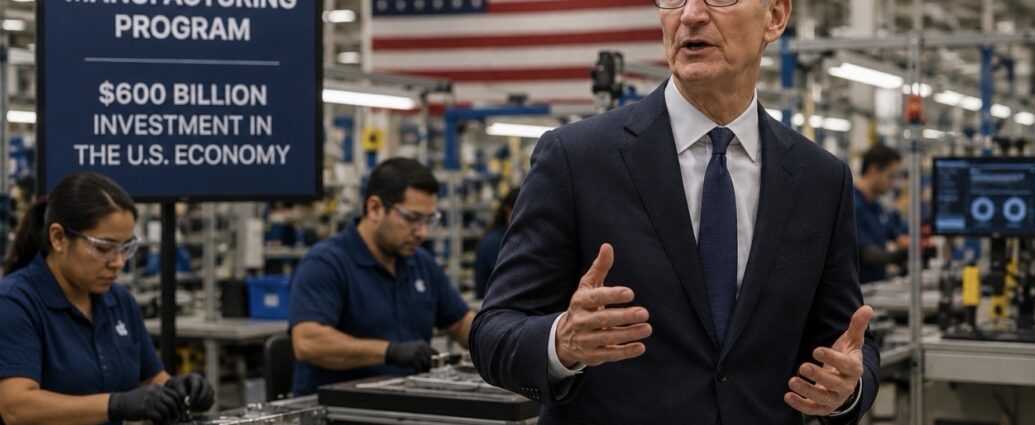
Apple Chief Executive Tim Cook arrived in Beijing this week as part of President Donald Trump’s high-profile business delegation, but the most consequential business move Apple made this year happened months earlier in Washington.
The company’s expanding $600 billion American Manufacturing Program commitment has effectively secured long-term tariff protection for the iPhone, Mac, iPad and Apple Watch, insulating Apple from the escalating import duties that have hit much of the global electronics industry.
The arrangement represents one of the clearest examples yet of how large multinational companies are increasingly using domestic investment commitments to secure trade and tariff advantages from Washington.
Apple originally pledged $500 billion in U.S. investment over four years in early 2025, including plans for roughly 20,000 manufacturing and research jobs, expanded semiconductor partnerships and a major server manufacturing facility in Texas.
Months later, after the Trump administration announced plans for steep tariffs on imported semiconductors and electronics components, Apple expanded the program by another $100 billion, bringing total pledged U.S. investment to $600 billion through 2029.
The revised commitment was announced alongside Trump in the Oval Office and included carve-outs that effectively shielded Apple products from the most severe portions of the administration’s electronics tariff framework.
The structure of the agreement matters.
Apple did not agree to move full iPhone assembly into the United States — something analysts widely view as economically impractical given current labor costs and supply-chain realities.
Instead, the company committed to expanding high-value manufacturing and component production domestically while continuing final assembly largely overseas.
The American Manufacturing Program now includes expanded partnerships with companies including Corning, Bosch, Cirrus Logic, TDK and Qnity Electronics, alongside deeper semiconductor commitments tied to TSMC’s growing Arizona fabrication facilities.
Apple also increased investment in Corning’s Kentucky operations, which manufacture specialized cover glass for iPhones and Apple Watches.
Meanwhile, advanced Apple chips for future iPhone and Mac product lines are expected to begin production at TSMC’s Arizona facilities later this decade.
The arrangement allows Apple to capture the political and supply-chain benefits of expanded U.S. manufacturing while avoiding the massive retail price increases that full domestic iPhone assembly would likely require.
The financial implications are enormous.
Analysts previously estimated that broad-based tariffs on imported electronics could have exposed Apple to meaningful margin compression or forced substantial iPhone price increases.
Morningstar analyst William Kerwin estimated last year that Apple faced roughly 15% earnings risk absent tariff exemptions.
Instead, Apple’s pricing structure remains largely intact.
The average iPhone selling price has stayed relatively stable despite escalating trade tensions, preserving one of the company’s most important competitive advantages in consumer electronics.
The broader industry picture looks very different.
Electronics manufacturers including Samsung Electronics, Sony, LG Electronics, HP, Dell Technologies and Lenovo continue navigating varying degrees of tariff exposure and supply-chain uncertainty.
Consumer-electronics accessory makers have already begun raising prices. Shenzhen-based Anker Innovations, for example, has increased U.S. retail prices significantly over the past year as import costs climbed.
Apple’s arrangement effectively creates a competitive moat built not only on brand strength and ecosystem loyalty, but also on tariff insulation that many rivals currently lack.
The Beijing summit itself remains strategically important for Apple.
Greater China still accounts for a significant portion of Apple’s global revenue, even after the company lost market share in recent years to domestic Chinese smartphone manufacturers including Huawei, Xiaomi and Vivo.
Cook’s participation in the delegation is partly aimed at stabilizing Apple’s position inside China while working through regulatory obstacles surrounding the launch of Apple Intelligence features in the mainland Chinese market.
Chinese regulators have maintained strict oversight regarding AI-related data handling and cloud infrastructure, creating additional complications for foreign technology companies operating inside the country.
For Washington, Apple’s manufacturing commitments also serve a political purpose.
The administration has increasingly framed the American Manufacturing Program as evidence that tariff policy can successfully drive domestic investment and industrial expansion without forcing sharp consumer-price inflation.
The arrangement effectively allows Trump to claim progress on reshoring portions of the electronics supply chain while avoiding the political backlash that would likely accompany dramatically more expensive iPhones.
The longer-term question is whether Apple’s current commitment becomes the new standard for tariff protection.
Other multinational corporations may now face pressure to make similarly massive domestic-investment pledges if they hope to secure comparable exemptions.
The answer may determine how future U.S. industrial policy evolves across technology, pharmaceuticals, semiconductors and consumer goods.
For Apple shareholders, however, the practical outcome is simpler.
The company has effectively spent a portion of its enormous balance sheet to protect one of the most profitable consumer-electronics franchises in history from the tariff shock hitting much of the broader industry.
For consumers, it means the iPhone sitting inside a Best Buy display case this year costs roughly the same as it did before the trade war intensified — something that, in 2026, has become increasingly rare across the consumer economy.
JBizNews Desk
© JBizNews.com. All rights reserved. This article is original reporting by JBizNews Desk. Unauthorized reproduction or redistribution is strictly prohibited.