JBizNews Desk | Friday, May 8, 2026
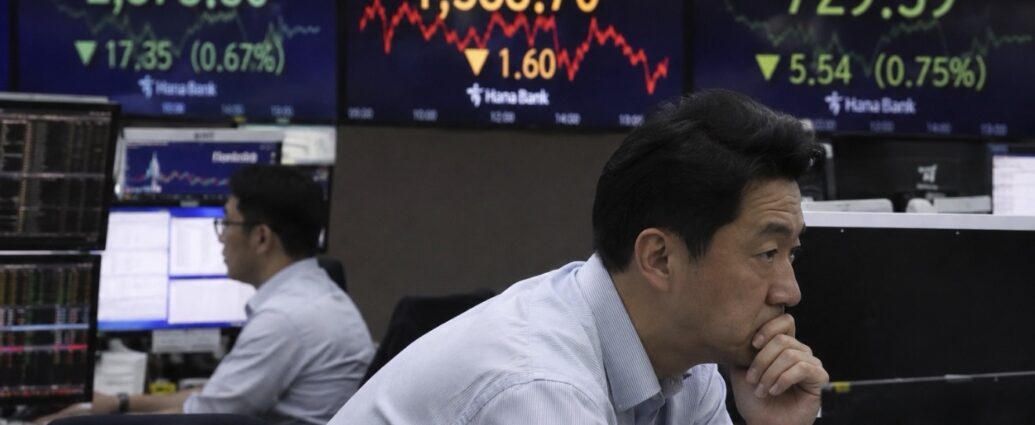
Asia-Pacific markets traded broadly lower Friday as concerns grew over renewed hostilities between Iran and the U.S. amid a fragile ceasefire. Japan’s Nikkei 225 slipped 0.36% after hitting an all-time record high Thursday. Australia’s S&P/ASX 200 extended early losses, declining 1.44%. Mainland China’s CSI 300 fell 0.60%, Hong Kong’s Hang Seng dropped 0.82%, and South Korea’s Kospi slipped 0.67%.
The broader MSCI Asia Pacific Index fell 1.1% overall, fueling speculation that higher energy costs would weigh on economic growth across the region.
The selloff erased a significant portion of this week’s gains — gains that had been built almost entirely on optimism that a U.S.-Iran peace framework was within reach.
That optimism did not survive the night.
What Happened Overnight
The U.S. and Iran traded fire in the Strait of Hormuz Thursday evening, with each side claiming the other initiated the attack.
U.S. Central Command said military forces “intercepted unprovoked Iranian attacks and responded with self-defense strikes” as a trio of U.S. Navy destroyers transited the waterway. The exchange reportedly involved Iranian small boats and drones.
Despite the escalation, President Donald Trump insisted the ceasefire remains in effect, calling the strikes “just a love tap” during a call with an ABC News reporter.
Trump later posted on Truth Social that the U.S. “completely destroyed” the Iranians involved in the exchange, describing Iranian small boats and drones that “dropped ever so beautifully down to the Ocean, very much like a butterfly dropping to its grave.”
For markets across Asia, Trump’s dismissive framing offered limited comfort.
Investors had spent the week pricing in the possibility of a negotiated resolution — a bet that drove Japan’s Nikkei 225 to an all-time high above 62,000 on Thursday and pushed U.S. indexes to records.
Friday’s overnight military exchange reversed that optimism sharply and broadly.
Up until this week, global markets had been betting on the fragile ceasefire turning into a longer-term peace deal.
But escalatory rhetoric, military action over the Strait of Hormuz, and fresh Iranian attacks on the United Arab Emirates over the past 48 hours have led analysts to warn that full-scale war could be back.
“It’s an incredibly delicate moment,” said Ben Powell, Chief Investment Strategist for APAC at BlackRock, speaking to CNBC.
Oil Climbs Back Above $100
West Texas Intermediate crude futures gained 1.07% to $95.82 per barrel in overnight trading, while Brent crude for July delivery gained 1.38% to $101.44 per barrel — climbing back above the psychologically significant $100 threshold after briefly dipping below it Thursday on peace deal optimism.
The swing in oil prices captures the central tension driving every market in the world right now.
When peace deal reports surface, oil falls and stocks rally.
When military exchanges resume, oil climbs and stocks sell off.
The pattern has repeated multiple times in the past two weeks — and each repetition makes it harder for businesses, investors, and consumers to plan with any confidence.
For American consumers, the overnight exchange means the brief relief at the gas pump that came with Thursday’s peace deal headlines is likely short-lived.
National gas prices hit $4.54 per gallon this week — up 52% since the war began — and any sustained return to hostilities puts that figure on a path higher, not lower.
U.S. Futures Also Slip
U.S. stock futures slipped Thursday night as traders monitored the Iran developments and looked ahead to the April 2026 jobs report due at 8:30 a.m. ET Friday.
S&P 500 futures and Nasdaq 100 futures were each down approximately 0.1%. Futures tied to the Dow Jones Industrial Average fell 32 points, or less than 0.1%.
The muted futures decline — compared to the sharper drops in Asia — reflects the fact that U.S. markets remain better insulated from the Iran war’s direct energy impact than most Asian economies.
But that insulation is thinning.
U.S. crude oil inventories unexpectedly plunged by 6.2 million barrels last week alone, with stockpiles of gasoline and distillates also falling sharply.
The excess supply buffers that have cushioned American consumers from the full force of the Strait of Hormuz closure are eroding faster than anticipated.
What the Jobs Report Could Mean
Friday morning’s April Employment Situation Report from the Bureau of Labor Statistics now lands in a dramatically different market environment than it would have just 24 hours ago.
With peace deal optimism punctured and oil prices climbing again, a weak jobs number could amplify the risk-off mood sweeping Asia into the U.S. open.
Economists are forecasting April nonfarm payrolls of roughly 70,000 to 100,000 new jobs — a sharp slowdown from March’s 178,000.
The unemployment rate is expected to hold at 4.3%.
A miss to the downside would raise recession fears at a moment when the economy is already absorbing:
- war-driven energy inflation
- elevated borrowing costs
- ongoing tariff uncertainty
Market analysts have described the current moment as a potential “inflection point” in the war — one where the gap between Washington’s public insistence that the ceasefire holds and the reality of continued military exchanges in the Strait of Hormuz can no longer be papered over by optimistic headlines.
“The latest developments could mark an inflection point in the war and a critical moment for financial markets and global energy supplies,” one analyst told CNBC.
For businesses and consumers on both sides of the Pacific, Friday’s session carries a simple but consequential message:
The war is not over, the oil shortage is not resolved, and the markets that had been betting on relief may need to reprice that bet — starting now.
JBizNews will have full coverage of the April Jobs Report the moment numbers drop at 8:30 a.m. ET.
© JBizNews.com. All rights reserved. This article is original reporting by JBizNews Desk. Unauthorized reproduction or redistribution is strictly prohibited.