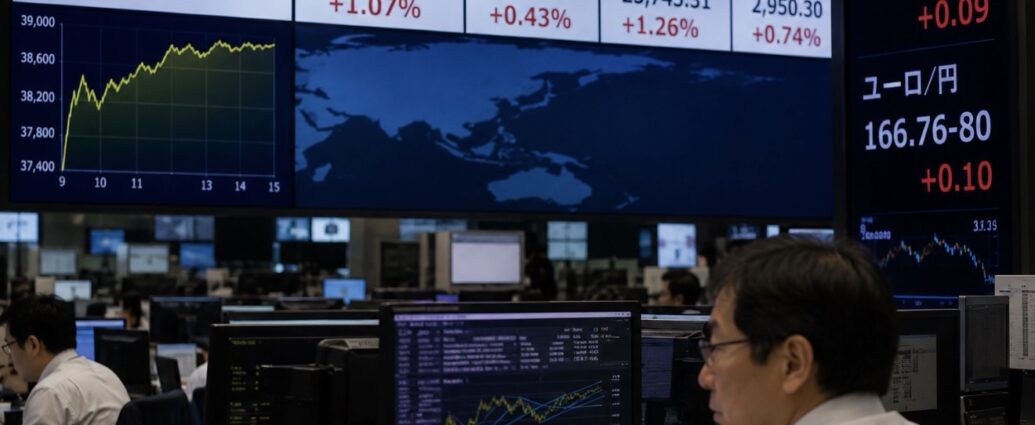
The Nikkei 225 topped 62,000 for the first time, leading a broad regional rally as investors bet that a U.S.-Iran peace framework is within reach — a development that could ease oil prices, unclog global shipping lanes, and lift economic growth worldwide.
Asian equity markets surged Wednesday, climbing to record levels as Japan returned from its extended Golden Week holiday to a world that looked considerably more optimistic than when it left.
The driving force behind the rally: growing investor confidence that President Donald Trump and Tehran are moving closer toward a framework agreement to end a conflict that has rattled financial markets, disrupted energy supplies, and clouded the global economic outlook since hostilities erupted in late February.
Japan’s Nikkei 225 soared more than 5%, briefly topping 62,000 for the first time in history as investors rushed back into technology, industrial, financial, and materials shares.
The broader MSCI Asia Pacific Index climbed 0.7%, with Tokyo’s powerful catch-up rally helping fuel gains across the region as markets increasingly priced in the possibility of lower oil prices and improved global growth prospects tied to easing Middle East tensions.
Japan’s Holiday Return Sparks Massive Catch-Up Rally
Part of Wednesday’s sharp move in Tokyo reflected timing.
During Japan’s Golden Week market closure, several major geopolitical developments unfolded, including reports suggesting the United States and Iran were nearing the outlines of a possible diplomatic framework agreement.
Japanese investors effectively had to compress several days of global market repricing into a single trading session.
Before the holiday break, the Nikkei had closed at 59,513 after already posting strong gains throughout 2026. The benchmark has emerged as one of the world’s strongest-performing major indices this year, driven by robust corporate earnings, favorable currency dynamics, and renewed global enthusiasm for Japan’s semiconductor and AI-related supply chain exposure.
International institutional investors have increasingly treated Japan as one of the clearest indirect beneficiaries of the global artificial intelligence infrastructure boom.
South Korea Set the Tone
While Tokyo markets were closed, South Korea offered traders an early preview of what was coming.
The Kospi index surged more than 6% to fresh record highs during Japan’s holiday period, led by powerful gains in semiconductor and AI-related technology stocks.
Samsung Electronics jumped sharply and crossed the $1 trillion market capitalization threshold, becoming only the second Asian company after Taiwan Semiconductor Manufacturing Co. to achieve that milestone.
The move reinforced broader investor confidence surrounding the AI supply chain, which remains one of the strongest global market themes entering the second half of 2026.
Given the deep ties between Japanese and Korean semiconductor industries, investors widely viewed South Korea’s rally as a leading signal for how Tokyo markets would react once trading resumed.
Oil Drops as Markets Price in De-Escalation
One of the most significant reactions unfolded in energy markets.
Brent crude fell roughly 1.6% to near $108 per barrel as traders increasingly bet that tensions in the Middle East could ease if negotiations continue progressing.
Lower oil prices would carry major implications for the global economy.
Cheaper energy reduces inflationary pressure on consumers, lowers transportation and manufacturing costs, improves corporate profit margins, and gives central banks greater flexibility on interest rates.
For import-heavy Asian economies such as Japan and South Korea, lower oil prices can act almost like an economic stimulus.
Currency markets also reacted sharply.
The Japanese yen strengthened more than 1% against the U.S. dollar to approximately 155.85, reviving speculation that Japanese authorities may again intervene in currency markets following recent efforts to stabilize the yen.
A stronger yen creates a mixed picture for Japan’s economy. It can pressure exporters by reducing overseas profit competitiveness while simultaneously helping consumers through cheaper import costs.
Why Markets Care So Much About Iran
Global investors have closely monitored developments surrounding the Iran conflict because of the enormous economic stakes attached to the Strait of Hormuz.
Roughly one-fifth of the world’s oil supply moves through the strategic waterway.
Any prolonged disruption threatens shipping routes, global energy markets, supply chains, insurance costs, freight pricing, and inflation expectations worldwide.
Recent reports indicating that the U.S. suspended certain military operations while allowing room for renewed diplomacy significantly improved investor sentiment.
Markets increasingly view a potential agreement not simply as a geopolitical development, but as a broad economic stabilizer.
A successful deal could lower freight and insurance costs, improve business confidence, reopen high-margin Middle Eastern consumer markets, and reduce supply chain uncertainty that has weighed on industries ranging from luxury goods to semiconductors and aviation.
China Adds More Fuel to the Rally
Asia’s momentum also received support from stronger-than-expected economic data out of China.
China’s economy expanded 1.3% during the first quarter of 2026 following 1.2% growth in the prior quarter, supported by continued government stimulus and infrastructure spending.
The data mattered especially for Japan, whose export-heavy economy remains deeply tied to Chinese demand.
Improving Chinese growth expectations tend to lift Japanese industrials, machinery makers, electronics firms, and semiconductor suppliers.
What Investors Are Watching Next
With Japan now fully back online after the holiday break, markets are turning their attention toward whether diplomatic momentum between Washington and Tehran can continue.
Investors will also closely monitor AI-related technology names across Asia, including SoftBank Group, Tokyo Electron, and major semiconductor suppliers tied to Nvidia and broader hyperscaler infrastructure spending.
For now, the message from Asian markets is unmistakable:
Investors increasingly believe the worst phase of the Iran conflict may be passing — and they are positioning for a world where oil flows more freely, inflation pressures ease, and the global AI investment cycle accelerates once again.
— JBizNews Desk