At least 120 Latin inscriptions, dating to the first and second centuries CE, were successfully identified at Valencia’s Cova Dones in eastern Spain, marking a significant jump from the roughly 15 inscriptions known at the site before 2026.
The findings, announced in late July by the University of Alicante, were made in May and June by a team led by Virginia Barciela of the University of Alicante and Aitor Ruiz-Redondo of the University of Zaragoza.
The inscriptions were found on the walls and ceilings of a cave previously discovered in 2024 at the site, located over 200 meters underground. The cave’s floor is dotted with small natural pools, known as gours, formed by water seeping through the rock.
“Preliminary results indicate that Cova Dones was a cave-sanctuary frequented by women, since several female names appear among the inscriptions documented so far,” explained the team.
Epigrapher Silvia Alfayé of the University of Zaragoza said that five votive inscriptions confirm that Roman-era visitors had worshipped a deity they called “Domina,” meaning “the Lady” in Latin, and that women played an active role in her cult.
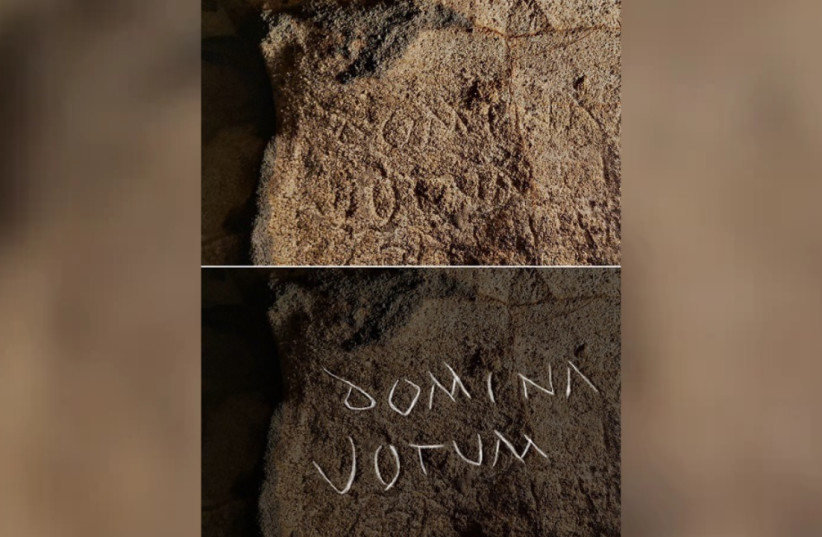
“Three of these inscriptions bear the name ‘MALACI’,” a previously unknown epithet for a goddess,” Alfayé added. “This goddess had a specific aspect, perhaps related to water, the definitive interpretation of which we are currently working on.”
Sergio García-Dils, an epigraphy specialist who worked on the readings, said that the presence of at least five inscriptions dedicated to the same deity rules out casual or one-off visits for a generic purpose, but rather points to specific cultic activity dedicated to a single deity.
“Likewise,” he said. “The fact that the texts are concentrated in a specific and delimited area of the cave, away from the entrance, confirms that it is an organized cult.”
Barciela noted that the research team at the site had found several spindle whorls, used to increase the rotation of a spindle, in addition to the inscriptions.
This indicates that worshippers at the site may have used spindles as offerings, which, in antiquity, “was associated with the female sphere,” Barciela explained. “This fact would fit with the epigraphic evidence pointing to the active participation of women at the sanctuary.”
“In this regard, it is worth considering the first written name that refers to the site: Cova de les Dones (Cave of the Women). It is possible that this is the fossilization of a toponym alluding to the presence of women or female entities there.”
Known to archaeologists since 2023
Cova Dones first drew archaeologists’ eye in 2023, after over 100 Paleolithic paintings were discovered inside it, making it the largest Paleolithic “art collections” found in the eastern Iberian Peninsula.
The site’s Roman layer was only found a year later, in 2024, when excavations uncovered the cave where the newly identified inscriptions were found.
Also found in 2024 were around 15 Latin inscriptions and a coin from the reign of Roman Emperor Claudius (41 CE to 54 CE).
In 2025, researchers succeeded in identifying over 100 pieces of stalagmite that had been altered by human hands.