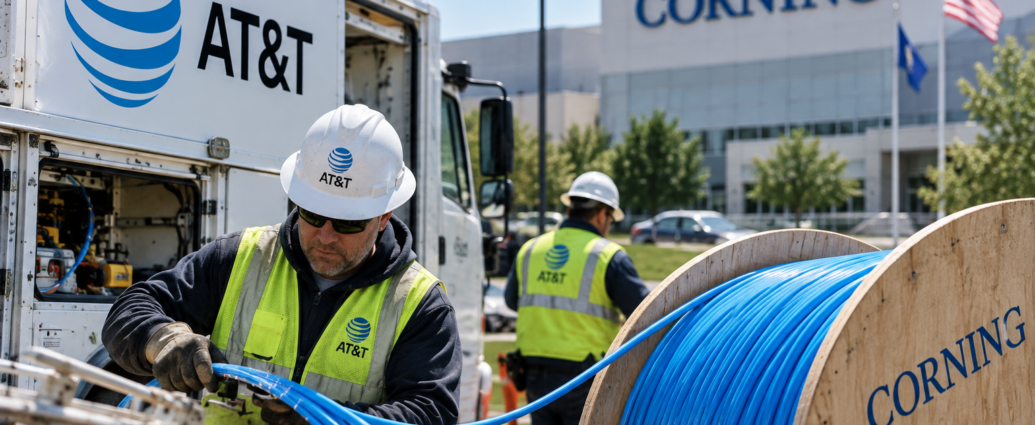
AT&T has agreed to buy more than $3 billion worth of fiber-optic cable from Corning over the next several years, locking in the glass strands it needs to bring faster home internet to millions more Americans.
The two companies announced the multi-year agreement on Sept. 29. Under the deal, Corning will supply the fiber and cable AT&T uses to expand its network. AT&T said the agreement is part of its plan to reach 60 million American homes and businesses with fiber internet by the end of 2030.
Here is what that means in everyday terms. Fiber internet runs on thin strands of glass that carry data as pulses of light. It is far faster and more reliable than older copper lines, and it can handle several people in one house streaming, gaming and working online at the same time without slowing down. But a company cannot hook up a single new neighborhood without first getting miles of that cable. This deal guarantees AT&T will have it.
The reason is simple: Americans are using more internet than ever. According to AT&T, the average household on its fiber service now uses more than 1 terabyte of data every month, five times more than in 2016. The company expects that number to roughly double, to between 2 and 2.5 terabytes a month, by 2030, as streaming, video calls, cloud storage and artificial intelligence tools become part of daily life.
“Fiber remains the gold standard for superior internet connectivity, and AT&T is the nation’s leader in fiber,” said John Stankey, chairman and CEO of AT&T. He said the company values its long relationship with Corning and plans to keep making the long-term investments needed to expand its network.
The deal also tackles a real supply problem. The rush to build data centers for artificial intelligence has put heavy pressure on the world’s supply of optical fiber, as tech giants compete with phone and internet companies for the same cable. By signing a large, long-term order, AT&T is making sure it does not get stuck waiting in line while it builds out to new customers.
Corning, based in Corning, New York, has become one of the biggest winners of that demand. It has recently signed large fiber supply deals with Verizon, Amazon, Microsoft, Meta and Zayo. In May, the company announced plans to build three new optical manufacturing plants in North Carolina and Texas to keep up with orders.
That matters for American jobs. Corning makes its fiber in the U.S., and the companies said its North Carolina facilities have already created hundreds of jobs. AT&T, for its part, said its technicians who install and maintain the network make up the industry’s largest union-represented workforce. In plain terms, the cable is made by American workers and installed by American workers.
“By pairing our large, U.S.-based advanced manufacturing with AT&T’s network leadership, we can keep co-innovating to build the dense fiber networks that will drive the future of connectivity,” said Wendell Weeks, chairman, CEO and president of Corning. He added that the partnership will help sustain thousands of skilled American jobs and strengthen domestic supply chains.
For households, the bigger picture is about choice and speed. AT&T says its fiber can deliver speeds about three times faster than the top advertised satellite internet services. The company plans to use satellite only to reach roughly 2% of remote areas, or about 1 in 50, where fiber and wireless are not practical.
The Corning order fits into a much larger spending push. AT&T has committed more than $250 billion over five years to strengthen U.S. internet and phone infrastructure. It also bought Lumen’s consumer fiber business for $5.75 billion, which added millions of homes to its reach. The company said the Corning deal is already reflected in the financial outlook it gave investors in July, meaning it does not change its spending plans or targets.
The deal also deepens a rivalry. Verizon struck its own multi-billion-dollar fiber agreement with Corning earlier, and both carriers are racing to wire up as many homes as possible before customers lock in with a competitor. For consumers in neighborhoods that currently have only one choice for home internet, that race could mean a second fiber option and more pressure on prices.
For now, the message from both companies is clear: demand for home internet keeps climbing, and the companies that secure the cable first will be the ones that connect the next wave of American homes.
JBizNews Desk | Dallas
© JBizNews.com All Rights Reserved. Reproduction or distribution without written permission is prohibited.