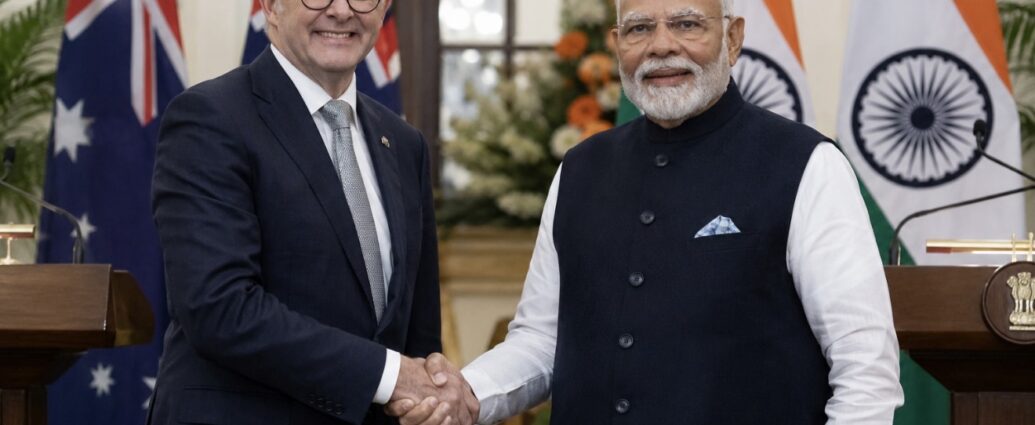
Australia and India have signed a long-awaited agreement that will allow Australia to begin supplying uranium for India’s rapidly expanding civilian nuclear power program, strengthening both countries’ energy and strategic partnership.
Australian Prime Minister Anthony Albanese and Indian Prime Minister Narendra Modi finalized the administrative arrangement on Thursday, completing the final step needed to implement the Australia–India Nuclear Cooperation Agreement first signed in 2015.
The agreement clears the way for commercial uranium exports from Australia to India under strict international safeguards governing peaceful civilian nuclear use.
Australia possesses approximately 28% of the world’s known uranium reserves, making it one of the world’s largest uranium suppliers.
India, meanwhile, has become one of the fastest-growing energy markets as it works to meet rising electricity demand while reducing carbon emissions.
The Indian government plans to increase nuclear generating capacity from approximately 8 gigawatts today to 100 gigawatts by 2047, making nuclear energy a central component of its long-term electricity strategy.
Because India has relatively limited domestic uranium resources, securing reliable foreign fuel supplies has become increasingly important.
Prime Minister Anthony Albanese described the agreement as an important opportunity for Australia to become a dependable supplier of critical energy resources to one of the world’s fastest-growing economies.
Prime Minister Narendra Modi called the arrangement a significant step toward advancing India’s clean-energy goals while strengthening economic cooperation between the two nations.
All uranium exports will remain subject to oversight by the International Atomic Energy Agency (IAEA) to ensure the material is used exclusively for peaceful civilian purposes.
The agreement follows years of diplomatic negotiations.
Although Australia and India established their nuclear cooperation framework nearly a decade ago, several regulatory and administrative requirements delayed large-scale commercial shipments until now.
India’s participation in international nuclear commerce expanded after receiving a waiver from the Nuclear Suppliers Group, despite not being a signatory to the Nuclear Non-Proliferation Treaty.
For Australia’s mining industry, the agreement opens an important new export market.
Industry representatives say India’s long-term nuclear expansion could provide stable demand for Australian uranium producers for decades as dozens of additional reactors are planned.
Australia currently exports uranium to several countries but does not generate nuclear electricity domestically.
Instead, the country continues relying primarily on renewable energy, natural gas and coal while prohibiting commercial nuclear power generation within Australia.
India has taken the opposite approach.
The country currently operates more than twenty nuclear reactors and continues constructing additional facilities as part of its broader effort to diversify electricity generation while reducing dependence on fossil fuels.
The uranium agreement also forms part of a broader package of economic and strategic cooperation announced during Modi’s visit.
Both governments agreed to expand collaboration in critical minerals, defense, advanced technology, space research and regional security.
The strengthening relationship reflects growing strategic cooperation between two Indo-Pacific democracies seeking more resilient supply chains and closer economic ties.
For businesses, the agreement creates opportunities across mining, engineering, transportation and energy infrastructure while supporting long-term investment in uranium production.
Global demand for uranium has risen steadily as more countries reconsider nuclear energy to meet growing electricity needs driven by artificial intelligence, manufacturing expansion and decarbonization efforts.
The agreement positions Australia to benefit from that demand while helping India secure reliable fuel supplies for one of the world’s most ambitious nuclear power expansion programs.
As construction of new reactors accelerates over the coming decades, the partnership is expected to become an increasingly important part of both countries’ long-term energy and economic strategies.
JBizNews Desk | Melbourne
© JBizNews.com All Rights Reserved. Reproduction or Distribution without Written Permission is Prohibited.