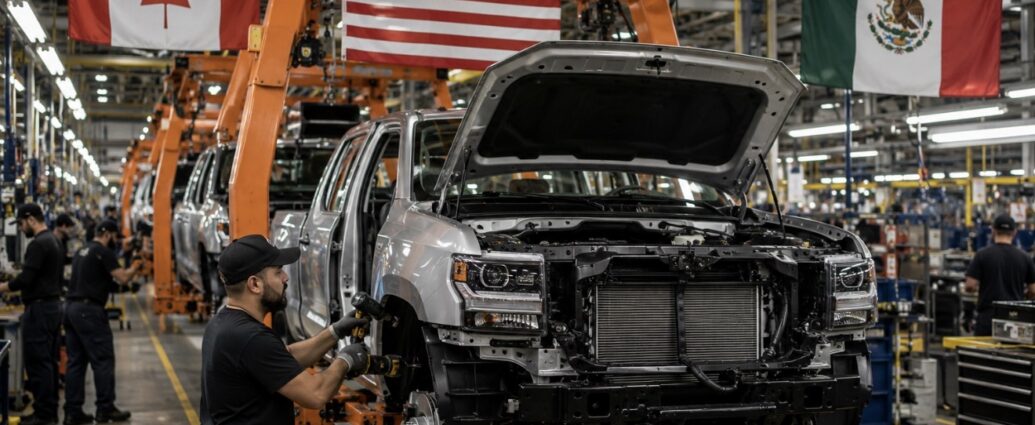
The Office of the U.S. Trade Representative is set to launch the first joint review of the United States-Mexico-Canada Agreement (USMCA) on July 1, and automakers across North America are preparing for what many consider the biggest risk to the industry: potential changes to the agreement’s automotive rules of origin. Trade officials from the three countries will begin discussions to determine whether to extend the 2020 trade pact or move toward years of renegotiation.
For the North American auto industry, few events carry greater significance. Millions of vehicles and auto parts cross the borders of the United States, Mexico, and Canada every year, and the USMCA determines which products qualify for duty-free treatment.
Current requirements are already among the strictest in the world. To avoid tariffs, a qualifying vehicle must contain at least 75% North American content, satisfy a 40% to 45% labor-value requirement tied to workers earning at least $16 per hour, and source 70% of its steel and aluminum from North America. Any tightening of those standards would require automakers to significantly restructure supply chains that have evolved over decades.
The Trump administration is widely expected to advocate for stronger domestic manufacturing requirements as part of its broader effort to bring more production and industrial jobs back to the United States. Administration officials have repeatedly indicated they favor higher North American content thresholds for automobiles and automotive components.
Negotiations are already underway. The first bilateral discussions between the United States and Mexico concluded in late May, covering automotive rules of origin, steel and aluminum requirements, and broader economic security issues. Canada has not yet participated in those initial talks, as trade tensions between Ottawa and Washington continue.
Even before any agreement changes, uncertainty itself carries economic costs. Automakers typically make investment, sourcing and factory-location decisions years in advance. Suppliers, particularly smaller manufacturers, face growing challenges as compliance requirements become more demanding and documentation requirements continue expanding.
China also remains a major focus of the review. U.S. officials have expressed concern about increasing amounts of Chinese-made content entering North American supply chains. Lawmakers have also questioned Canada’s commercial relationship with Beijing, raising concerns that Chinese investment or components could circumvent existing trade rules. Several members of Congress have urged negotiators to prioritize restricting Chinese influence in North American manufacturing.
One important safeguard remains in place. Even if the three countries fail to reach agreement during the review process, the USMCA would not immediately expire. The agreement contains a 16-year sunset provision, meaning annual reviews would begin while the current framework remains in effect through 2036. Although that avoids an immediate disruption, years of uncertainty could still discourage long-term manufacturing investment.
The consequences extend well beyond manufacturers. Stricter content rules or additional tariffs could increase vehicle production costs, raise prices for consumers, reduce automobile sales and potentially affect employment throughout the North American automotive supply chain. Previous studies by the U.S. International Trade Commission found that existing USMCA rules shifted some production back to the United States, although the broader economic impact has remained relatively modest.
Despite ongoing uncertainty, manufacturers continue investing heavily in Mexico. Foreign direct investment reached record levels during 2025, with billions of dollars in additional automotive and advanced-manufacturing projects announced entering 2026. Those investments suggest many companies continue making decisions based on long-term labor costs and regional manufacturing advantages rather than waiting for the review’s outcome.
Trade advisers are offering companies one consistent recommendation: understand every link in your supply chain before negotiations intensify. For an industry built on long planning cycles, integrated production networks and narrow profit margins, the decisions made over the coming weeks could shape North American automotive manufacturing for years to come.
JBizNews Desk
© JBizNews.com All Rights Reserved. Reproduction or distribution without written permission is prohibited.