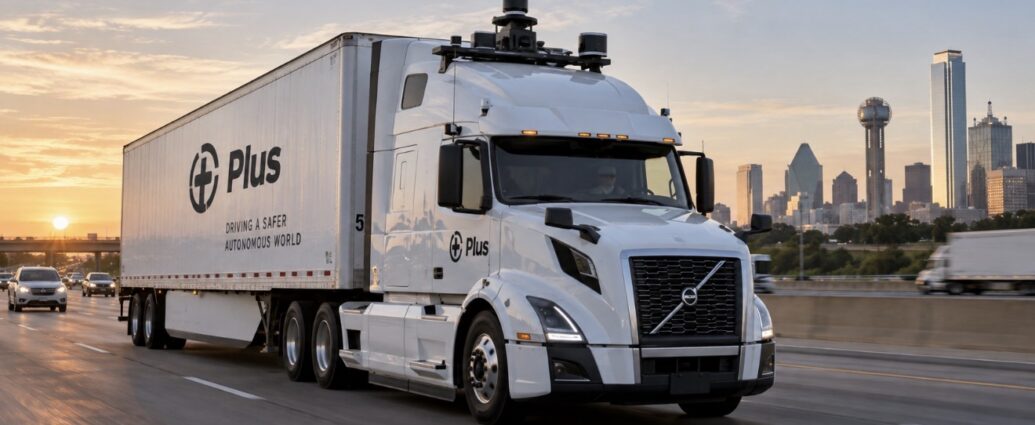
DALLAS — Autonomous-trucking software company PlusAI is heading toward the public markets through a deal that values the business at approximately $800 million before new investment, giving investors another opportunity to bet on driverless freight.
PlusAI agreed to merge with Texas Ventures Acquisition III, a special-purpose acquisition company, in a transaction expected to provide roughly $300 million in capital.
That includes more than $60 million in committed financing and approximately $236 million currently held by the SPAC.
The company develops SuperDrive, a Level 4 autonomous-driving system designed for commercial trucks.
Level 4 automation means a truck can handle the complete driving task under defined operating conditions without requiring a human driver to remain continuously responsible.
PlusAI is targeting a commercial launch in 2027.
The company already operates autonomous freight routes in Texas with Ryder and International and is working with major truck manufacturers on factory-built autonomous vehicles.
The financial scale is still relatively small compared with the valuation.
PlusAI says its HyperFoundry software-development platform has generated about $25 million in revenue, while the broader company expects roughly $40 million to $50 million in contracted revenue this year.
That means investors are being asked to value the company primarily on what autonomous trucking could become rather than what it earns today.
The potential market is enormous.
Trucking companies face persistent driver shortages, rising insurance costs, fuel expenses and strict limits on how many hours a human driver can legally remain behind the wheel.
A truck capable of safely operating for much longer portions of the day could fundamentally change freight economics.
For large carriers, autonomous systems could increase the number of miles each truck covers and reduce dependence on long-haul drivers.
For warehouses, retailers and manufacturers, that could eventually mean faster deliveries and lower transportation costs.
The technology could also reshape labor.
Long-haul trucking employs hundreds of thousands of drivers, and widespread Level 4 deployment would change what those jobs look like.
Human drivers could increasingly handle local pickup, delivery and complicated urban routes while autonomous systems perform more predictable highway segments.
But commercial success is far from guaranteed.
Autonomous trucks still need to prove they can operate safely in difficult weather, construction zones, emergencies and unpredictable traffic conditions.
Insurance companies and regulators will also have to determine who carries liability when a vehicle is operating without a human driver.
The planned public listing shows that investors are again becoming willing to finance the next stage of autonomous transportation.
For years, driverless trucking lived mainly inside research programs and limited testing.
Now the industry is moving toward a much harder test:
Can autonomous trucks become a real business?
JBizNews Desk | Dallas
© JBizNews.com All Rights Reserved. Reproduction or distribution without written permission is prohibited.