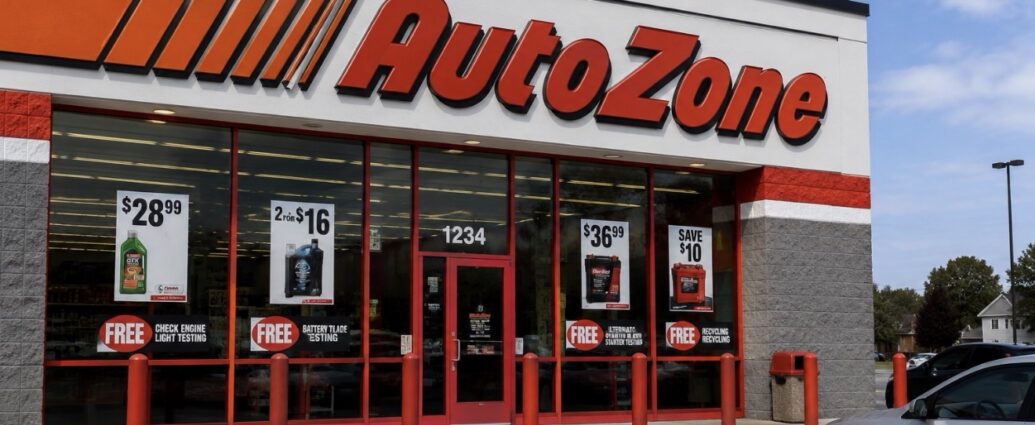
AutoZone beat Wall Street earnings expectations Tuesday, but investors focused instead on shrinking profit margins and weaker-than-expected international performance, sending shares of the auto-parts retailer sharply lower.
The company’s stock fell roughly 9.6% after reporting fiscal third-quarter results for the period ending May 9.
Phil Daniele, AutoZone’s president and chief executive officer, said the company remains focused on “a disciplined approach of increasing earnings and cash flows to drive shareholder value,” but the details inside the earnings report raised concerns across Wall Street.
AutoZone earned $641.5 million during the quarter, equal to $38.07 per share, beating analyst expectations of roughly $36.18 per share.
Revenue rose 8.4% to $4.84 billion, though that figure came in slightly below forecasts.
The biggest issue was margins.
Gross margin fell to 52.2%, down 57 basis points from a year earlier. Much of the decline came from a large accounting-related inventory charge tied to the company’s use of LIFO accounting — short for “last in, first out.”
Under LIFO accounting, the newest and often most expensive inventory costs are recognized first during inflationary periods, reducing reported profit margins.
AutoZone said the LIFO adjustment alone reduced quarterly gross margin by 77 basis points.
The pressure is expected to continue.
Jamere Jackson, the company’s chief financial officer, warned analysts during the earnings call that another significant LIFO-related hit is likely in the current quarter, with an estimated $30 million impact on operating profit.
That guidance disappointed investors who had hoped the inventory-related pressure would begin easing.
International operations also weakened.
AutoZone reported softer-than-expected results in Mexico and Brazil, two markets the company has increasingly relied upon to support long-term growth outside the United States.
Management maintained that the company continues gaining market share internationally, but slower growth in Latin America raised concerns about the pace of expansion abroad.
Domestic operations, however, remained relatively solid.
Comparable U.S. store sales rose 4.1%, with both do-it-yourself customers and commercial repair-shop demand holding up well.
The company opened 82 new stores during the quarter, including:
- 57 in the United States
- 20 in Mexico
- 5 in Brazil
AutoZone now operates nearly 7,900 stores across North and South America.
Management reaffirmed plans to open approximately 350 to 360 stores during the current fiscal year.
The company also continued aggressively repurchasing its own stock.
AutoZone spent roughly $586 million buying back shares during the quarter and still has approximately $800 million remaining under its current authorization program.
Share repurchases have long been one of the company’s major drivers of earnings-per-share growth.
Despite the earnings beat, investors reacted strongly because AutoZone has historically traded as one of Wall Street’s most consistent and predictable retail performers.
When highly valued companies show any signs of margin pressure or slowing international growth, stock reactions often become amplified.
The broader backdrop remains mixed for the auto-parts industry.
Historically, companies like AutoZone benefit when consumers delay buying new vehicles and instead spend more maintaining older cars.
That trend still appears intact across much of the United States.
But inflation pressures, accounting impacts, and uneven overseas performance are now complicating the story.
Daniele also addressed concerns tied to rising global energy prices and supply disruptions surrounding the Middle East conflict, telling analysts the company does not currently view lubricant or inventory supply issues as materially disruptive to operations.
AutoZone maintained its broader fiscal 2026 outlook and said management still expects continued growth domestically and internationally.
Still, Tuesday’s sharp selloff reflected a broader reality on Wall Street:
even companies known for consistency can face significant investor backlash when profit pressures, elevated expectations, and international uncertainty collide in the same quarter.
JBizNews Desk — New York
© 2026 JBizNews. All Rights Reserved. Reproduction or distribution without written permission is prohibited.