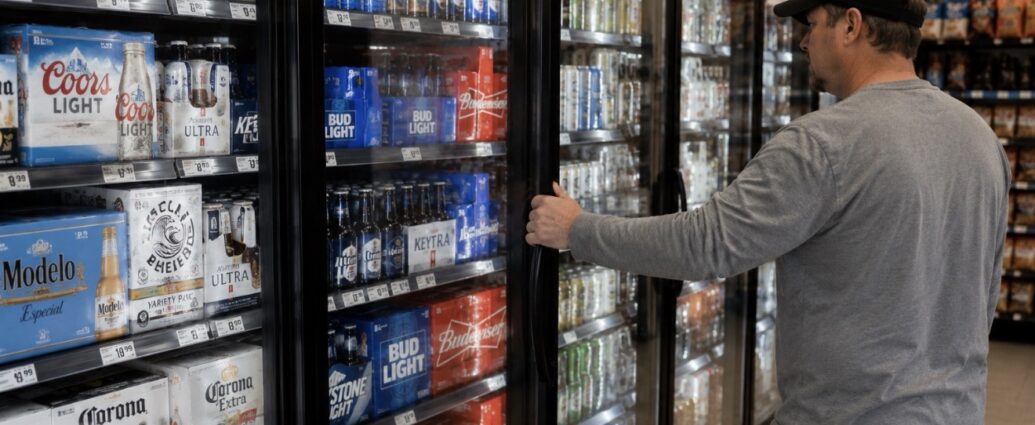
U.S. beer sales are deteriorating faster than major brewers and Wall Street analysts expected, with new scanner data showing consumers pulling back sharply on convenience-store purchases as gasoline prices continue climbing nationwide.
According to a research note from Bernstein analyst Nadine Sarwat, beer, flavored malt beverage, and cider volumes fell 6.3% year over year through the week ending May 2, based on Nielsen-tracked retail data. The decline marks a sharp acceleration from the roughly 3% contraction recorded between November and mid-April and signals what analysts increasingly believe is a broader consumer spending slowdown rather than temporary seasonal volatility.
While some fluctuation had been anticipated because Easter fell earlier this year than last, the breadth and consistency of the weakness across regions and beverage categories are changing the narrative on the industry.
What initially appeared to be a soft spring now increasingly looks like evidence that rising fuel prices are directly squeezing discretionary consumer spending.
The convenience-store channel — historically one of the beer industry’s most dependable sales drivers — is taking the hardest hit. Volumes at chains including 7-Eleven, Wawa, Shell, and Exxon convenience locations are down roughly 9% year over year since late April, significantly worse than the broader beer market.
Analysts say the decline matters because convenience stores function as one of the clearest real-time indicators of household financial stress. Beer remains among the most reliable impulse purchases at gas stations and convenience retailers, meaning falling sales often signal shrinking discretionary cash flow among consumers.
The pressure point is increasingly obvious: gasoline prices.
According to AAA, average U.S. gasoline prices have risen roughly 52% since the start of the Iran conflict, with the national average now hovering near $4.51 per gallon. Each additional dollar spent filling a tank effectively reduces the amount consumers spend inside convenience stores on beverages, snacks, and other discretionary items.
Sarwat drew the connection directly in her note, writing that Bernstein found “a negative correlation between the absolute price of gas in a given state today and the sequential change in beer/FMB volume growth.”
The regional data reinforces that relationship. California — where average gasoline prices now exceed roughly $6.16 per gallon — has become the weakest beer market in the country, with beer volumes decelerating by approximately 16% compared with the previous month’s trend. Arizona and Texas have also experienced notable slowdowns as fuel prices climbed.
The weakness is no longer limited to alcohol. Bernstein noted that soft drinks, bottled water, and energy drinks have also softened in recent weeks, suggesting that the strain is broader than changing consumer taste preferences.
The deterioration aligns with worsening national consumer sentiment. The University of Michigan’s preliminary May Consumer Sentiment Index fell to a record low of 48.2, missing expectations and slipping below April levels. The survey’s current-conditions component dropped nearly 9%, with consumers increasingly citing gasoline prices and tariffs as major concerns weighing on household finances.
Survey director Joanne Hsu noted that roughly one-third of respondents spontaneously mentioned higher gasoline prices during interviews.
The beer industry itself has already begun adjusting expectations. Constellation Brands, brewer of Modelo and Pacifico, previously projected its beer division operating profit would decline between 7% and 9%, sharply worse than earlier forecasts that had expected flat or slightly positive growth.
Chief Executive Bill Newlands cited “volatile consumer purchasing behaviour” and weakness among Hispanic consumers — a critical demographic for the company’s premium beer portfolio.
Sarwat described the broader environment as “an overall painful beer industry where volumes are declining at a mid-single-digit percentage rate,” a characterization that now appears increasingly accurate for 2026.
Competitors are responding defensively. Molson Coors recently estimated that overall U.S. beer-industry volumes declined approximately 1.6% during the quarter while its own market share slipped modestly. The company expects second-quarter U.S. financial volumes to fall between 6% and 9% year over year.
To defend market share, brewers are increasingly leaning toward lower-cost brands and value offerings. Molson Coors recently announced the return of Keystone Ice, a discontinued budget beer brand, signaling that many lower-income consumers are trading down rather than abandoning the category entirely.
For the industry, the larger problem is that the biggest forces driving the slowdown remain largely outside brewers’ control.
Energy markets continue grappling with supply disruptions tied to the Iran conflict, gasoline prices remain elevated, and consumer confidence sits near the weakest levels recorded since the University of Michigan began tracking sentiment in 1952.
As a result, what is unfolding inside the convenience-store cooler may increasingly reflect something larger than beer demand alone: a growing sign that inflation-fatigued American consumers are beginning to cut back across nearly every discretionary category.
JBizNews Desk
© JBizNews.com. All rights reserved. This article is original reporting by JBizNews Desk. Unauthorized reproduction or redistribution is strictly prohibited.