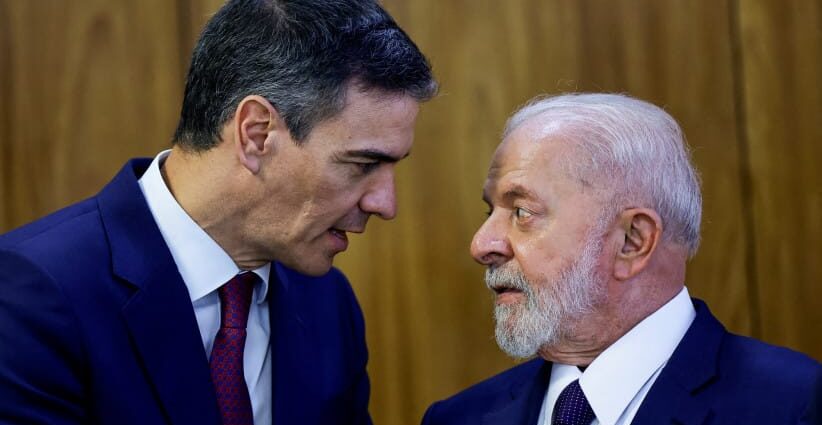
Spanish Prime Minister Pedro Sánchez, whose face and anti-war messaging were plastered on Iranian regime missiles in March (according to footage distributed by Iranian state Tasnim News Agency) and who regularly receives direct thanks and praise from Hamas, is in the news again, posturing against Israel. This time, he is calling the detention of two Global Sumud Flotilla members “kidnapping” and demanding Prime Minister Benjamin Netanyahu return a Spanish citizen “illegally detained.”
Sánchez’s passionate remarks on the subject were delivered last week at a PSOE (Spanish Socialist Workers’ Party) rally in Málaga and were reported by news outlets.
Meanwhile, in Israel, following an appeal, the two he referred to, Palestinian-Spanish-Swedish national Saif Abu Keshek and Brazilian Thiago Ávila, have been further detained by the Beersheba District Court until Sunday, suspected of aiding the enemy during wartime, of contact with a foreign agent and terrorist elements, and of additional terrorism-related offenses.
Sánchez permanently withdrew his country’s ambassador from Israel in March, four decades after the 1986 establishment of diplomatic relations between the State of Israel and the Kingdom of Spain. He also attempted to isolate the Jewish state from Europe last month, insisting that the European Union’s failure to sanction Israel over its military action in Gaza and Lebanon had weakened the collective “credibility” and “legitimacy” to defend Ukraine against Russia’s full-scale invasion, according to Euronews.
It was only Germany and Italy’s refusal to play ball that blocked the European Union from suspending the EU-Israel association agreement. Additionally, Sánchez not only disallowed his country’s participation in Eurovision but has also forbidden its broadcast in Spain on its 70th anniversary.
Deep crisis
For his take on the situation, The Jerusalem Post spoke to influential Spanish businessman David Hatchwell – president and co-founder of the Hispanic Jewish Foundation, co-founder of Action and Communication on the Middle East (ACOM), former president of the Jewish Community of Madrid, and former vice president of the Federation of Jewish Communities of Spain. ACOM has defeated the anti-Israel boycott, divest, and sanctions (BDS) movement in over 90 cases in Spanish courts.
“We are living through the deepest crisis in the relationship between Spain and the Jewish people in 500 years,” Hatchwell said.
Speaking from Madrid, he contrasted Sanchez’s attitude with two “great gestures by Spain toward Israel and the Jewish people,” the 1986 normalization of the Spain-Israel relationship and “the fantastic gesture of reconciliation between Spain and its past made in 2015, with the law giving nationality to descendants of Sephardim.”
Hatchwell defined the present time as “the most painful moment in our relationship, because right now we are led in Spain by the most anti-Israel and, definitely, the most antisemitic government in the West.”
While Spain finally accepted the International Holocaust Remembrance Alliance’s definition of antisemitism in 2018, antisemitism in Spain has grown exponentially since Sánchez came to power.
“During the last two or three years, antisemitism has been flying in terms of incidents,” Hatchwell underlined. “The national plan to fight antisemitism is a joke. It has not been put into motion and serves only as a whitewashing tool.”
“And although we know that, traditionally, antisemitism came from ignorance and prejudice, today it comes from constant media intoxication, including social media,” he noted.
Because of the targeted misinformation around Gaza, Hatchwell told the Post, “a generation of people today, of all ages, have been fed the trope of the Jews committing genocide.”
“Spaniards are generally tolerant, easy going, and fun-loving people. They also have great sympathy for underdog narratives. It is very difficult for them as for Europeans in general, to understand Israel and its dilemmas,” he explained.
Never won an election
Sánchez has never won an election. As head of the other main party, PSOE, he took over (2018 to 2020) after ousting then-prime minister Mariano Rajoy in a no-confidence motion due to corruption in the ruling Partido Popular (PP) party. Since then, he has remained in power thanks to coalition agreements.
From 2018 to 2020, Sanchez’s deputy prime minister was Complutense University of Madrid political science professor Pablo Iglesias, who co-founded the Podemos party in 2014, capitalizing on the 2011 anti-establishment movement, Indignados, aka 15-M.
At the time, the Post visited the 15-M encampment at Madrid’s Puerta del Sol and witnessed, among posters for social initiatives, a sign reading: “Israel, asesino” (Israel, murderer).
The UK journal New Left Review defined Podemos’s core group as “intellectuals and publicists… radicalized in the 1990s,” whose “presentational skills were first honed on community TV” with “hands-on confidence gained working with radical governments in Bolivia, Ecuador, or Venezuela.”
From 2013 to 2019, Iglesias developed a following among the young and progressives who were fed up with the old political order, and hosted the talk show Fort Apache, which focused on political topics from a radical Left perspective. It was broadcast on HispanTV, the Iranian government’s Spanish-language television channel, launched in 2011 by then-Iranian president Mahmoud Ahmadinejad and broadcast via Spanish satellite company Hispasat.
By the time Iglesias began his show, EU sanctions against the Islamic Republic of Iran Broadcasting (IRIB) had caused Spain to cancel HispanTV’s satellite transmission and it had gone online. Iglesias also hosted talk shows on El Público TV media platform, airing anti-Israel interviews and referring to Israel as an “illegal state.”
According to political analyst Sergio Castano, a professor at the International University of La Rioja, HispanTV was created to serve Iran’s soft power strategy aimed at political influence in Latin America and Spain.
“Iranian TV channel HispanTV has acted as the voice of Iran for its Spanish-language audience since it began broadcasting. The creation of the medium was part of Iran’s foreign policy agenda,” Castaño wrote on the Uruguay media platform Diálogo Político in 2024.
The Institute for National Strategic Studies publication NDU Press identified Iglesias as “a bridge within the Iranian-Bolivarian network,” aimed at undermining US influence in South America.
The Iranian-Bolivarian network is a strategic alliance between Iran, Venezuela, and other South American countries – notably Bolivia – with Iranian proxy groups such as Hezbollah, designed to influence the West.
Under former Venezuelan presidents Hugo Chávez and Nicolás Maduro, Venezuela became a key hub for Iran’s Quds Force and Hezbollah activity in the region.
Except for Argentina, where, in 1994, Hezbollah carried out a terror attack on the Jewish community center of the Asociación Mutual Israelita Argentina, killing 80 people, wounding 300, and shedding light on the nature of the Islamic regime, there had not been much mainstream information about Iran in Latin America.
“For Iran, the task of finding new international allies was very complicated,” Castaño wrote in March last year. However, “the good rapport with the government of Hugo Chávez [in Venezuela] made it easier for Iran to extend a comprehensive soft power strategy in Latin America.”
To this end, Iran increased the diplomatic and cultural activity of its embassies in Argentina, Brazil, Uruguay, Venezuela, and Mexico, and established others. However, that was not enough to gain sympathy in Latin America, Castaño explained.
“Following the strategy deployed by other countries, such as the Russian news channel RT, the government of Tehran created HispanTV. Through its Spanish-language television channel, Iran deploys its narrative and tries to build a story aimed at Spanish-speaking people,” he noted.
Despite Iran’s ideological principles being the antithesis of the ideas of the South American Left, and “the great distance that separates both realities… common interests based on the rejection of the United States and the formation of an alternative world order have allowed the consolidation of ties between Iran and several Latin American countries.”
Last month, the political analyst concluded: “Iran has woven in Latin America an adaptable network based on Hezbollah and alliances with organized crime, allowing it to maintain influence despite international pressure and political changes.”
The beginning of the fall
“The beginning of the fall of Spain began with Zapatero,” Hatchwell pointed out. He was referring to PSOE member José Luis Rodríguez Zapatero, Spanish prime minister from 2004 to 2011, who, he said, had been collaborating with the Venezuelan regime and had visited Venezuela 37 times in the past three years, “whitewashing this narco-state.”
Not all PSOE leaders have been anti-Israel, however.
Felipe González, 84, Spain’s first socialist premier and its longest-serving democratically elected leader (1982-1996), addressed Hamas directly last year: “You don’t want women and children killed in Gaza? Release the hostages!” His speech can be found on YouTube.
González became the first Spanish leader to visit Israel after hosting the 1991 Madrid Peace Conference to restart Arab-Israeli negotiations. He spoke at the Knesset and met with then-prime minister Yitzhak Shamir. Previously, González had visited Israel incognito in the 1970s, meeting with Labor Party members.
Power pacts
To remain in power, Sánchez has formed alliances with several groups. His current coalition, formed in 2023, has been decried by the mainstream Spanish public since its inception, for the amnesty pacts he signed to achieve it.
Hatchwell explained, “Today, Spain is led by a coalition financed by Iran, which is composed of radical left-wingers, Catalan and Basque independentists, and terrorists who have never answered for their crimes. The Catalan independence parties hate Spain, and 10 years ago, the old pro-terrorist Bildu people were part of [Basque terrorist group] ETA that killed close to 1,000 Spaniards between 1968 and 2010.
“And, by the way, they are the traditional allies of organizations such as the PLO, Abu Nidal, the People’s Front for the Liberation of Palestine, and radical organizations in Latin America.
“So that is the coalition that Pedro Sánchez put together; it hates Spain, it hates Israel, and it hates America,” he emphasized.
BDS hub
Over the years, the Political Science and Sociology Department at “La Complutense,” Iglesias’s alma mater and Podemos’s incubator, became a prominent hub for the anti-Israel BDS campaign, with its student delegation approving a 2023 motion to declare the faculty an “Israeli-apartheid-free space.”
An appeal by ACOM obtained a 2024 ruling from Madrid’s Contentious-Administrative Court that the student body’s declaration was illegal and discriminatory, but that did not change attitudes.
Celebrated by Hamas and Iran
Sánchez, Hatchwell said, “used the war in Gaza to become a champion of Palestinian rights, and never said a word about the legitimacy of Israel’s fight against Hamas. And now he is doing the same with Iran, saying that this is an illegitimate war. So he has become greatly celebrated by Hamas, by Hezbollah, by the Houthis, and by the Iranian regime.”
The Spanish prime minister understands that public opinion is strongly anti-war. It was widely opposed to the Iraq war against Saddam Hussein, and later felt misled when weapons of mass destruction were not found. Playing on those sensitivities, Hatchwell said, “is why Sánchez positioned himself as the pro-Palestinian leader in the world.
“And now, with Iran, he is doing exactly that, even challenging [US President Donald] Trump, because he understands that the Spanish population is very anti-war, anti-American, and prone to conspiracy theories.
“Maybe 95% of the media is controlled by the government, and that gives him a strong element to be able to come out as the ‘White Knight’ of Palestinian rights.”
Hatchwell additionally noted that, over the past year, “pro-government journalists” in Spain had been conducting “a harassment campaign against me, in an attempt to intimidate a very vocal Jew.”
Spain’s narratives around Iran ignore internal realities, he said, including the recent executions of “some 40,000 people” and nuclear enrichment developments.
“Iran uses terrorism internationally as one of its levers,” Hatchwell warned. “It also relies heavily on international media influence. The reason it has not engaged in large-scale international terror attacks is because it still believes global opinion is relatively favorable to it. If that changes, it will escalate operations through its international networks.”
Looking to the future
“Spain, like the rest of Europe, is in big trouble,” Hatchwell warned. He argued that a coalition between the Center Right Partido Popular (PP) and the right-wing Vox could stabilize the country “if, this time round, the government would be willing to carry out reforms in education, identity, security, tax, and labor policy.”
He further highlighted that Spain could benefit from closer ties with the Americas, “where 550 million Spanish-speakers share language and cultural links.”
“We can look toward that side of the world and less toward Europe,” Hatchwell pointed out, indicating political shifts in Latin America, including Argentina, Chile, Ecuador, Paraguay, El Salvador, and Guatemala, “and possibly Colombia in the next election; this is a trend that is taking place.”
He also referenced emerging international agreements involving Latin American governments and Israel.
Corruption and scandal
Although not reflected in the media, Sánchez’s popularity ratings are plummeting, according to Center Left sources in Madrid and Toledo who spoke to the Post on condition of anonymity. They are afraid that continued government by Sánchez will ruin their country and their lives, referring to him as a “sinverguenza” (shameless person).
“Now in Spain, it turns out that the burka is for liberated women,” one of them told the Post.
In July, a report in El Mundo quoted opposition PP President Alberto Núnez Feijóo accusing Sanchez in Parliament of having “benefited financially from an abominable business,” in reference to the pre-2013 businesses run by his father-in-law, in “the sex and erotica industry via the company known as San Bernardo 36 SL.” That newspaper is not the only one reporting on the issue.
The prime minister himself is continuously accused of corruption. His wife is facing charges of corruption and influence peddling; his public appearances are often met with calls for him to resign, according to videos shared on social media; and the country appears to be moving toward the Right, with the next election coming up in 2027 at the latest.
“Sánchez’s government is at its lowest point in terms of popularity,” Hatchwell said. “It has never had so few votes in the congressional chambers in terms of representation, so it is very weak and there have been very serious corruption scandals affecting the prime minister’s surroundings, starting with his wife, continuing with his brother, and then involving the two people closest to him, who have practiced real endemic corruption throughout – first his party, and then in abuse of power with respect to the government.”
Additionally, ”Sánchez is being accused by his former business crony, socialist Victor de Aldama [currently a key figure in a corruption case], of being funded by Venezuela to protect the Maduro regime,” he said.
Local bully
“Sánchez has understood, like few leaders, the political weaknesses of Spain’s political system and, as prime minister, he has acted like a local bully, upping the ante, a policy that has worked for him in Spanish affairs,” Hatchwell told the Post. “However, his attacks against Israel and the US have taken him into uncharted waters where, judging by history, he won’t have as much success.”
Brave judges
Regarding whether Sánchez might manage another term in office, Hatchwell opined that although the outcome of the 2027 election is naturally uncertain at this point, there is one element that Sánchez does not fully control, and that is the judicial system.
“There are cases continuing against him despite pressure. A few brave judges are maintaining them, preserving checks and balances.”
Something to look out for
“In the coming weeks, the conclusion of an investigation will be presented at the South New York District Court where former prime minister Zapatero, Sánchez’s mentor, may very well be indicted as a collaborator of the Venezuelan regime by the testimonies of Nicolas Maduro, [his key ally] Alex Saab, and [his former intelligence chief Hugo] ‘Pollo’ Carvajal,” Hatchwell concluded.