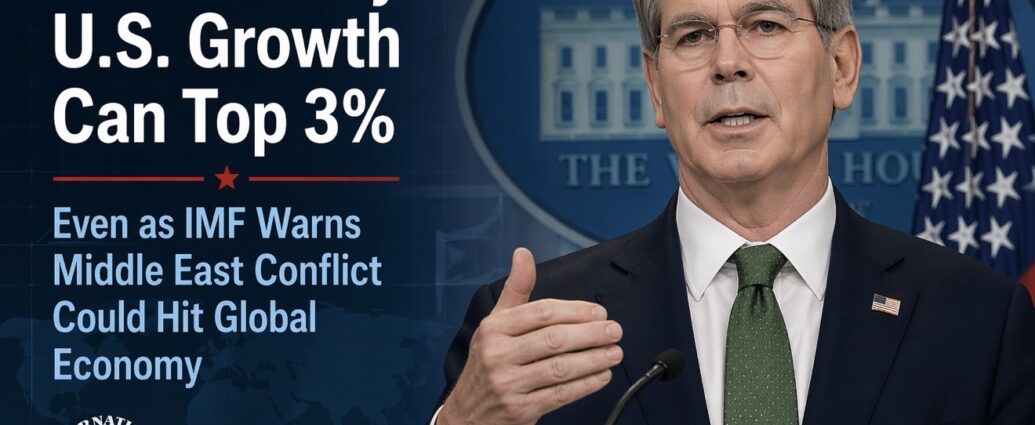
Treasury Secretary Scott Bessent said the U.S. economy could still expand by more than 3% this year even as the International Monetary Fund cut its global outlook and warned that a deeper Middle East conflict could damage growth through higher energy prices. Speaking at a Wall Street Journal event in Washington on April 14, Bessent said, “I think the underlying economy remains strong,” adding, “I do think that the growth could easily exceed 3 percent, 3.5 percent this year, still,” according to remarks reported by the Wall Street Journal and other outlets covering the event.
The upbeat assessment landed just as the IMF struck a more cautious tone on the world economy. In its latest public update on April 14, the fund said an escalation in the Iran conflict and a sustained rise in oil prices could materially weaken global activity, with IMF economists warning that the world economy could move closer to recession under a more severe shock scenario. In the fund’s published analysis, Pierre-Olivier Gourinchas, the IMF’s chief economist, said geopolitical tensions “could lead to renewed supply disruptions and higher commodity prices,” a risk that matters because inflation pressures had only recently begun to ease in many major economies.
President Donald Trump moved quickly to push back on fears that the conflict would fuel a fresh inflation spike, arguing that energy costs would retreat. Trump said oil prices would “fall sharply” and suggested the inflation impact would prove limited, according to public remarks cited by major U.S. media including Reuters. That message aligns with the administration’s broader effort to reassure markets that the U.S. expansion can withstand geopolitical shocks, even as crude traders and economists monitor whether any disruption to regional supply routes becomes more than temporary.
The divergence between Bessent’s confidence and the IMF’s warning underscores the central economic question for executives and investors: whether the U.S. can keep outrunning a softer global backdrop. The IMF said in its update that global growth risks had tilted further to the downside, while Reuters reported that policymakers and analysts increasingly view oil as the key transmission channel from the conflict into broader inflation and consumer spending. Bessent, by contrast, framed the domestic picture as resilient, pointing to what he described as strong underlying momentum in the U.S. economy during his Wall Street Journal appearance.
That resilience faces a practical test in the months ahead through fuel costs, freight rates and business confidence. Economists have long argued that a sustained oil shock acts like a tax on households and companies, and the IMF reiterated that point in warning that higher energy prices could slow demand while complicating central-bank efforts to return inflation to target. In comments published by the fund, Gourinchas said policymakers face “a more difficult trade-off” if commodity prices rise again, because growth would weaken even as inflation pressure reappears.
Market participants, for now, appear to share part of Bessent’s view that the U.S. enters the latest geopolitical flare-up from a position of relative strength. Recent U.S. data on employment and consumer activity had signaled continued expansion, and Reuters and Bloomberg both noted in recent coverage that traders have treated any energy spike as potentially manageable unless supply disruptions broaden. Still, economists cited by CNBC and Reuters have warned that confidence can deteriorate quickly if oil remains elevated long enough to squeeze transport, manufacturing and household budgets.
The policy implications extend beyond growth forecasts. If oil prices stay high, the Federal Reserve could face renewed pressure to keep interest rates restrictive for longer, even if headline growth slows. Officials at the central bank have repeatedly said they need greater confidence that inflation will return sustainably to 2%, and public remarks from Federal Reserve policymakers in recent months have emphasized sensitivity to commodity-driven price shocks. That makes Bessent’s optimism more than a headline number: a stronger-than-expected U.S. economy would give the administration political cover, but it could also leave borrowing costs higher if inflation proves sticky.
For corporate leaders, the more immediate issue lies in whether the conflict remains contained. The IMF’s warning made clear that a limited disturbance in energy markets differs sharply from a prolonged disruption that affects shipping lanes or regional production. In its analysis, the fund said a more severe escalation could produce “significant adverse effects” on global output, language that investors typically read as a signal to watch not only oil benchmarks but also insurance costs, logistics bottlenecks and emerging-market vulnerabilities. Reuters similarly reported that the economic fallout would depend heavily on the duration and breadth of the conflict rather than the initial shock alone.
What comes next will determine whether Bessent’s 3%-plus call looks prescient or overly confident. If oil prices ease as Trump predicted, the U.S. could preserve stronger growth than many peers even as the IMF trims global expectations. If the conflict deepens and energy stays elevated, the fund’s warning about weaker growth and renewed inflation pressure could move from scenario analysis to baseline risk. For markets, policymakers and boardrooms, that gap between resilience and vulnerability now stands as one of the most important economic variables of the year.
JBizNews Middle East Desk