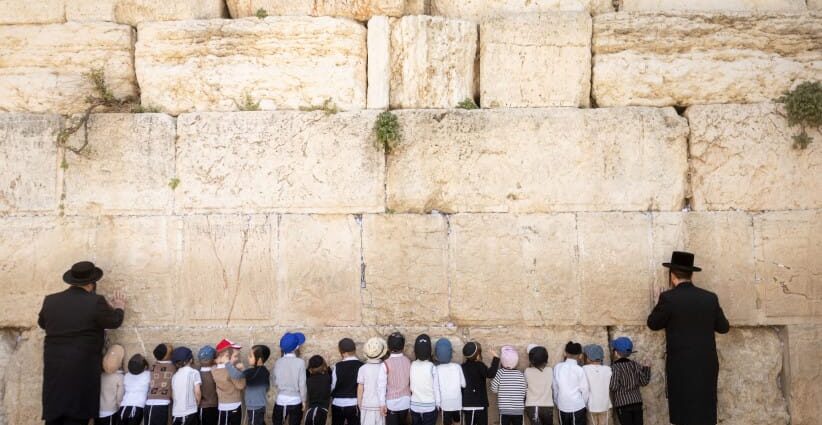
What can we take away from Shavuot? This past holiday of Shavuot, some 100,000 people came to the Western Wall, according to data released by the Western Wall Foundation and local police. I was privileged to be among them.
At dawn, I participated in a festive and moving morning service with 100 students from the Nefesh Yehudi organization, most of whom were taking part in this service for the first time.
We were surrounded by tens of thousands of people, different groups from across Israel and the entire world. I noticed the diversity of the people in attendance: tourists standing next to Israelis, children next to seniors. Most had walked to the Wall after having devoted the entire night to Torah study.
Shortly after five in the morning, as the sun began to rise over the Western Wall Plaza, everyone recited the Ten Commandments, which we received on this day thousands of years ago at Mount Sinai.
Of course, this wasn’t taking place only at the Western Wall; it was happening throughout the Jewish world.
Maybe you were at home with your children, at a neighborhood synagogue, with friends or family, or even outside Israel. Regardless of whether you experienced a moving or challenging holiday, each and every Jew, no matter where they were, received the Torah and, specifically, his or her own portion in the Torah.
But what can we take away from this? Where do we go from here?
On Shavuot, it is customary to make a new commitment to Torah study. Our Sages explain that Shavuot is considered a “Rosh Hashanah” for the Torah, and that a new year of Torah study is about to begin. It is an appropriate time to dedicate ourselves to learning a specific part of the Torah or to join a Torah class.
In this way, we can find a practical way to continue the Revelation at Sinai by incorporating it into our daily lives. Following Shavuot, I encourage you to think of ways to continue receiving the Torah every day.
The Mishnayot Campaign in Johannesburg
Meir Raff is the principal of an elementary school in Johannesburg, South Africa. A few years ago, one of the teachers in his school read an article I had written about a project in the northern city of Ma’alot, where all the residents of the city completed the study of the entire Torah together.
That teacher suggested that the school do something similar, and so the principal launched the Mishnayot Campaign.
To be part of the project, each child learns Mishnayot whenever he wants, and however much he wants.
This is not a contest where children compete against one another, and one winner is announced at the end. Everyone contributes something to the shared total, and everyone wins.
A child in first grade can learn one Mishnah, while a child in sixth grade can learn a thousand Mishnayot.
“The success has been tremendous,” Meir Raff shared. “Children sit together during recess and after school to learn a Mishnah. They meet on Shabbat to learn together.
“Parents tell me that their child asks them to come home early from work so they can learn Mishnayot together. They’ve even sent me pictures of children learning Mishnah on the school bus or in bed. All the teachers, even the secular studies teachers, have felt a positive change in the school.”
Some of the children were not the strongest students in the class, but this campaign turned them into leaders. It gave them a sense of capability, he added.
At the beginning of the campaign, the principal announced a goal of 5,000 Mishnayot, but the children passed that goal very quickly, and the school realized that a major celebration was in order.
They rented a hall with an orchestra and held a moving event, with dancing, a certificate for every child, a great deal of Simchat Torah, and many tears of emotion.
The week before Shavuot marked the third year that the school celebrated the completion of the campaign.
“The 63 children in this small school have learned a total of 25,678 Mishnayot, dedicated to the success of the Jewish people,” Meir Raff wrote.
“I’d like to recommend that everyone implement what I have learned through my position as a principal: We need to make Torah a joyful, exciting experience, so that each one of us can acquire our own portion in Torah.”
Parashat Naso: At Peace with Ourselves and the World
The following was written by Rabbi Jonathan Sacks, zt”l, on Birkat Kohanim, the Priestly Blessing, which appears in Parashat Naso, the Torah portion that is read this week outside of Israel (In Israel we are up to Behaalotecha).
“The famous Priestly Blessing ends with the words: ‘May Hashem lift His face toward you and grant you peace.’
The knowledge that Hashem turns His face toward us is the deepest, ultimate, and absolute root of peace. It means knowing that we are not just another face in the crowd, because God relates to us as individuals. Each of us is unique.
“The competition, jealousy, and hatred in the world come from a lack of inner security. These things are not signs of faith, but of a great emptiness where faith should be. Faith means that I believe that God cares about me. That I am here, in this world, because He wanted me to be here. This is the deepest inner source of peace.
“In order to merit God’s blessing, we do not need to prove ourselves. We only need to know and internalize that His face is turned toward us. When we are at peace with ourselves in this way, then we can begin to make peace with the world.”
With Love
And another thought: Did you ever pay attention to the blessing that the kohanim say before the actual Priestly Blessing?
After they are called up to the bimah, the kohanim wrap themselves in their prayer shawls and say: “Blessed are you, Hashem, our God, King of the Universe, who has sanctified us with the holiness of Aaron and commanded us to bless his people Israel with love.”
Why love? We do not say, “to light Shabbat candles with love,” or “to eat matzah with love.”
But in order to bless and to be blessed, we have to open our hearts and love.
This is the prerequisite for the abundance and goodness with which the kohanim bless the people. We need a generous eye, a giving spirit, and a sense of identification with the community. That is what brings blessing into our lives.
Want to read more by Sivan Rahav Meir? Google The Daily Thought or visit sivanrahavmeir.com