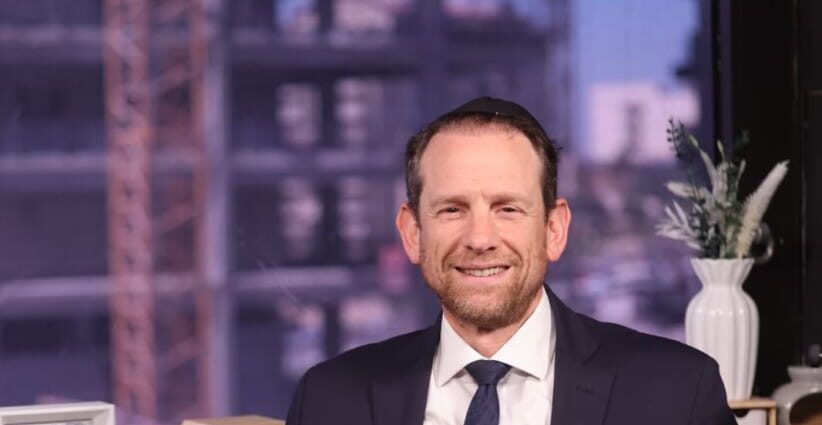
For many people, the Orthodox Union is synonymous with the small “OU” symbol found on millions of kosher products. But Executive Vice President and Chief Operating Officer Rabbi Josh Joseph says that’s only one piece of the organization’s story.
“The OU is very well known for its kashrus with 1.5 million products worldwide,” Joseph told The Jerusalem Post on Monday. “It is a huge part of what we do, and we’re a nonprofit. But that money goes back into the community and into all of our actions and activities and programs and projects.”
Founded in 1898 as an umbrella organization for Orthodox synagogues, the OU initially focused on representing Jewish communal interests. Kosher certification was added in 1916 and has since become its most recognizable function, but far from its only one.
Some of the OU’s most well-known projects outside of kashrut are NCSY (the international youth movement), Yachad (the National Jewish Council for Disabilities) and JLIC (Jewish Learning Initiative on Campus). It also runs a Daf Yomi initiative, with 10,000 plus people learning the Talmud daily.
Then there are other subsets that don’t necessarily have the OU’s name on them.
The Teach Coalition, for example, is a grassroots organization that fights for equitable government funding, security resources, and affordable tuition.
“When it comes down to it, it’s about support, and it’s about relationships and growing those relationships externally, but also within the community,” Joseph told the Post.
Of course, in many ways, the nature of the OU’s advocacy and relationships has shifted since October 7th.
“Absolutely yes there’s challenges. Yes, there’s antisemitism around the world. In America. And yes, there’s challenges in Israel. But that also means that Hashem is asking each one of us what our role is in fixing it instead of just sitting back.”
Joseph says one of the OU’s values is being solution-oriented.
“You can point things out, you can complain. But then what are you going to do about it? What’s next? How are you going to try and make it better?”
On October 6th, 2023, there were 304 Jewish Student Unions (JSUs) in US public schools. And “really overnight, without doing any recruitment, it went from 300 to well over 500 clubs across the country,” Joseph told the Post.
What he found interesting was that the JSUs were not interested in asking the OU to come to the schools and talk about combatting antisemitism.
“They told us: ‘We want to know what it means to be Jewish. What does it mean to have a Jewish identity? What does it mean to be proud of your Judaism? Give us some content. Give us some context. Give us some something that’s genuine and that’s authentic and that’s content rich.'”
“So there is a moment of opportunity right now at every stage for us to talk about Torah, Torah concepts. It’s not necessarily about making people orthodox, but to share thousands upon thousands of years of godly ideas with the entire Jewish world.”
“What we find inside is a spark. And if we can connect that spark to God and to inspiration and to spirituality, then we have a chance to light the world on fire.”
Combating the divide
Joseph noted that the relationship between American orthodoxy and Israel is changing, but nevertheless remains at the heart of US Jewry.
“What happens in Israel really matters to us in America and certainly in the Orthodox circles. When a member of Knesset might do something or say something that gets our politicians all riled up, there’s no separation.
“We are one community. And yet there is a divide that we need to keep working on.”
In order to combat this divide, the OU organizes many trips to Israel for people of all ages; “In both directions, we can learn about each other, and we can talk to each other face to face.”
Joseph doesn’t agree with the idea that Jews worldwide must be unified. He says a little fraction is okay.
“We can disagree as long as we can do that agreeably. There are different pathways, but we’re all ending up at the same place.”
In terms of combatting antisemitism, Jospeh says what works best is one-on-one conversations.
“It’s going to somebody and saying, come visit the Holy Land with me, and then coming to Israel and taking them to the Valley of Elah and showing them where Goliath stood and where David stood. That’s a different conversation than I’m going to take you to Nova. Both are important. Both have a role, and some people might need to see one and some people might see others, and some people might need to see both.”
When it comes to political antisemitism, Joseph stressed the importance of thanking supporters instead of just criticizing opposition.
“There were 104 Democrats who voted for the Massie Amendment. But there were also 98 Democrats who voted against it. Did anybody reach out and say thank you?”
“Nathan Diamond from the OU put out an action order to not the 104, but also to thank the 98 for standing up.”
“It’s very hard to go one-on-one, especially when there are maybe 15 million Jews, but the more we can have some of those engagements, I think the better shot we have,” he concluded.