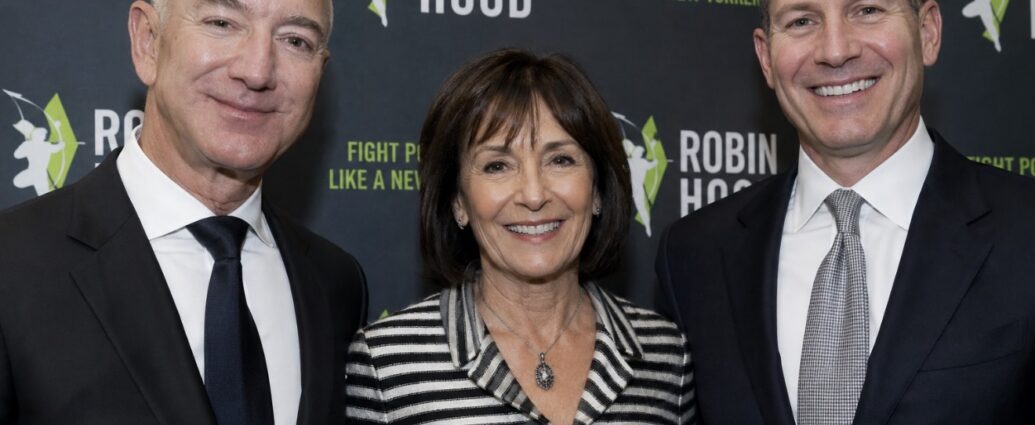
The Bezos Family Foundation has committed $100 million to Robin Hood, with an additional $25 million pledge subject to a match, anchoring the New York poverty-fighting organization’s newly launched $1 billion endowment campaign and creating a permanent fund for early childhood work in the name of the late Jackie Bezos, according to an announcement from Robin Hood at its annual benefit Monday night.
The gift establishes the Jackie Bezos Endowment for Early Childhood at Robin Hood and serves as the lead commitment to the Campaign for the Future – Endowing the Fight Against Poverty, which Robin Hood said is already 70% of the way to its billion-dollar target.
Robin Hood co-founder Paul Tudor Jones II described the endowment as a structural shift designed to safeguard the group’s work in perpetuity, separate from the organization’s traditional year-by-year fundraising, which raised approximately $73 million at Monday’s gala.
Jackie Bezos, the mother of Amazon founder Jeff Bezos, served on Robin Hood’s board for ten years and chaired its Early Childhood Committee before her death.
Under her leadership, Robin Hood’s annual early childhood grantmaking grew from $13 million to $22.8 million, a 75% increase, and her seed funding launched the Fund for Early Learning, a ten-year, $66 million initiative that has directed $53.8 million in grants and catalyzed more than $63 million in additional public and private capital.
Mark Bezos, her son and a Robin Hood board member, said the gift was intended to make permanent the work his mother helped build, framing the endowment as a generational commitment to the city’s youngest residents rather than a transactional grant.
The Bezos Family Foundation, co-founded by Jackie and Miguel Bezos, has been a longtime Robin Hood partner, including a $10 million contribution in 2022 to a previous child care initiative.
The timing carries unmistakable policy weight.
The donation lands as New York Mayor Zohran Mamdani, who took office on an affordability platform, moves to implement free universal child care.
Last month, the mayor announced that 2-K programming, free early care and education starting at age 2, would be universally accessible year-round, and his administration has begun recruiting providers for additional 3-K and 2-K seats.
The city’s FY2027 budget, released Tuesday, included $59.6 million for child care for all and K-12 education support, against a backdrop of a $12 billion budget shortfall the mayor has described as historic in magnitude.
Richard R. Buery Jr., Robin Hood’s chief executive, said public funding must remain the primary driver of the city’s child care expansion, with philanthropy serving to help deploy those resources more effectively.
City Hall echoed that framing. Spokesperson Jenna Lyle said delivering universal child care across the five boroughs would require a coalition of government, providers, working families, labor, philanthropy and residents.
The endowment campaign reflects a broader shift in how high-net-worth donors are structuring their commitments to New York’s social infrastructure, favoring permanent vehicles over annual gifts.
The first contribution to the Campaign for the Future came from Bloomberg Philanthropies, the giving vehicle of former Mayor Michael Bloomberg, with additional lifetime and legacy commitments from Citadel founder Kenneth Griffin, John Overdeck, Elizabeth and Lee Ainslie, Eva and Glenn Dubin, Dina Powell McCormick, Laurie M. Tisch and others drawn largely from Wall Street and hedge funds.
Robin Hood has invested $3 billion in poverty programs since its founding in 1988.
State-level momentum is also building.
Governor Kathy Hochul has proposed a $1.7 billion increase in child care funding for the upcoming fiscal year, including $1.2 billion in subsidies, and has set a target of a seat for every 4-year-old by the 2028-29 school year.
The combined trajectory of city, state and philanthropic capital is reshaping the financial architecture of early education in New York at a moment when child care costs remain a leading driver of household financial stress and a constraint on labor-force participation.
For Robin Hood, the structural significance is the move toward a permanent capital base.
Annual giving in the philanthropic sector tends to fluctuate with market cycles, and an endowment provides operational stability when economic conditions tighten or donor priorities shift.
For the Bezos family, the gift extends a multi-decade pattern of Robin Hood involvement and reframes a fortune most often associated with Amazon and Blue Origin around a New York-anchored legacy in early education.
The political backdrop adds complexity.
Mayor Mamdani’s coalition includes voters skeptical of concentrated wealth, while the donor base behind Robin Hood is drawn largely from the financial sector. Whether the endowment becomes a durable bridge between those constituencies will depend on execution, accountability and the city’s ability to translate philanthropic capital into measurable outcomes for families.
JBizNews Desk
© JBizNews.com. All rights reserved. This article is original reporting by JBizNews Desk. Unauthorized reproduction or redistribution is strictly prohibited.