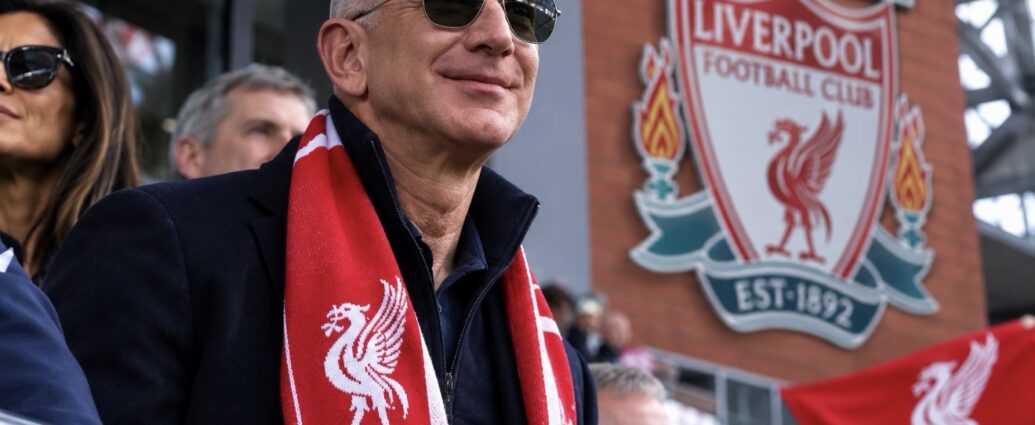
Fenway Sports Group is not selling Liverpool. It is selling a piece of it. The Boston-based company that has controlled the English soccer club since 2010 has been negotiating to sell roughly a third of the club to an outside investor group — one that includes Amazon founder Jeff Bezos — for cash, while keeping majority control and day-to-day command of the operation. The stake under discussion is more than 30%, worth about £1.35 billion, or close to $1.8 billion.
The price sets the club’s total value at £4.4 billion, roughly $6 billion, which would rank among the largest deals the sport has seen. Sky News reported on August 10 that Fenway is preparing to announce the transaction as soon as this week. Nothing has been formally announced yet, and both sides have declined to discuss timing publicly.
The buyers are led by Amit Bhatia, a British businessman who is the son-in-law of Indian steel billionaire Lakshmi Mittal and who was previously a shareholder and vice-chairman at Queens Park Rangers before stepping away from that club earlier this summer. Bezos is the largest name attached to the group. Also participating is Eduardo Saverin, the Facebook co-founder, whose fortune is estimated above $32 billion. Fenway acknowledged the approach in a statement last month, saying an investment consortium led, managed and represented by Bhatia had expressed interest in a strategic minority investment in the club.
For Bezos, this would be a first. He looked at buying the Seattle Seahawks and the Washington Commanders in the past and walked away from both. Soccer has never been on his list. His participation says less about the sport than about the asset: top-tier European clubs are now traded the way infrastructure and media properties are, priced on global broadcast revenue, sponsorship reach and scarcity of supply.
The arithmetic behind Fenway’s side of the table is the part worth studying. The group bought Liverpool for £300 million in 2010, when the club was in financial distress. If the current deal closes at the reported valuation, the franchise has multiplied roughly fourteen times in sixteen years, and Fenway monetizes part of that gain without giving up the asset. The last comparison point is recent: when Dynasty Equity bought a small interest in 2023, the club was valued at more than £3.3 billion, about $4.5 billion. The new number is a third higher in under three years.
That trajectory explains the buyers as much as the seller. American money has been moving into English soccer steadily, and half of the Premier League’s 20 clubs are now primarily controlled by U.S.-based investors. One driver is availability — NFL and Major League Baseball franchises are increasingly closed to new buyers or simply unaffordable, while a Premier League club remains within reach for technology and finance fortunes. Rising American viewership of the sport has done the rest.
Liverpool supporters should temper expectations about what the cash buys on the field. The Premier League’s profitability and sustainability rules cap what clubs can lose against revenue, so an injection of this size does not translate into an open transfer budget. In practice the money tends to go toward stadium capacity, training facilities, debt reduction and balance-sheet cushion — the items that let a club compete with state-backed rivals without depending entirely on matchday and broadcast income.
There is a legitimate caution attached, and it has been voiced by soccer finance analysts since the report surfaced: investors of this size put money in to earn a return, and the presence of a group with this much capital raises the question of whether a minority position stays a minority position. Fenway retains control under the structure as described. Whether the same is true in five years is a separate matter.
What happens next is procedural but not automatic. Fenway must issue the announcement, the parties must sign definitive documents, and the incoming owners must clear the Premier League’s owners’ and directors’ test before the shares change hands. Until that sequence completes, the deal is an agreement in principle carried by reporting rather than a closed transaction. For Fenway, the fix to a familiar problem — how to fund a club competing against sovereign-backed budgets without selling it — is a partial sale that brings in outside billions and leaves the boardroom intact.
JBizNews Desk | New York
© JBizNews.com All Rights Reserved. Reproduction or distribution without written permission is prohibited.