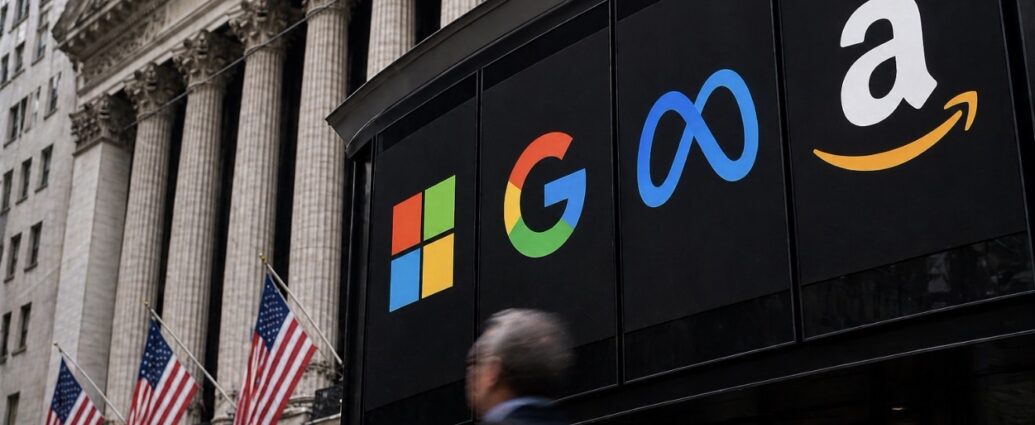
NEW YORK — Wall Street is entering one of the most consequential earnings windows of 2026 as Microsoft, Alphabet, Meta Platforms, and Amazon prepare to release first-quarter results after the closing bell Wednesday, putting the technology sector’s unprecedented artificial intelligence spending surge under its first true stress test.
The four companies — all central pillars of the “Magnificent Seven” — are collectively expected to deploy roughly $600 billion in capital expenditures this year, a scale of investment that has reshaped global infrastructure markets and driven the current rally in semiconductor and cloud stocks. The core question now confronting investors is whether that spending is translating into measurable revenue growth and margin expansion — or simply front-loading costs ahead of uncertain returns.
Alphabet CEO Sundar Pichai has emphasized that the company’s aggressive investment cycle is essential to maintaining leadership in AI, stating in prior remarks that “the opportunity with AI is as big as it gets,” as the company guides toward $175 billion to $185 billion in 2026 capital expenditures, roughly double last year’s total. At the same time, analysts warn that depreciation tied to that spending is set to begin flowing more heavily through earnings statements in coming quarters.
At Amazon, CEO Andy Jassy has framed AI as a once-in-a-generation platform shift centered on cloud dominance. The company is expected to spend close to $200 billion this year, building out data centers and custom silicon such as its Trainium chips. AWS growth remains the key barometer. Analysts broadly expect cloud expansion above 25% to signal sustained demand for AI workloads, particularly after Amazon confirmed this week that OpenAI models will be available on AWS, expanding its competitive positioning against Microsoft.
Microsoft CEO Satya Nadella has positioned the company at the center of enterprise AI adoption, with Azure cloud performance serving as the primary scorecard. Azure grew 39% in the prior quarter, and investors are watching closely to see whether that figure can push toward or above 40%. Microsoft’s multi-year, $100+ billion annual investment in AI infrastructure has made it one of the largest capital allocators in the global economy, and executives have repeatedly stressed that AI services are now contributing meaningfully to cloud growth.
At Meta Platforms, CEO Mark Zuckerberg has leaned aggressively into AI-driven advertising and platform optimization. Wall Street expects roughly $55 billion in quarterly revenue, implying growth near 30% year-over-year. Zuckerberg has said Meta’s AI investments are already improving ad performance through tools like Advantage+, noting that “AI is driving better results for businesses at scale.” Analysts are now focused on whether those gains can continue offsetting the company’s rapidly expanding infrastructure costs.
The stakes extend well beyond individual earnings reports. Together, these four companies represent a dominant share of U.S. equity market gains over the past year and are central to the broader thesis that artificial intelligence will drive the next phase of economic productivity. JPMorgan analysts recently noted that hyperscaler capital spending is “the single most important variable in the global tech outlook,” underscoring how closely markets are tied to their investment decisions.
Adding another layer of complexity is the shifting competitive landscape around AI partnerships. This week’s developments involving OpenAI, including expanded cloud distribution agreements and evolving relationships with major platforms, highlight how quickly alliances in the sector are changing — and how critical access to models and compute capacity has become.
Investors are also watching the timing. With all four companies reporting after the bell, markets could receive a compressed wave of information within minutes, creating the potential for sharp after-hours volatility across equities, ETFs, and futures tied to the technology sector.
Beyond earnings, Wednesday also marked a major development in financial markets with the public debut of Pershing Square Capital Management’s U.S. investment vehicle, led by billionaire investor Bill Ackman. The IPO raised approximately $5 billion, pricing at the lower end of expectations but still representing one of the largest market debuts of the year. Ackman called the launch “an important milestone” in expanding access to Pershing Square’s strategy, as shares of the newly listed entities began trading on the New York Stock Exchange.
The convergence of these events — record-scale AI spending, pivotal earnings releases, and a high-profile IPO — reflects a market increasingly defined by capital intensity, technological transformation, and investor concentration in a small group of dominant firms.
What happens after the closing bell may determine not just the next move in tech stocks, but the credibility of the entire AI investment cycle that has come to define this market.
— JBizNews Desk