
October 16, 2026 | JBizNews | New York
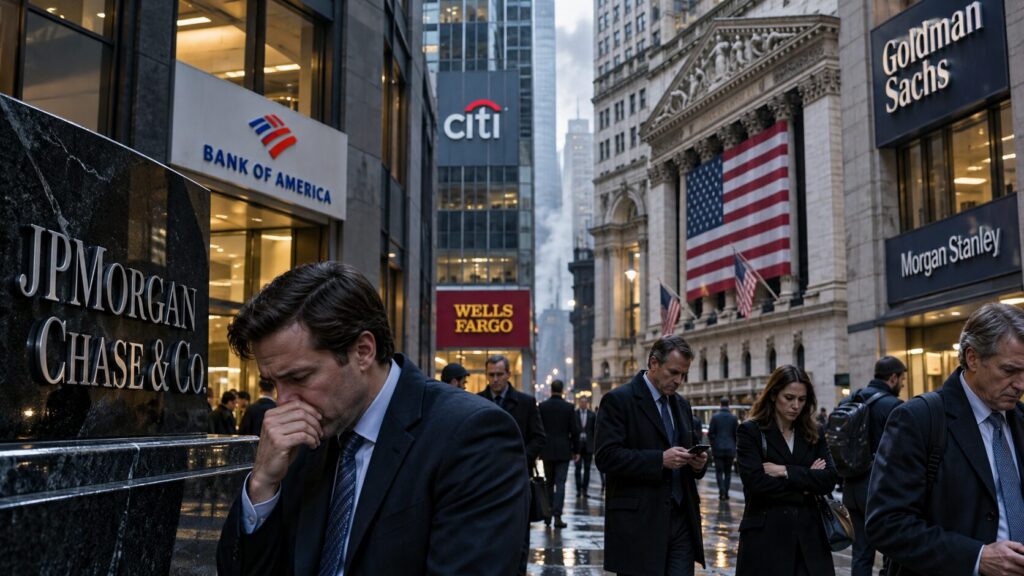
America’s largest banks are facing their longest weekly stock-market losing streak since the 2008 financial crisis, as disappointing earnings reactions, elevated interest rates and growing concerns about the economy continue to weigh on Wall Street.
The KBW Bank Index, which tracks 24 major U.S. banking companies, was headed for its sixth consecutive weekly decline Friday. The index has fallen approximately 13% from its August record high, placing the sector firmly in correction territory.
The prolonged decline is particularly notable because it comes during a quarterly earnings season in which several of the country’s biggest financial institutions reported profitable results. Investors, however, are increasingly focused on the challenges ahead rather than profits already recorded.
Bank Earnings Fail to Restore Confidence
JPMorgan Chase, Bank of America, Citigroup, Goldman Sachs, Wells Fargo and Morgan Stanley reported mixed third-quarter results this week, exposing a widening divide between areas of strength and weakness across the banking industry.
JPMorgan Chase and Bank of America missed analysts’ profit expectations, while Goldman Sachs and Morgan Stanley benefited from stronger equity-trading activity.
Citigroup delivered earnings above expectations but still experienced sharp selling pressure, demonstrating that beating Wall Street forecasts is no longer sufficient to reassure investors.
Investment banking operations have also faced difficulties as companies delay mergers, acquisitions and public offerings amid rising borrowing costs and economic uncertainty.
While trading desks benefited from volatile equity markets, fixed-income trading results were less encouraging at several institutions.
The combination has raised concerns that banks may struggle to maintain earnings growth if financial conditions remain restrictive.
Higher Interest Rates Add Pressure
The Federal Reserve’s September interest-rate increase has contributed to the downturn in banking shares.
Although higher rates can improve banks’ lending margins, they can also raise funding costs, weaken borrowing demand and increase financial pressure on households and businesses.
Persistent inflation has complicated expectations for future rate reductions, forcing investors to reconsider how long restrictive borrowing conditions might remain in place.
The banking sector has significantly underperformed the broader market since the September rate increase, indicating that investors are increasingly concerned about the industry’s earnings outlook.
AI Adds Another Layer of Uncertainty
Artificial intelligence has emerged as an additional concern for bank investors.
Financial institutions are investing heavily in technology to improve efficiency and compete with emerging financial platforms. At the same time, investors are questioning whether AI-driven changes to banking, payments and financial services could challenge traditional revenue streams.
Uncertainty surrounding the wider AI investment boom has also unsettled financial markets, adding pressure to industries sensitive to corporate borrowing and investment activity.
For major banks, these concerns arrive as elevated interest rates are already complicating lending and dealmaking.
Why the Banking Selloff Matters Beyond Wall Street
The significance of the decline extends beyond shareholders.
Major U.S. banks play a central role in financing businesses, commercial real estate, consumer spending and corporate expansion. A sustained deterioration in banking-sector confidence can eventually affect the availability and pricing of credit throughout the economy.
Businesses seeking financing for expansion, equipment purchases or real estate projects could face greater difficulty if lenders become more cautious.
Consumers could also encounter tighter credit standards, particularly if economic growth slows or concerns about loan performance increase.
The current downturn does not establish that a banking crisis is underway. Unlike 2008, when severe losses and funding problems threatened major financial institutions, the present decline primarily reflects investor concerns about valuations, profitability and the economic outlook.
Nevertheless, the historical comparison is difficult to ignore.
What Wall Street Will Be Watching
Investors will now focus on whether the Federal Reserve signals additional interest-rate increases, whether inflation begins to moderate and whether corporate borrowing and investment activity recover.
Bank lending trends, credit quality and the outlook for investment banking will also become increasingly important indicators of the sector’s financial health.
The next several weeks could help determine whether the selloff represents a prolonged reassessment of bank valuations or an early warning of broader economic weakness.
For now, the message from Wall Street is clear: Even profitable financial institutions are struggling to convince investors that the outlook is improving.
And with major U.S. bank stocks recording a losing streak unmatched since the global financial crisis, the pressure is no longer confined to individual companies. It has become an industrywide concern.
JBizNews Desk | New York
© 2026 JBizNews. All Rights Reserved.