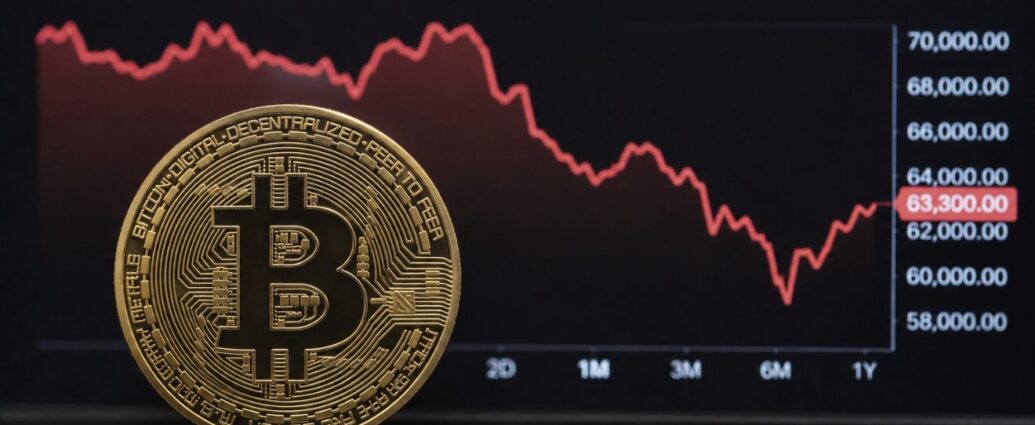
NEW YORK — Bitcoin has taken a severe hit from its record highs, and some market analysts believe the downturn may not be over.
As of Friday, June 12, the world’s largest cryptocurrency was trading around $63,300, up less than 1% on the day but substantially below levels seen earlier in the cycle.
Speaking at the BTC Prague conference, André Dragosch, Head of European Research at Bitwise Asset Management, warned that Bitcoin could fall another 20%, potentially reaching approximately $48,000 in a worst-case scenario.
The decline has been significant.
Bitcoin has fallen roughly 28% from its May peak near $82,000, briefly dropping below $60,000 before recovering into the low $63,000 range.
Viewed over a longer timeframe, the pullback is even more dramatic.
The cryptocurrency reached an all-time high of approximately $126,000 in October 2025, meaning it now trades at roughly half its peak value.
The broader trend since last fall has been decisively lower.
According to Dragosch, the primary driver of the decline has been persistent outflows from Bitcoin investment funds.
He pointed to approximately $2 billion in weekly outflows from Bitcoin exchange-traded products, investment vehicles that allow investors to gain exposure to Bitcoin through traditional brokerage accounts.
That level of selling pressure is equivalent to roughly 50,000 Bitcoin entering the market over a short period.
Notably, Dragosch said large corporate buyers, including Strategy, have largely maintained their accumulation programs, suggesting the pressure is coming primarily from fund redemptions rather than institutional buyers abandoning the asset.
The weakness has extended beyond Bitcoin.
In a recent research note, Bitwise reported that Bitcoin touched a cycle low near $58,000, while Ether, the second-largest cryptocurrency, fell to approximately $1,507, its lowest level in more than a year.
The firm described Bitcoin as the “canary in the macro coal mine,” reflecting its tendency to react quickly to shifts in investor sentiment and broader economic conditions.
That characterization appeared timely as technology stocks also came under pressure, with the Nasdaq experiencing a sharp selloff during the same period.
Dragosch outlined three key support levels that traders are closely monitoring.
The first sits near $61,000, a long-term average price level that has historically attracted buyers.
Below that is approximately $56,000, representing the average purchase price of many current holders.
The final major support zone is around $48,000, which reflects the average cost basis of long-term investors.
Dragosch described that level as the market’s “maximum pain scenario.”
If all three support zones fail, he believes Bitcoin could ultimately test the $48,000 range.
Other analysts remain cautious as well.
Alex Thorn, Head of Research at Galaxy, recently said Bitcoin may not have reached its ultimate bottom.
According to Thorn, only four of thirteen historical indicators typically associated with major market bottoms have been triggered.
Galaxy’s research suggests Bitcoin could potentially fall into a range between $40,000 and $46,000 before the current cycle fully resets.
There are, however, some early signs that selling pressure may be easing.
Dragosch noted that Bitwise’s proprietary bottom-detection model has started moving higher in recent weeks.
At the same time, he cautioned that blockchain data has not yet reached the extreme levels often associated with major market capitulation.
In simple terms, the market may be moving closer to a bottom, but analysts do not yet see definitive evidence that the decline has ended.
Not everyone is bearish.
Matt Hougan, Chief Investment Officer at Bitwise, continues to maintain a constructive long-term outlook.
Hougan argues that Bitcoin’s fundamental scarcity remains unchanged.
With a maximum supply capped at 21 million coins, he believes the long-term investment case remains intact despite short-term volatility.
As Hougan recently noted, “there is good news underneath the surface,” even if investors have not yet seen it reflected in prices.
That debate—between short-term selling pressure and long-term scarcity—is now at the center of the Bitcoin market.
For everyday investors, the lesson is clear.
Bitcoin remains one of the most volatile major financial assets in the world.
The same exchange-traded funds that made cryptocurrency easier for mainstream investors to buy can also accelerate selling when sentiment shifts.
The key level now is $61,000.
If Bitcoin holds above it, fears of a deeper selloff may begin to fade.
If it breaks below, traders will quickly turn their attention to the next support levels further down.
JBizNews Desk — Markets
© JBizNews.com All Rights Reserved. Reproduction or distribution without written permission is prohibited.