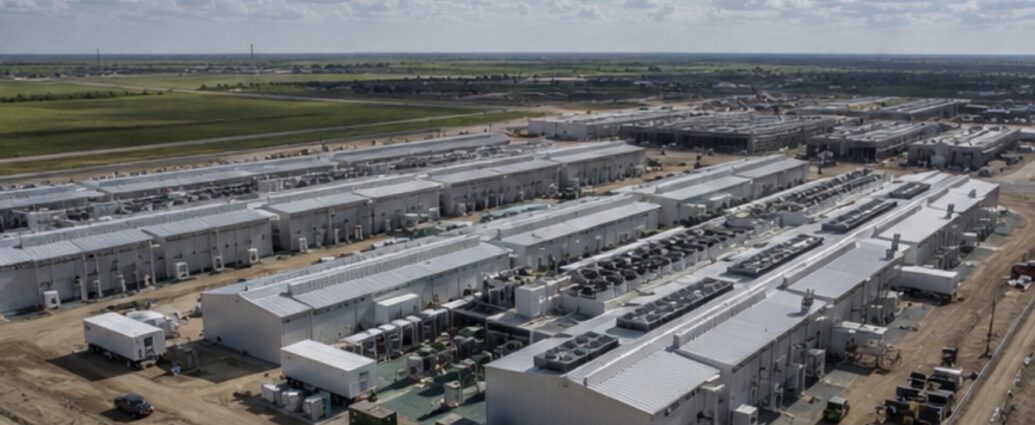
A company that made its name mining Bitcoin has just signed one of the largest data center leases in the country — a deal that captures how completely the AI boom is rewiring the technology economy and turning crypto miners into the landlords of artificial intelligence.
Bitcoin miner Hut 8 announced in early May that it had signed a 15-year lease worth $9.8 billion for the first phase of its Beacon Point data center campus in Nueces County, Texas, near Corpus Christi. The agreement covers 352 megawatts of computing capacity, with the tenant described only as a confidential, high-investment-grade company that plans to run AI training and inference at massive scale.
Notably, the facility is engineered to Nvidia’s specifications even though the customer’s name is being kept private. The 352-megawatt site was designed to Nvidia’s DSX reference architecture, the blueprint for the chipmaker’s most power-hungry AI systems — a sign of how thoroughly Nvidia’s technology now dictates how these buildings are constructed, regardless of who occupies them.
The financial terms grow even larger over time. The lease is structured on triple-net, take-or-pay terms, and if all three five-year renewal options are exercised, its total value could reach roughly $25.1 billion. The deal lifts Hut 8’s total contracted AI data center capacity to 597 megawatts, with a contracted revenue base of about $16.8 billion.
Investors reacted instantly. Hut 8’s shares jumped about 34% to nearly $108 the day the deal was announced, an all-time high, after more than doubling over the prior month. The market is rewarding the pivot from a volatile, low-margin business — mining cryptocurrency — to long-term contracts with creditworthy tenants paying for guaranteed power and space.
Hut 8 Chief Executive Asher Genoot framed the strategy around a single resource: electricity.
He said the company’s power-first development model is repeatable across tenants and geographies, and that it identified a site rivals overlooked, more than doubling its contracted capacity within five months. The campus was originally meant to house crypto-mining hardware before being redesigned for AI. An initial data hall scoped for 224 megawatts was enlarged to 352 megawatts — a 57% increase — after Nvidia’s denser systems advanced toward deployment.
Hut 8 is not alone in making this turn.
IREN, an Australian-listed company that began as a Bitcoin miner, unveiled a partnership with Nvidia to deploy up to 5 gigawatts of AI infrastructure and signed a separate $3.4 billion AI cloud services contract. TeraWulf recently added a 285-acre campus in eastern Kentucky expected to support up to a gigawatt of capacity. Across the industry, miners are racing to convert the one asset they spent years accumulating — access to cheap, large-scale electricity — into the hottest commodity in technology.
The logic is straightforward.
Bitcoin mining and AI computing both require the same thing: enormous amounts of power and the infrastructure to deliver it. Mining profits swing wildly with the price of Bitcoin, while AI tenants sign 15-year leases that pay whether crypto is up or down. For companies that already control gigawatts of grid capacity and the permits to use it, leasing that power to AI firms is far steadier money than digging for digital coins.
The shift also underscores what has become the real bottleneck in the AI build-out: not chips alone, but the electricity and physical sites to run them. Hut 8 has secured an interconnection agreement for a full gigawatt of utility capacity at the campus, with initial power expected in early 2027. In a country where the grid is straining to keep up with demand, the companies that locked up power early are suddenly sitting on something close to gold.
For Hut 8, the gamble is that AI’s appetite for computing keeps growing long enough to justify a 15-year commitment. For the broader economy, the deal is a marker of how the AI era is reshaping industries that have nothing to do with software — turning a Bitcoin miner in a Texas county most Americans have never heard of into a key supplier of the infrastructure powering the future.
The AI boom is often described through the lens of chatbots, software, and algorithms. But deals like this reveal what may matter most: power, land, transmission access, and the ability to deliver massive amounts of electricity where AI companies need it. In that race, former Bitcoin miners are discovering they already own some of the most valuable assets in the economy.
JBizNews Desk — Artificial Intelligence
© JBizNews.com All Rights Reserved. Reproduction or distribution without written permission is prohibited.