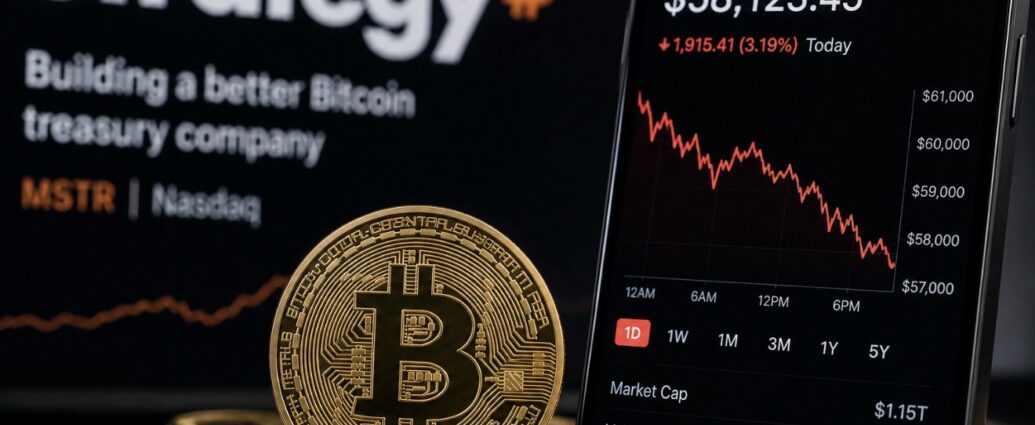
On Monday, Strategy Inc., the company led by Michael Saylor and the world’s largest corporate holder of Bitcoin, announced a sweeping change to how it manages its capital—including, for the first time, authority to sell some of its Bitcoin. By Tuesday, Bitcoin had fallen more than 3% toward $58,000 as investors reversed an initial wave of optimism over Strategy’s financing overhaul, rattling a crypto market already on edge.
Under what it calls the Digital Credit Capital Framework, Strategy revised its capital structure to allow fundraising through Bitcoin sales of up to $1.25 billion—roughly 21,082 Bitcoin, or about 2.5% of its holdings of 847,363 Bitcoin. The company emphasized that the framework does not require it to sell any Bitcoin. But for the first time, it has formally given itself the option.
For years, Strategy followed a simple playbook: raise money by issuing stock or bonds, then use the proceeds to buy more Bitcoin. Investors came to expect that every capital raise meant additional Bitcoin purchases. Monday’s announcement altered that assumption. Once traders realized one of Bitcoin’s largest and most consistent buyers could also become a potential seller, market sentiment shifted quickly.
The reversal was dramatic. On Monday, Strategy shares surged about 12.6% to roughly $92.70, while its STRC preferred shares climbed more than 12%, and Bitcoin briefly moved back above $60,000. By Tuesday, however, much of that enthusiasm had evaporated. Strategy shares dropped nearly 10% at one point, erasing most of the previous day’s gains, while Bitcoin slipped back below the psychologically important $60,000 level.
Part of the concern centers on Strategy’s own valuation. The company now trades for less than the market value of the Bitcoin it owns, with its mNAV falling below 1, meaning investors value the company at less than its digital assets. Strategy purchased its Bitcoin at an average price of roughly $75,646 per coin, leaving the company sitting on an unrealized loss of approximately $13 billion with Bitcoin trading near current levels. When the stock trades below the value of its holdings, issuing new shares to buy additional Bitcoin becomes far less attractive.
Technical analysts also see warning signs. Matt Maley, chief market strategist at Miller Tabak + Co., said Bitcoin’s chart remains weak after breaking below key technical support earlier this year and failing to reclaim those levels. Another significant decline, he warned, could reinforce a bearish trend.
Bitcoin has already endured a difficult year. The cryptocurrency has lost more than half its value from last year’s peak above $126,000. Investor demand has weakened as well. Spot Bitcoin exchange-traded funds have recorded more than $5.1 billion in net outflows this year, while BlackRock’s IBIT is reportedly on pace for its largest month of withdrawals since launching, with more than $3 billion leaving the fund during June.
The latest selloff has also revived debate over Strategy’s business model. Ripple Chief Executive Brad Garlinghouse argued that Strategy’s debt-financed Bitcoin strategy magnifies volatility across the cryptocurrency market. Longtime Bitcoin critic Peter Schiff warned that continued weakness in Strategy’s stock could eventually pressure the company to sell Bitcoin to meet financial obligations, potentially adding further downward pressure to prices.
Not everyone shares that view. Crypto analyst Ran Neuner argued that the new framework could ultimately strengthen investor confidence because it removes uncertainty over how Strategy would respond if liquidity became necessary. Citi maintained its buy rating on the stock with a $260 price target. Meanwhile, Jeff Dorman, chief investment officer at Arca, suggested the company may eventually need to sell between $2 billion and $3 billion of Bitcoin to ease ongoing market pressure.
For his part, Michael Saylor insisted the company’s long-term strategy remains unchanged. Bitcoin continues to serve as Strategy’s primary treasury reserve asset, he said, while adding that “Digital Credit requires liquidity, discipline, and active capital management.”
For now, Bitcoin remains locked in a tense battle around the $60,000 level that traders have watched closely for weeks. The next move may depend on whether buyers regain confidence—or whether the possibility of Strategy becoming a seller turns into reality.
JBizNews Desk
© JBizNews.com All Rights Reserved. Reproduction or distribution without written permission is prohibited.