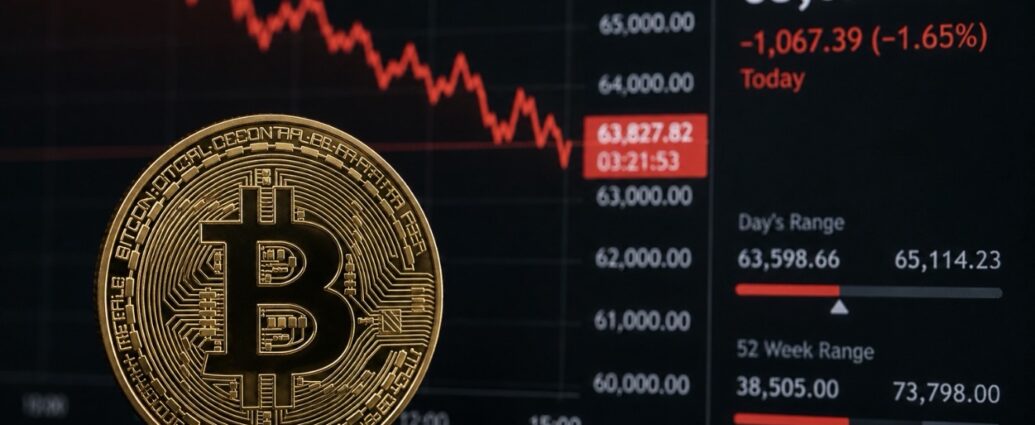
Bitcoin fell below $64,000 on Thursday as investors reacted to a more hawkish Federal Reserve and growing concerns surrounding Strategy, the company formerly known as MicroStrategy and the world’s largest corporate holder of Bitcoin.
The cryptocurrency was trading near $63,800, down about 1% over the previous 24 hours, after briefly climbing toward $67,000 earlier in the week. That rally had been fueled by optimism surrounding a developing agreement between the United States and Iran aimed at ending hostilities and reopening the Strait of Hormuz, easing concerns about inflation and energy prices.
The mood changed sharply following Wednesday’s Federal Reserve meeting, the first chaired by Kevin Warsh. While policymakers left interest rates unchanged, they signaled that rates may remain elevated longer than expected and could even move higher before year-end.
The Fed’s updated projections showed the median policymaker expects the benchmark federal funds rate to finish 2026 at 3.8%, up from 3.4% projected in March. Nine of the eighteen officials who submitted forecasts now expect at least one additional rate increase before the end of the year.
Higher interest rates generally weigh on speculative assets because they increase returns on safer investments and reduce demand for assets that generate no income. Bitcoin, which pays no yield, often struggles when investors expect tighter monetary policy.
Investors responded by pulling money from cryptocurrency investment products. Spot Bitcoin and Ethereum exchange-traded funds recorded approximately $111 million in net outflows following the Fed announcement.
A second source of concern is Strategy, led by executive chairman Michael Saylor, which owns approximately 846,842 Bitcoin, more than any other publicly traded company.
Shares of MSTR fell roughly 5% on Wednesday and extended losses Thursday as investors questioned the company’s ability to continue financing its aggressive Bitcoin acquisition strategy.
Particular attention has focused on the company’s preferred-share offerings. One series, known as STRC, recently traded around $89, well below its $100 face value. When preferred shares trade below par value, raising new capital becomes more difficult and more expensive.
Analysts at QCP Capital have warned that if financing conditions deteriorate further, Strategy could eventually face pressure to sell portions of its Bitcoin holdings to meet dividend obligations and other funding needs.
Those concerns intensified after Strategy disclosed in late May that it had sold 32 Bitcoin for approximately $2.5 million. While small relative to its overall holdings, the sale marked the first time the company had sold Bitcoin after years of promoting a “never sell” philosophy.
The move sparked debate among investors who viewed Strategy’s Bitcoin reserves as effectively untouchable.
Saylor has pushed back on those concerns, arguing that the company’s long-term commitment to Bitcoin remains unchanged. On Thursday, he reiterated that message by publicly highlighting Strategy’s holding of 846,842 Bitcoin and emphasizing the firm’s continued confidence in the asset.
Additional pressure has come from shifting investor attention toward new opportunities elsewhere in the market. The recent public debut of SpaceX, which disclosed holding 18,712 Bitcoin, has attracted significant investor interest and added competition for capital flowing into crypto-related investments.
Market sentiment has also weakened. The widely followed Crypto Fear & Greed Index recently fell into “extreme fear” territory, reflecting growing caution among traders. Bitcoin briefly touched a 2026 low near $59,100 last week before recovering.
Analysts now view $60,000 as a critical support level. A successful defense of that level could stabilize prices and encourage buyers to return. A decisive break below it, however, could open the door to additional declines toward $57,500 or lower.
Gerry O’Shea, head of global market insights at Hashdex, said he expects Bitcoin to trade largely between $60,000 and $70,000 in the near term unless a major catalyst emerges.
The next major driver remains inflation and Federal Reserve policy. If inflation cools and expectations for future rate hikes fade, pressure on both Bitcoin and Strategy could ease. If inflation remains elevated and the Fed signals additional tightening, cryptocurrency markets may face further headwinds.
For now, a market that spent much of the spring chasing record highs is increasingly focused on defense, with traders watching closely to see whether $60,000 can hold.
JBizNews Desk
© JBizNews.com All Rights Reserved. Reproduction or distribution without written permission is prohibited.