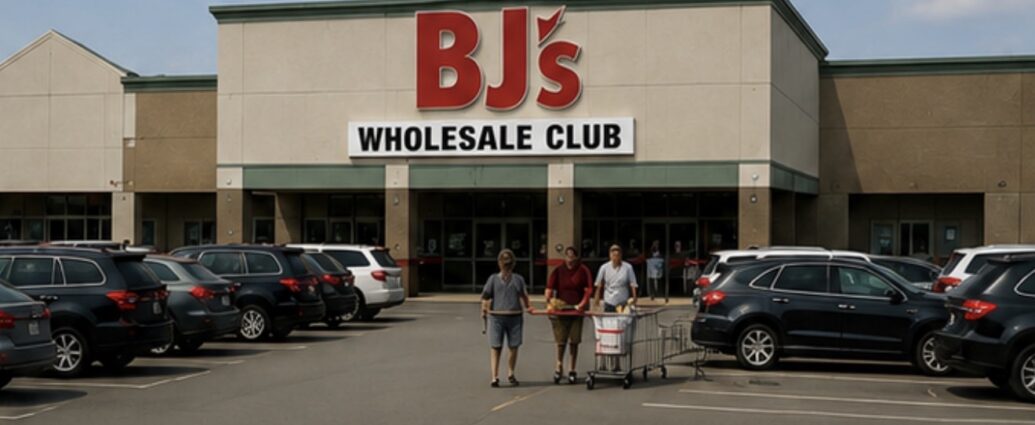
BJ’s Wholesale Club delivered a strong second-quarter report Friday, with consumers continuing to reward warehouse clubs even as spending becomes more selective across the broader retail economy.
For the quarter ended August 1, BJ’s reported $6.23 billion in total revenue, up 15.7% from a year earlier. Net sales rose 15.9% to $6.09 billion, while net income increased 15.4% to $173.9 million. Diluted earnings were $1.36 a share, up from $1.14 a year earlier and comfortably ahead of Wall Street expectations.
The headline sales increase, however, needs some explanation. Comparable-club sales rose 11.9% overall, but only 3.1% when gasoline is excluded. That means higher fuel sales accounted for a substantial portion of the reported growth. Even so, the 3.1% merchandise increase was stronger than analysts expected and showed that shoppers were still increasing purchases inside BJ’s clubs.
Membership is becoming an increasingly important part of the business. Membership-fee income rose 9.9% to $135.6 million, and BJ’s said its member count reached a record 8.5 million. The growth came from new-member acquisition, strong retention and more customers moving into higher-priced membership tiers.
Digital shopping is growing even faster. Digitally enabled comparable sales increased about 30%, showing that the warehouse-club model is no longer dependent entirely on customers making large physical shopping trips. BJ’s is increasingly combining its traditional bulk-discount model with online ordering, pickup and delivery.
The company also produced stronger operating results. Operating income rose 16.5% to $252.4 million, while adjusted EBITDA increased 14.3% to $347.2 million. BJ’s opened three clubs and one gas station during the quarter and repurchased roughly $124 million of its own shares.
Management responded by raising its fiscal 2026 adjusted earnings forecast to $4.60 to $4.80 a share, from its previous outlook of $4.40 to $4.60. BJ’s kept its forecast for comparable-club sales excluding gasoline at growth of 2% to 3% for the year.
For consumers, the report says something broader about the economy.
Households have not stopped spending, but they are increasingly looking for a clear value proposition. Warehouse clubs benefit because they can spread lower margins across high-volume purchases while generating recurring income from memberships. Bulk groceries, household products and discounted gasoline become particularly attractive when families are trying to stretch the same paycheck further.
BJ’s results therefore sit inside a larger shift in retail. Consumers may cut discretionary purchases, postpone expensive items or trade down from premium brands, yet continue spending heavily at stores where they believe the savings are measurable.
That is why the membership number may ultimately matter as much as the quarterly sales number. A record 8.5 million members gives BJ’s a larger recurring customer base and creates a powerful incentive for those households to concentrate more of their grocery, fuel and household spending inside the BJ’s ecosystem.
For investors, Friday’s report is evidence that value-oriented retail remains one of the more resilient corners of the consumer economy — even when the headline 16% revenue increase is adjusted for the unusually strong contribution from gasoline.
JBizNews Desk | Marlborough, Mass.
© JBizNews.com All Rights Reserved. Reproduction or distribution without written permission is prohibited.