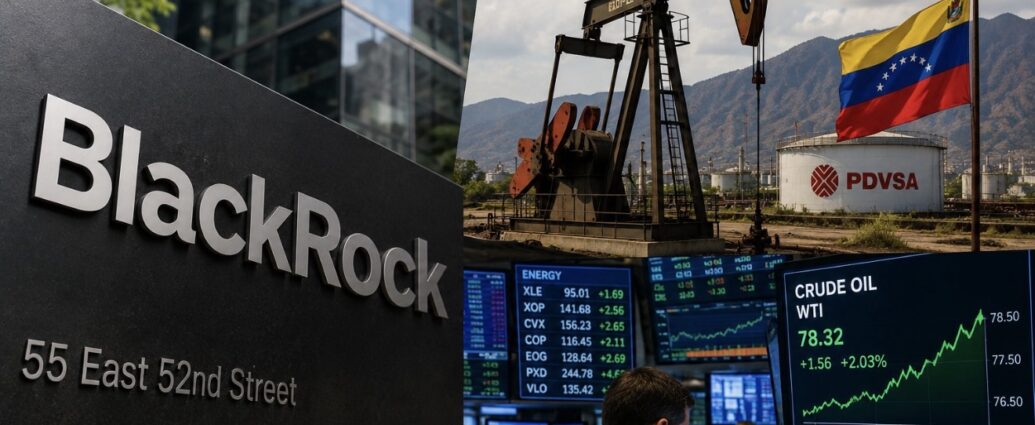
BlackRock Chairman and Chief Executive Officer Larry Fink delivered one of the strongest signals yet that major institutional investors are preparing to reenter Venezuela, declaring Monday that he is “quite bullish” on investing in the country following the removal of former President Nicolás Maduro earlier this year.
Speaking during a high-profile investment forum in New York, Fink said Venezuela’s vast natural resource base and reconstruction potential could eventually return the country “back into its glory” — remarks that immediately drew attention across energy markets, Wall Street trading desks and geopolitical circles.
“I’m actually quite bullish on the opportunity to invest in Venezuela,” Fink said during the panel discussion, publicly aligning the world’s largest asset manager with what could become one of the biggest frontier-market investment stories of the decade.
The comments carry unusual weight because of who made them.
BlackRock manages more than $11 trillion in global assets, making it the largest money manager on Earth and one of the most influential institutions shaping where pension funds, sovereign wealth funds, insurers and institutional capital deploy money globally. When Fink publicly endorses a country as investable, markets pay close attention.
The backdrop to the growing investor interest is Venezuela’s enormous untapped energy potential.
The South American nation possesses the world’s largest proven oil reserves, estimated at roughly 303 billion barrels, representing approximately 17% of global reserves, according to international energy data. Yet despite those enormous reserves, Venezuela currently produces only around 1 million barrels of oil per day, a fraction of its historic production levels.
Before the rise of the Chávez-Maduro socialist era, Venezuela produced more than 3.5 million barrels daily, serving as one of the world’s major oil exporters and a cornerstone supplier to U.S. refiners.
The collapse that followed became one of the most dramatic economic declines in modern history.
Years of nationalization, sanctions, corruption, underinvestment and infrastructure deterioration devastated Venezuela’s oil sector. International oil companies were forced out following asset seizures initiated under former President Hugo Chávez, while state-owned energy giant PDVSA steadily deteriorated under political control and mounting debt burdens.
The turning point came earlier this year.
A U.S.-led military operation in January 2026 resulted in Maduro’s capture and extradition to New York, where he now faces federal drug trafficking and weapons-related charges. The operation dramatically reshaped geopolitical expectations surrounding Venezuela and immediately reignited speculation about whether Western energy firms could eventually regain access to the country’s vast oil fields.
Within hours of Maduro’s removal, President Donald Trump publicly encouraged U.S. energy companies to pursue major investments in Venezuela’s oil sector.
Secretary of State Marco Rubio later said the administration expected “dramatic interest from Western companies” should sanctions and political conditions permit expanded energy development.
Among the companies viewed as best positioned is Chevron, currently the only major U.S. oil producer maintaining limited operations inside Venezuela. Industry analysts also point to Exxon Mobil and ConocoPhillips as potential beneficiaries if the political transition stabilizes.
Both Exxon and Conoco participated heavily in Venezuela’s oil expansion during the 1990s before Chávez’s nationalization policies forced Western firms out. ConocoPhillips alone continues pursuing arbitration claims against Venezuela worth nearly $10 billion tied to expropriated assets.
The broader financial opportunity extends beyond crude oil.
Venezuela also holds nearly 200 trillion cubic feet of natural gas reserves, accounting for more than 60% of Latin America’s known natural gas reserves. In addition, geologists believe the country possesses substantial deposits of strategic minerals including nickel, coltan and rare earth elements critical to defense systems, semiconductors, telecommunications and clean energy technologies.
For global investors increasingly focused on resource security and commodity supply chains, those reserves are becoming harder to ignore.
Still, the path from investor optimism to actual capital deployment remains highly uncertain.
Energy analysts caution that rebuilding Venezuela’s oil infrastructure would require tens of billions of dollars and potentially decades of sustained investment. Pipelines, refineries, drilling systems and export terminals across the country remain severely degraded after years of neglect.
Robert McNally, President of energy consultancy Rapidan Energy Group, recently described Venezuela’s reserves as “tantalizing” for Western energy firms if sanctions are eventually lifted, but warned that companies would require long-term political and contractual stability before committing large-scale capital.
That remains Venezuela’s greatest unresolved risk.
The political transition following Maduro’s removal remains fluid. Former Vice President Delcy Rodríguez has temporarily maintained elements of administrative authority even as opposition leader María Corina Machado pushes for a broader democratic transition and internationally recognized governance structure.
No major Western oil company has yet formally announced large-scale investment plans.
But Wall Street’s tone is unmistakably shifting.
For years, Venezuela was viewed primarily as a geopolitical risk and humanitarian crisis. Fink’s comments suggest institutional investors are increasingly beginning to view it instead as a high-risk but potentially transformative frontier-market opportunity — one capable of reshaping global oil flows, energy geopolitics and emerging-market investment strategies.
For a country whose economy has contracted by roughly 75% over the past decade, driving millions into poverty and migration, the attention of the world’s most powerful asset manager represents more than financial optimism.
It signals that global capital may once again be preparing to enter Venezuela — if political stability can finally follow.
JBizNews Desk
© JBizNews.com. All rights reserved. This article is original reporting by JBizNews Desk. Unauthorized reproduction or redistribution is strictly prohibited.