Taxes, energy costs, immigration and Jewish safety drive a combative exchange as Hochul repeatedly challenges her opponent’s ties to Trump.
October 13, 2026
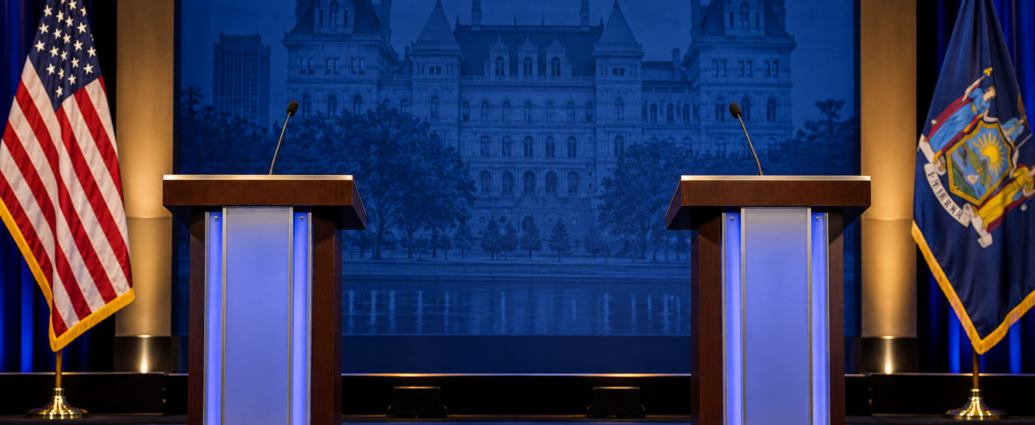
Bruce Blakeman pressed Gov. Kathy Hochul over New York’s living costs, immigration policies and public safety Tuesday night, using their only scheduled gubernatorial debate to challenge her record three weeks before Election Day. Hochul countered by portraying the Nassau County executive as a vehicle for President Donald Trump’s policies.
The contest carries concrete consequences for households and businesses: the candidates offer different approaches to income taxes, electricity costs, energy development and immigration enforcement. The debate repeatedly returned to their political alliances, however, as each sought to make the other defend an unpopular association.
The New York Post’s account described Hochul as being on the defensive over immigration. Blakeman challenged restrictions on local law enforcement cooperation with Immigration and Customs Enforcement, while Hochul argued that her policies still permit cooperation against criminals.
That exchange exposed a central disagreement about public safety: Blakeman wants broader local participation in federal enforcement; Hochul defended limits on that participation.
Affordability provides another dividing line. Blakeman’s published platform proposes eliminating state personal income tax on the first $50,000 of income for single filers and $100,000 for joint filers. It also calls for a 10% income-tax reduction for people earning under $250,000 annually.
His energy proposals include returning $2.4 billion in unspent energy funds to ratepayers, removing specified charges and expanding natural gas and nuclear generation. These are campaign proposals, rather than enacted savings. Their implementation and financing would determine what households ultimately receive.
Hochul repeatedly challenged Blakeman’s association with Trump. He responded by accusing her of using the president to avoid defending her own performance. He also identified differences with Trump on abortion and immigration, seeking to establish a separate position.
The exchange over antisemitism brought Hochul’s alliance with Mayor Zohran Mamdani into focus. Blakeman accused Mamdani of antisemitism and challenged Hochul over the protection of Jewish students during campus unrest.
Hochul answered by defending the New York Police Department, arguing that Blakeman’s warnings about possible violence questioned its ability to protect communities. Both candidates expressed support for Police Commissioner Jessica Tisch, according to The Times of Israel.
The candidates were addressing different parts of the controversy: Blakeman emphasized political leadership and Mamdani’s positions; Hochul emphasized confidence in law enforcement. The exchange left voters to assess whether those answers adequately addressed their concerns about Jewish safety.
Cornell’s handling of sexual-assault allegations produced another confrontation. Blakeman questioned Hochul’s oversight as an ex-officio university trustee. She rejected responsibility for misconduct inside a fraternity. The Times Union reported that Blakeman did not clearly explain how he would have handled the case himself.
The sharper attacks do not establish who persuaded more voters. The New York Sun described a contentious debate with little sustained policy discussion, and no credible post-debate voter survey was identified in the reporting reviewed.
For voters weighing a change in leadership, the next test is whether the candidates’ proposals withstand scrutiny beyond the stage: how tax reductions would be financed, how energy savings would be delivered and how public-safety policies would work. New Yorkers vote November 3.
JBizNews Desk | New York
© JBizNews.com. All rights reserved. This article is original reporting by JBizNews Desk. Unauthorized reproduction or redistribution is strictly prohibited.