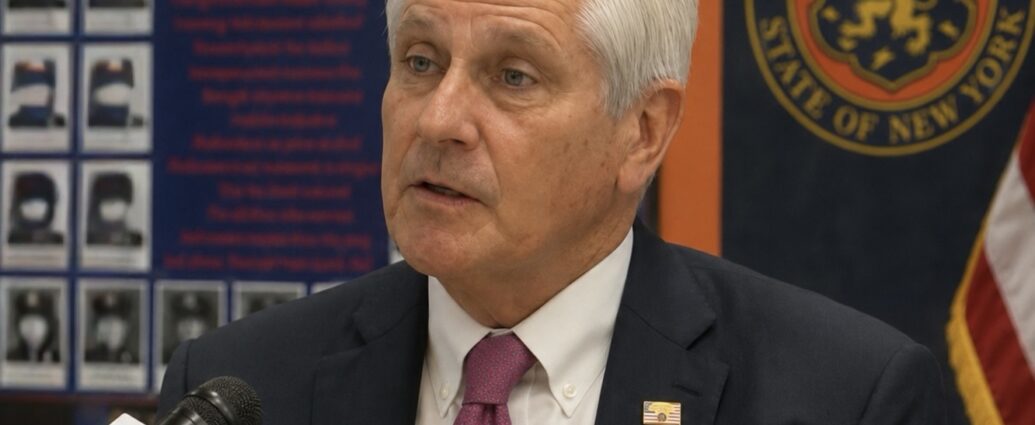
Bruce Blakeman, the Nassau County executive and Republican nominee for New York governor, said this week that he intends to use a little-known provision of the state constitution to try to kill Mayor Zohran Mamdani’s roughly $70 million plan to open city-owned grocery stores across the five boroughs, arguing that public money spent to undercut private operators runs afoul of the charter. In comments reported Friday, Mr. Blakeman pointed to the constitution’s gift-and-loan clause as the legal basis for a challenge, framing the fight as a defense of the neighborhood stores he says the plan would crush.
The clause Mr. Blakeman is leaning on is roughly 150 years old and bars local governments from giving or lending public funds or property to private entities, while requiring that municipal spending serve a genuine public purpose. It was written to stop cities and counties from steering taxpayer money to favored businesses, railroad companies chief among them, during an era of aggressive public subsidy. Mr. Blakeman’s argument is that opening one store in each borough and handing day-to-day operations to a chosen private company would use public dollars to lower that operator’s costs, amounting to a subsidy for select firms while nearby shops get no such help.
“City-run supermarkets can use public money to push prices down, leaving independent grocers and bodegas to face unfair competition that threatens local jobs and the survival of existing businesses,” Mr. Blakeman said, according to the reporting. He has separately called the broader plan unworkable and warned that taxpayers would carry the tab.
The proposal Mr. Blakeman is targeting took its first concrete step in April, when Mr. Mamdani named La Marqueta, a city-owned market in East Harlem, as the site of the Manhattan store. The mayor has said he wants the full five-borough network running by the end of his first term in 2029, using publicly owned space that is exempt from rent and property taxes to trim overhead and pass savings to shoppers on staples such as eggs, milk and bread. City Hall has not detailed how prices would be set, and the mayor’s office did not respond to a request for comment on Mr. Blakeman’s threat.
For the grocery trade, the stakes are concrete. Supermarkets typically operate on net margins of just 1% to 3%, and independent operators argue that a rival exempt from rent and property taxes would enjoy an advantage they cannot match. Roughly 450 independent stores in the city, many of them family-run and a large share operated by immigrant owners, sit closest to the proposed sites, and their operators say pricing and location decisions by a city-backed competitor could pull away the foot traffic they depend on. John Catsimatidis, the chief executive of the supermarket chain Gristedes, opposes the city-run model but said he was not familiar with the constitutional clause Mr. Blakeman cited. His alternative: rather than build new stores, the city could subsidize existing grocers who buy in bulk and require them to pass the savings to customers.
Whether the legal theory holds is another question. James M. McGuire, a former state appellate judge who served as chief counsel to former Republican Governor George Pataki, cautioned that existing New York Court of Appeals precedent could make Mr. Blakeman’s argument difficult to sustain. Courts have generally given lawmakers wide latitude to define what counts as a public purpose, a deference that has blunted past gift-and-loan challenges. A suit would likely turn on how directly the arrangement channels benefit to a private operator versus the public at large.
The clash also feeds directly into the governor’s race. Gov. Kathy Hochul, who backed Mr. Mamdani’s mayoral bid, told a business breakfast last August that she “supports free enterprise,” but she has largely stayed quiet on the grocery plan since. Mr. Blakeman, who carries President Donald Trump’s endorsement, trails Ms. Hochul by about six points in some polls, and he appears intent on making the cost of living and the proper role of government the center of his campaign. A courtroom fight over the grocery stores would give him a high-profile vehicle to press that case, whatever its odds of success.
For now, the plan remains on track inside City Hall, with site scouting underway and no store yet open. Mr. Blakeman’s threat adds legal uncertainty to a program already facing questions about pricing, supply chains and operating costs, and it signals that the first city-owned shelves, whenever they arrive, may open under the shadow of litigation.
JBizNews Desk | New York
© JBizNews.com All Rights Reserved. Reproduction or distribution without written permission is prohibited.