JBizNews Desk | May 10, 2026
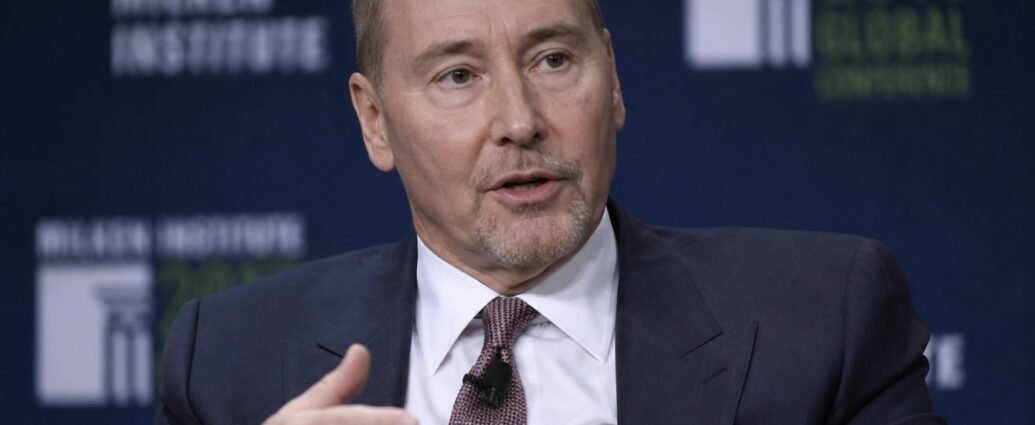
Jeffrey Gundlach — the billionaire investor known on Wall Street as the “Bond King” and founder of DoubleLine Capital — is quietly repositioning some of his funds for a scenario that most mainstream investors refuse to seriously consider:
That the United States government may one day be forced to restructure its own debt, effectively forcing the people and institutions that lent it money to accept less than they were promised.
Gundlach is repositioning some of his funds for the extreme scenario that the U.S. government could choose to restructure its debt in response to a potential future recession.
In an interview with Bloomberg Television, Gundlach suggested that, while unlikely, the U.S. may at some point opt to swap out bondholders’ higher-coupon Treasuries and replace them with ones with lower interest payments across the maturity curve.
In plain terms:
The U.S. government currently pays investors a set interest rate — called a coupon — on the bonds it sells to fund its operations.
Gundlach is positioning for the possibility that Washington could force a swap, handing bondholders new bonds that pay lower rates than the ones they currently hold.
That is, by any technical definition, a form of default — and it would be among the most destabilizing events in the history of global finance.
Why Gundlach Is Thinking About This Now
The context behind Gundlach’s bet is a U.S. fiscal picture that has deteriorated with remarkable speed.
The U.S. Treasury is on pace to borrow more than $2 trillion this fiscal year — more than $166 billion every single month.
The national debt has already crossed $41 trillion following the debt ceiling increase enacted in July 2025, and interest payments on that debt are now consuming more than $1 trillion per year — rivaling the entire defense budget and the combined annual costs of Medicare and Medicaid.
Gundlach has argued that the U.S. faces two difficult paths forward:
- currency debasement — printing money and allowing inflation to erode the real value of the debt
- or a soft default on Treasury obligations through debt restructuring
He has described DoubleLine as being at its lowest risk position in the firm’s 17-year history and has made the case that the secular decline in interest rates is over, with long-term U.S. Treasury yields likely to continue rising even through a recession.
Gundlach has warned that the U.S. deficit now stands at approximately 6% to 7% of GDP — a level historically associated only with the depths of major recessions.
He has cautioned that if that figure continues climbing toward 13%, it leads to a catastrophic debt crisis where the likelihood of restructuring becomes substantially higher.
The Iran war — now in its tenth week — is accelerating the fiscal deterioration Gundlach has been warning about for years.
War costs have already exceeded $200 billion and are being financed entirely through additional borrowing, layered on top of a structural deficit that was already projected at over $2 trillion before the first shot was fired.
What Debt Restructuring Would Actually Mean
For most Americans, the phrase “U.S. debt restructuring” sounds distant and technical.
It is neither.
U.S. Treasury bonds are held by pension funds, 401(k) plans, insurance companies, banks, foreign governments, and individual savers across the country and around the world.
Treasuries are considered the safest asset on earth — the bedrock on which the entire global financial system is built.
If the U.S. government were to force a coupon swap — replacing existing bonds paying, say, 4.5% with new bonds paying 2% — the immediate effect would be a massive wealth transfer away from every holder of U.S. government debt.
Pension funds would see the value of their portfolios collapse.
401(k) balances invested in bond funds would shrink.
Foreign central banks holding Treasuries as reserves would suffer enormous losses.
And the credibility of the U.S. dollar as the world’s reserve currency — an advantage worth trillions to the American economy — would be permanently damaged.
Gundlach is not predicting this happens tomorrow.
He has repeatedly described it as a tail risk — a low-probability but high-consequence scenario that responsible portfolio management requires taking seriously given the trajectory of U.S. fiscal policy.
The Private Credit Warning
Gundlach has also sounded the alarm on the $1.7 trillion private credit market, drawing explicit comparisons to the subprime mortgage market ahead of the 2008 financial crisis.
He has described private credit as potentially “the defining financial stress of this cycle” — a market characterized by opaque valuations, limited liquidity, and marks that may not reflect true underlying asset quality.
Gundlach noted that private credit shares “the same trappings as subprime mortgage repackaging in 2006” — complex structured vehicles, optimistic valuations, and a widespread assumption among investors that losses will be contained when the cycle turns.
He argued that $1 trillion in speculative-grade debt maturities hitting in 2028 will force a reckoning across private credit, corporate debt, and leveraged buyout structures that have been extended and refinanced repeatedly without underlying improvement in credit quality.
What Gundlach Is Actually Buying
Rather than holding long-duration U.S. Treasuries — the conventional “safe” bond investment — Gundlach has been advocating shorter-term Treasury bills and aggressively diversifying into non-U.S. equities.
He has continued recommending non-U.S. investing in equities since January 2025, arguing that European and emerging market stocks will continue to outperform the S&P 500 as the U.S. budget deficit grows at roughly $2 trillion per year.
The national debt, he noted, is now above $39 trillion and will exceed $40 trillion by year end 2026.
Gundlach has also maintained a positive view on gold as a hedge against both the inflation and restructuring scenarios — a position that has proven prescient as gold has climbed sharply since the Iran war began.
For American investors, savers, and businesses, the Gundlach repositioning is a signal worth taking seriously — not because U.S. debt restructuring is imminent, but because the person who has been most consistently right about the direction of interest rates and bond markets over the past decade is now quietly building a portfolio that hedges against a scenario most of Wall Street still refuses to model.
When the Bond King takes a longshot bet, the prudent question is not whether it will pay off — it is why he felt it necessary to make it at all.
© JBizNews.com. All rights reserved. This article is original reporting by JBizNews Desk. Unauthorized reproduction or redistribution is strictly prohibited.