
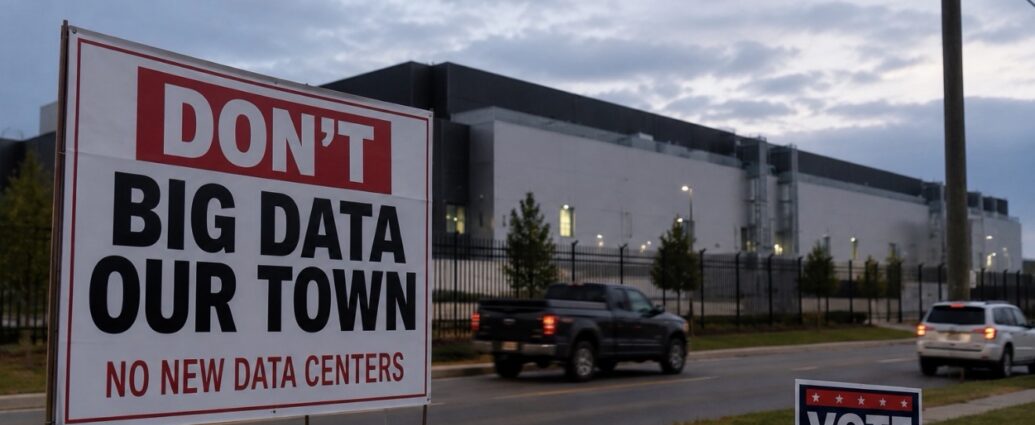
The buildings that house artificial intelligence have become a campaign issue in both parties, with candidates from town council races up to Senate contests running against the data centers going up in their states, according to reporting Friday by The National News Desk.
The complaint is a kitchen-table one. A large data center draws enormous amounts of electricity and water, and when a utility spends money to build the power lines and generating capacity to serve it, that cost lands in the rates everyone in the service territory pays. Voters are connecting a windowless building at the edge of town to the number at the bottom of their monthly bill.
The polling is lopsided. A Gallup survey earlier this year found 7 out of 10 Americans opposed to a data center being built in their area, and a Reuters/Ipsos poll in June found 59% — roughly 3 in 5 — opposed to one within 10 miles of their home. More than 1,500 new data centers have been proposed nationwide.
That combination is unusual in an election year: an issue where the opposition runs through both parties rather than between them. Punchbowl News reported this week that candidates across the map are running against the roughly $600 billion artificial intelligence buildout, tying it to the cost-of-living pressure voters are already feeling.
Texas state Rep. James Talarico, a Democrat running for Senate, has campaigned on reining in the companies, saying they are driving up utility bills, arriving in communities without resident input, and drawing down water in a state already short of it. Republican Rep. Byron Donalds, running for governor of Florida, has taken the other side of the water question — arguing that the facilities recycle and contain their own supply — while agreeing that they should be sited away from residential neighborhoods.
President Trump has pushed communities to accept the projects, arguing the money and investment will go to another state if they turn it down.
The states are not waiting for the election. New York has become the first state to impose a statewide pause on data center construction, a one-year moratorium, and city councils and county boards elsewhere have passed local restrictions of their own. Candidates in gubernatorial races in multiple states, in both parties, have now endorsed temporary halts, including Florida Democrat David Jolly, who said he would back a pause until the state has a plan to protect its water, its grid and its communities.
Moratoriums are the blunt instrument. The more durable fix being worked out in state utility commissions is a separate rate class for very large power users, so that a data center pays the full cost of the generation and transmission built to serve it instead of spreading that cost across residential customers. Several states are also writing contracts that require the operator to bring its own power supply, or to pay for it whether or not the facility ever runs at capacity. Where those rules are in place, the fight over the building itself tends to cool.
There is real money on the other side of the ledger. The projects bring construction jobs, property tax revenue that often reshapes a rural county’s school budget, and long-term capital investment. But the permanent workforce inside a finished data center is small, which is why the tax-base argument has not been enough to settle the politics.
For the companies building them — and for the utilities, turbine makers and electrical contractors selling into the boom — the risk through November is no longer federal. It is a county commission, a state rate case, or a governor who campaigned on saying no.
JBizNews Desk | Washington, D.C.
© JBizNews.com All Rights Reserved. Reproduction or distribution without written permission is prohibited.




