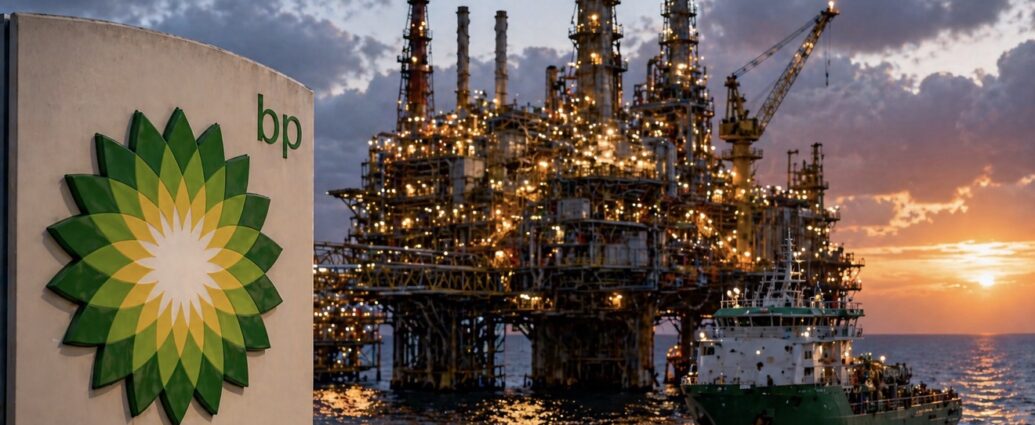
BP delivered a powerful first-quarter earnings report Tuesday, as surging oil and gas prices tied to the ongoing U.S.-Israel conflict with Iran pushed the British energy giant’s profits to more than double year over year, underscoring how geopolitical instability is reshaping global energy markets.
The company reported underlying replacement cost profit — its preferred metric — of $3.2 billion for Q1 2026, sharply above the $2.63 billion consensus estimate compiled by LSEG. The result compares with $1.38 billion in the same period last year, marking a more than 130% increase, as higher crude prices and volatility boosted trading and refining margins.
The driving force behind the surge is the prolonged disruption in the Strait of Hormuz, a critical chokepoint through which roughly 20% of global oil supply flows. The conflict, which escalated on February 28, has tightened supply and pushed Brent crude above $103 per barrel, while U.S. gasoline prices have climbed to an average of $4.18 per gallon, according to AAA.
The International Energy Agency (IEA) has described the current disruption as “one of the most significant energy security threats in modern history,” highlighting the scale of the shock reverberating through global markets.
BP said its trading division delivered an “exceptional” performance during the quarter, benefiting from both elevated prices and sharp market swings. The company’s integrated model — spanning upstream production, midstream logistics, and downstream refining — positioned it to capitalize across multiple segments of the value chain.
In its earnings commentary, BP leadership emphasized a continued focus on simplifying operations, reducing debt, and improving shareholder returns. Maurizio Carulli, analyst at Quilter Cheviot, interpreted the messaging as a constructive signal, noting that “integrated energy players like BP are uniquely positioned to generate enhanced cash flow in periods of sustained price strength.”
BP shares have risen more than 32% year-to-date, making it one of the strongest performers among global oil majors, second only to TotalEnergies. The company reaffirmed its $13 billion to $13.5 billion capital expenditure guidance for 2026 and projected $9 billion to $10 billion in divestment proceeds for the year, though it cautioned that upstream production could decline modestly in the second quarter.
Across the sector, energy companies are experiencing a resurgence reminiscent of the post-pandemic commodity boom. Analysts note that while higher oil prices benefit the entire industry, companies with sophisticated trading operations are seeing disproportionate gains.
“For as long as geopolitical tensions remain unresolved, the earnings environment for energy majors is likely to remain elevated,” Carulli added, pointing to continued uncertainty around diplomatic efforts involving Iran.
The results arrive amid rising political and shareholder scrutiny. BP recently faced pressure at its annual general meeting over transparency around climate-related risks and long-term fossil fuel investments. Environmental groups have criticized the scale of profits, with some describing the earnings surge as “deeply concerning” given global energy affordability challenges.
Still, from a financial perspective, BP’s momentum appears firmly intact. With additional earnings reports from ExxonMobil, Chevron, Shell, and TotalEnergies expected in the coming days, investors are watching closely to see whether the current geopolitical environment translates into a broader wave of outsized profits across the energy sector.
The key variable now is duration. As long as supply disruptions persist and diplomatic efforts remain stalled, energy markets are likely to stay tight — and companies like BP will continue to operate in a highly favorable pricing environment.
JBizNews Desk