
JBIZNEWS | ENERGY, ECONOMY & POLITICS | OCTOBER 16, 2026
NEW YORK — Global oil prices surged above $110 a barrel Friday for the first time since May, delivering another economic setback for President Donald Trump just 18 days before the November 3 midterm elections, as escalating Middle East hostilities threaten energy supplies, raise inflation concerns and complicate Republicans’ efforts to retain control of Congress.
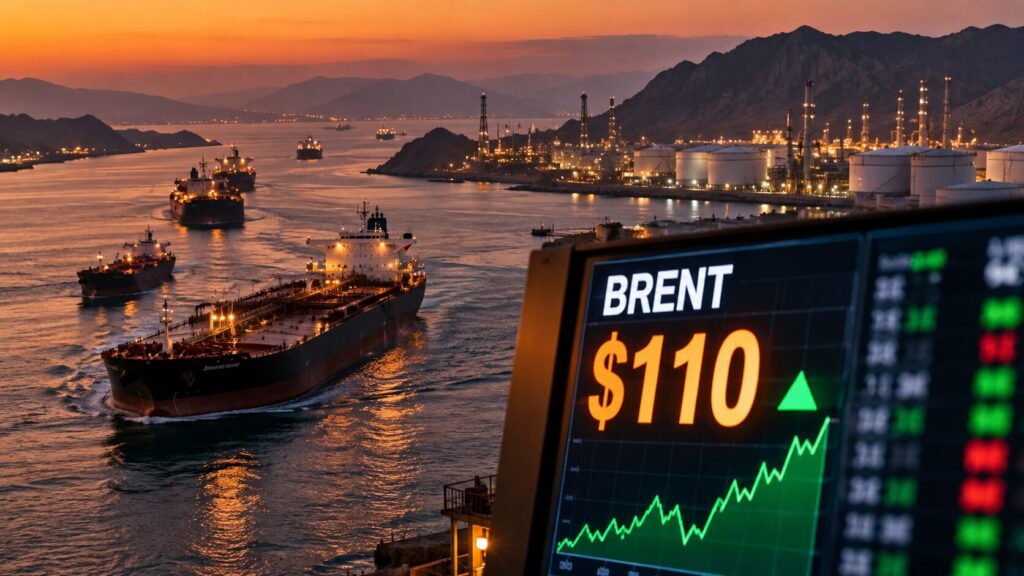
The benchmark Brent crude oil price briefly crossed the critical $110 threshold amid renewed attacks on shipping routes and energy infrastructure. Brent futures were subsequently quoted near $109.86 a barrel, their highest level since May 19, while U.S. West Texas Intermediate crude closed at $101.41, gaining approximately 3.5% in a single session.
For the White House, the timing could hardly be more consequential.
Trump has made lower energy costs a central part of his economic agenda, but continued conflict involving Iran, Houthi attacks and disruptions to Russian energy infrastructure are pushing oil prices in the opposite direction. The resulting increases in gasoline, diesel and transportation costs are reaching American consumers at precisely the moment both political parties are making their final appeals to voters.
A Global Energy Crisis Collides With the Midterm Elections
The rise above $110 represents more than another milestone in commodity trading. It highlights a growing political challenge for an administration seeking to demonstrate economic progress before voters decide control of the House and Senate.
A Pew Research Center survey conducted September 28 through October 4 found that 84% of registered voters consider the economy very important to their congressional vote.
The same survey showed Democratic congressional candidates holding an eight-percentage-point advantage over Republicans nationally, with President Trump’s approval rating at 30%.
Those findings preceded Friday’s latest oil rally.
Rising energy prices now threaten to reinforce voters’ concerns about affordability, particularly among households already struggling with gasoline, groceries, housing and transportation expenses.
The danger for Republicans is not simply the price of oil itself. It is the possibility that voters will connect the worsening cost-of-living picture with the administration’s economic and foreign policies.
Republicans Rework Their Election Strategy as Gas Prices Rise
The political consequences are already visible.
Republican campaign organizations have been shifting resources toward defending competitive seats, including contests in traditionally Republican states where higher living costs and dissatisfaction with the Iran conflict have complicated the electoral landscape.
Financial Times reporting this week showed Republicans committing hundreds of millions of additional dollars to congressional races amid intensifying competition.
Meanwhile, Trump has increased campaign appearances in an effort to energize Republican voters, while some GOP candidates have focused their messaging on tax reductions, public safety and local economic concerns rather than making the president the central subject of their campaigns.
Democrats have taken a different approach, emphasizing affordability and connecting Republican candidates to Trump’s record.
According to Associated Press reporting Friday, Democrats have spent more than $163 million since September 1 on television advertisements referencing Trump, compared with approximately $11 million in Republican advertising that mentions him.
The energy crisis has become part of that broader contest over economic credibility.
The political risk is particularly apparent in Kansas, where Republican Senator Roger Marshall warned in July that gasoline prices in October could determine the midterm elections. Since then, gasoline and diesel costs have risen sharply, and his reelection contest has attracted increased national attention.
Trump Faces a Difficult Choice Over Iran and Oil Prices
The administration is attempting to balance competing priorities: maintaining pressure on Iran, protecting Middle East shipping routes and preventing further increases in energy prices.
Yet seven months into the conflict, international oil markets remain vulnerable to fresh attacks.
Recent threats to vessels traveling through the Strait of Hormuz, renewed Houthi military operations and strikes affecting energy infrastructure have created uncertainty over the reliability of oil deliveries.
At the same time, Ukrainian attacks on Russian refining facilities have added another layer of instability to global petroleum supplies.
Efforts to ease restrictions affecting some Russian oil shipments, combined with emergency petroleum stockpile releases, have so far failed to eliminate the market’s concerns.
The International Energy Agency has committed substantial additional emergency supplies, but the continuing rise in crude prices illustrates the limits of such intervention while military threats remain unresolved.
The White House also faces a political complication: lower gasoline prices could provide immediate economic relief before the elections, but achieving that objective depends partly on international security developments that cannot be resolved through domestic economic policy alone.
Higher Oil Prices Threaten Inflation, Transportation and Consumer Spending
The consequences extend well beyond Washington.
National gasoline prices have climbed above $4.30 a gallon, substantially increasing the cost of driving for American households.
Diesel prices present an additional threat to trucking companies, manufacturers, construction businesses and retailers that depend on ground transportation.
Airlines face higher jet fuel expenses, while ocean freight operators must contend with increasing fuel costs, shipping insurance premiums and the possibility of longer delivery routes around dangerous waterways.
These additional expenses can ultimately reach consumers through higher prices for food, merchandise and essential services.
For the Federal Reserve, another sustained increase in energy costs could complicate efforts to control inflation. Higher fuel and freight expenses can spread through supply chains, making it more difficult to justify lower interest rates even as businesses face increasing borrowing costs.
Small businesses are particularly exposed because many lack the financial flexibility to absorb sudden increases in operating expenses.
The Final 18 Days Could Be Critical
With early voting already underway in several states, the administration has limited time to demonstrate that energy costs are moving in the right direction.
Even if crude prices begin to retreat, reductions at gasoline pumps may take time to reach consumers. Conversely, continued supply disruptions could keep petroleum prices elevated through Election Day.
Republicans retain substantial campaign resources and are counting on Trump to motivate voters who might otherwise stay home. Democrats are concentrating on economic dissatisfaction and the president’s handling of the Iran conflict.
Friday’s oil rally adds pressure to that contest.
The price of crude does not determine an election on its own. But when 84% of registered voters identify the economy as a major voting issue, a sharp increase in the world’s most important energy commodity becomes difficult for either party to ignore.
Oil crossing $110 just 18 days before the midterms is no longer merely an energy-market story. It is an economic shock arriving at one of the most politically sensitive moments of the year, with consequences for American businesses, household budgets and the battle for control of Congress.
JBizNews Desk | New York
© 2026 JBizNews. All rights reserved.