Monday, May 4, 2026
More than 330,000 American businesses are now filing claims to recover a combined $166 billion in import duties after the U.S. Supreme Court struck down President Donald Trump’s sweeping tariffs earlier this year — opening what could become one of the largest government repayments to importers in U.S. history.
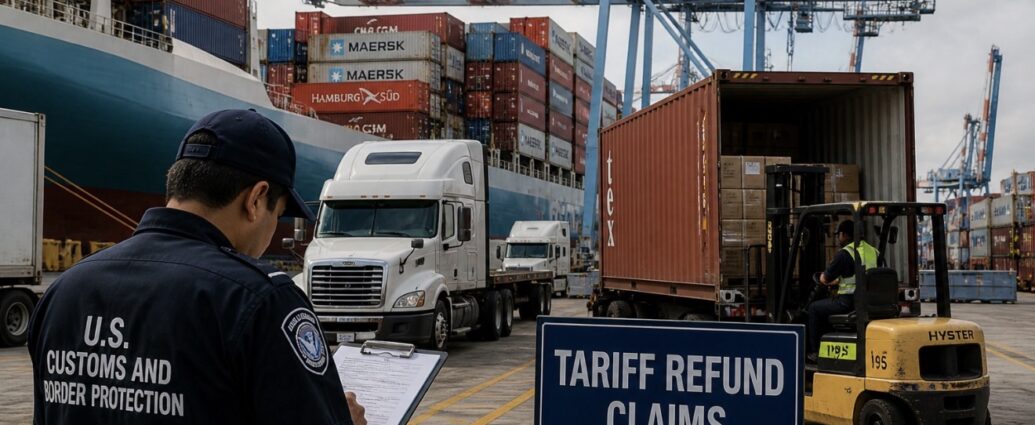
The Supreme Court ruled 6-3 in February that Trump’s tariffs, imposed under the International Emergency Economic Powers Act (IEEPA), exceeded presidential authority, finding that Congress — not the executive branch — holds constitutional power over the imposition of tariffs. Following that decision, U.S. Court of International Trade Judge Richard Eaton ordered the government to stop collecting the duties and establish a refund system. U.S. Customs and Border Protection (CBP) launched the first phase of its new claims portal on April 20, allowing importers and their customs brokers to submit refund requests through its Automated Commercial Environment (ACE) system using a newly developed tool called the Consolidated Administration and Processing of Entries (CAPE). Refunds are expected to be processed within 60 to 90 days, according to CBP.
The scale of the repayment is significant. Court filings show the $166 billion in duties was collected across more than 53 million shipments from over 330,000 importers — covering tariffs commonly known as “fentanyl,” “trafficking,” “reciprocal,” and “baseline” duties, as well as some charges applied to goods from Brazil and India. Tariffs imposed under separate legal authorities — including Section 232, Section 301, and anti-dumping measures — are not eligible for refunds. As of April 28, CBP had approved approximately 21 percent of relevant customs entries for removal of the IEEPA tariffs, with the agency continuing to issue updated guidance as businesses encounter technical issues with the portal.
The companies that stand to recover the most are major retail and logistics giants. Citi analysts project that Walmart alone could recoup approximately $10.2 billion. Target is expected to receive around $2.2 billion, Nike close to $1 billion, and retailers including Gap, Kohl’s, and Home Depot stand to collect hundreds of millions each. FedEx and UPS have both pledged to pass refund savings along to customers. Costco Wholesale CEO Ron Vachris suggested shoppers might see the benefit through lower prices. Trump has publicly praised companies including Apple and Amazon that have declined to claim refunds or pledged to keep the funds invested domestically.
For small businesses, the path to recovery is more complicated. Jaime Chamberlain, owner of produce wholesaler Chamberlain Distributing in Nogales, Arizona, said he filed for a refund of nearly $100,000 his company paid in tariffs over just three days — money he absorbed rather than passing on to customers. “Anytime the federal government says we were wrong and we need to go ahead and replace that money, that’s money well welcomed back,” Chamberlain said. He cautioned, however, that consumers should not expect prices to drop as a result. “It’s gonna pay us back for what we had already cut back, so it really won’t impact the consumers at all,” he said. Alex Jacquez, chief of policy and advocacy at Groundwork Collaborative, echoed that assessment, noting the logistical challenge of processing 330,000 claimants. “It’s going to be a bit of a challenge to get everybody their money back,” Jacquez said.
Economists also warn that shoppers should not expect broad relief at the register. Goldman Sachs analysts noted that consumer prices are unlikely to decline meaningfully as a result of the refunds, and that tariff-related costs are projected to add another 0.1 percent to inflation in 2026, on top of the 0.7 percent they contributed the prior year. The reason is straightforward: many importers absorbed the tariff costs rather than raising prices, meaning a refund to the business does not automatically translate to savings for the end buyer.
The ruling did not eliminate tariffs entirely. Following the Supreme Court‘s February decision, Trump moved quickly to impose a 10 percent tariff on nearly all U.S. imports under Section 122 of the Trade Act of 1974, a separate legal authority. Those tariffs took effect February 24 and are set to expire after 150 days. U.S. Trade Representative Jamieson Greer announced Section 301 investigations in March covering more than a dozen countries and trading blocs — including China, the European Union, Japan, Mexico, and India — signaling the administration’s intent to reimpose tariffs at or near previous levels through an alternative legal mechanism. For businesses weighing whether to lower prices now, that uncertainty is reason enough to hold steady.
The Liberty Justice Center, the legal advocacy group that represented small business plaintiffs before the Supreme Court, has launched the Tariff Equity Refund Resource for America — a free online platform offering guidance on how to properly submit documentation for refunds. “We took this fight all the way to the Supreme Court on behalf of small businesses, and we’re not stopping now,” said Sara Albrecht, chair of the Liberty Justice Center.
JBizNews Desk
© JBizNews.com. All rights reserved. This article is original reporting by JBizNews Desk. Unauthorized reproduction or redistribution is strictly prohibited.