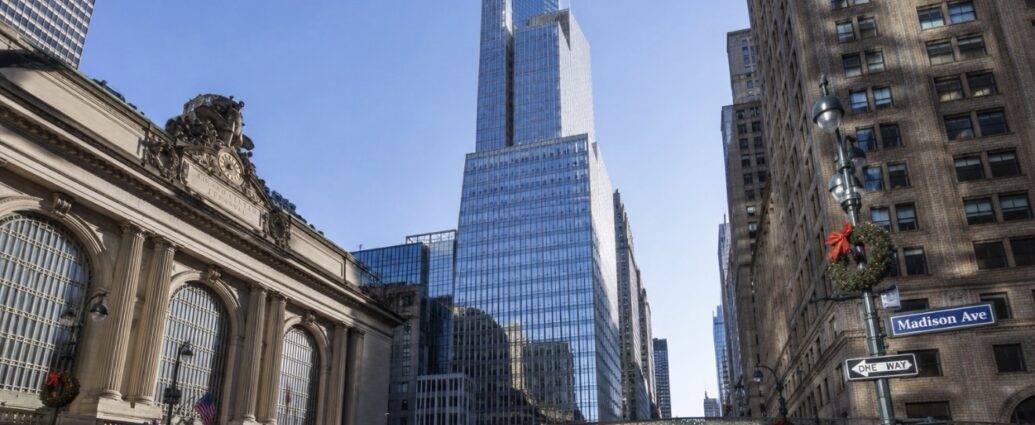
BXP has closed a $1.2 billion construction loan for its 343 Madison Avenue development, completing the financing for a roughly $2 billion Midtown Manhattan office tower and delivering one of the clearest signs yet that major lenders are once again willing to finance premier office projects in New York City.
The Boston-based real estate investment trust is developing the 46-story, approximately 930,000-square-foot tower directly across from Grand Central Terminal, with completion expected in 2029. The building is already about 50% pre-leased, providing lenders with significant leasing commitments years before delivery.
A lending syndicate led by Wells Fargo provided the financing alongside BofA Securities, The Bank of New York Mellon and JPMorgan Chase Bank. The loan carries a four-year initial term with a one-year extension option and is priced at Term SOFR plus 2.50%, falling to Term SOFR plus 2.25% once specified construction and leasing milestones are achieved. Fried Frank represented BXP, while Riemer Braunstein advised Wells Fargo.
The pricing tells a larger story than the loan itself. During the commercial real estate credit freeze of 2023 and 2024, financing a ground-up Manhattan office tower at any reasonable price proved exceptionally difficult as regional banks retreated from commercial real estate and even the nation’s largest lenders largely confined new lending to refinancing existing assets. The willingness of four major financial institutions to syndicate more than $1 billion for a building that remains only half leased signals that construction lending has returned for the highest-quality projects, even if financing remains scarce elsewhere.
BXP Chief Financial Officer Mike LaBelle said the financing reflects both the quality of the project and lenders’ confidence in the company’s development platform, adding that the company secured attractive terms despite a still-selective lending environment.
The project reached this point only after overcoming significant financial hurdles. Built on the former headquarters site of the Metropolitan Transportation Authority, the development lost a planned investment from Norges Bank, Norway’s sovereign wealth fund, which had intended to acquire a 45% ownership stake. BXP also reduced its dividend by 30% last September, preserving roughly $50 million each quarter to help finance construction internally while waiting for lending markets to recover. For a REIT, cutting its dividend to support development rather than acquisitions was an uncommon move that increased pressure to secure outside financing.
Strong leasing momentum ultimately strengthened the project’s investment case. Since announcing the development in late 2024 and breaking ground in mid-2025, BXP has secured major commitments from real estate investment firm Starr, including a 49,000-square-foot lease followed by a 275,000-square-foot, 20-year agreement signed four years before the building’s expected completion. Long-term anchor leases of that size provide precisely the predictable cash flow lenders seek when underwriting large office developments.
Designed by Kohn Pedersen Fox, the tower will include direct access to Grand Central Terminal’s Madison Concourse, private terraces, bicycle facilities with cabanas, a lobby café and a fully electric operating system pursuing LEED Platinum certification. The all-electric design also positions the property ahead of New York City’s tightening Local Law 97 emissions requirements, avoiding future retrofit costs facing many older office buildings that continue to rely on on-site fossil fuel combustion.
Its direct transit connection may prove equally valuable. Tenants will have immediate access to Metro-North’s Hudson, Harlem and New Haven lines, along with the Long Island Rail Road through Grand Central Madison, allowing commuters from New York, Connecticut and Long Island to reach the building without changing trains. As employers continue refining return-to-office policies, transportation convenience has become one of the strongest competitive advantages premium office buildings can offer.
The broader market also favors newly constructed trophy properties. Manhattan currently has only about 3.3 million square feet of office space under construction across nine projects—roughly 0.7% of its existing inventory. That limited supply leaves relatively few options for companies seeking modern Class A headquarters while widening the competitive gap between newly built buildings and aging office inventory that increasingly struggles to attract tenants, financing and investment.
The financing does not resolve the long-term challenges facing older office properties across New York City. It does, however, demonstrate that institutional capital remains available for projects offering premier locations, strong tenant demand and modern building standards. For developers, lenders and investors alike, 343 Madison Avenue suggests the market has begun distinguishing far more sharply between the best office assets and everything else.
JBizNews Desk | New York
© JBizNews.com All Rights Reserved. Reproduction or distribution without written permission is prohibited.