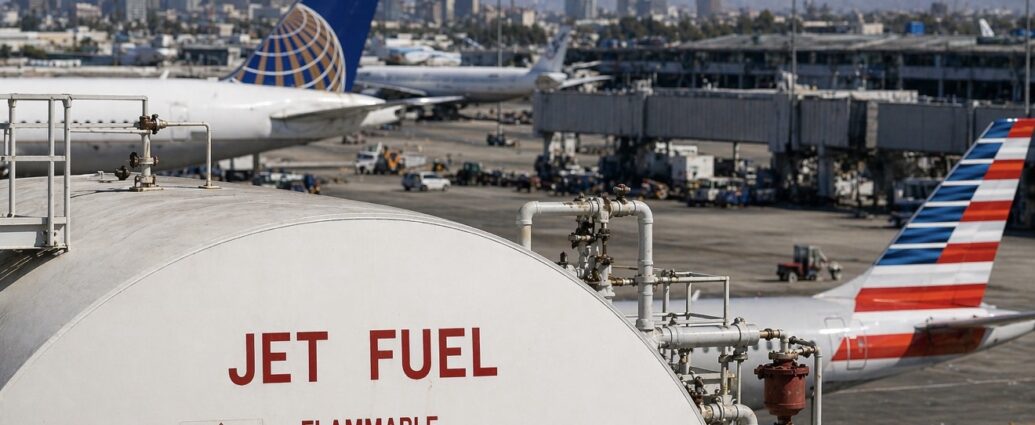
California is rapidly approaching a fuel-driven aviation shock that could ripple across the U.S. economy, as disruptions tied to the U.S.-Iran war choke off global jet fuel supply lines and expose long-standing vulnerabilities in the state’s energy infrastructure. According to the U.S. Energy Information Administration (EIA), California remains the largest jet fuel consumer in the nation, making it uniquely exposed to global supply disruptions tied to geopolitical conflict.
The Strait of Hormuz — a critical artery for roughly 20% of global oil and up to 30% of jet fuel shipments — has been largely shut for nearly two months following escalating conflict between the United States and Iran, triggering cascading supply disruptions worldwide. Energy analysts at Goldman Sachs and S&P Global Commodity Insights have warned that prolonged disruptions at Hormuz could create sustained imbalances in refined fuel markets, particularly impacting import-dependent regions like California.
The breakdown of supply chains is already evident. California imports roughly one million barrels of oil per day, with a meaningful share historically sourced through Asian refineries processing Middle Eastern crude, according to the International Energy Agency (IEA). With those refineries now constrained, industry officials cited by Bloomberg say fuel shipments to the U.S. West Coast have effectively halted, leaving only two to three weeks of fuel shipments currently en route.
The structural strain has been compounded by domestic policy decisions. The closure of Valero Energy Corp.’s Benicia refinery earlier this year removed approximately 145,000 barrels per day of refining capacity, according to company disclosures and filings with the California Energy Commission. California now operates just eight refineries, down sharply from more than 40 in the early 1990s.
Energy analysts warn the consequences could be severe. Gasoline inventories are already near decade lows, while prices in parts of Northern California have climbed sharply, according to data from AAA. Aviation markets are under particular strain, with Andrea Sachs of The Washington Post noting that jet fuel prices have roughly doubled since the conflict began, pushing airlines into what she described as “triage mode.”
Military readiness concerns are also emerging. Facilities including Travis Air Force Base and Naval Air Weapons Station China Lake, according to the U.S. Department of Defense, depend heavily on California’s fuel network, raising national security concerns alongside commercial disruptions.
Airlines are now reassessing routes, trimming capacity, and preparing for fare increases ahead of peak summer travel, according to industry updates reported by Reuters and CNBC. The convergence of geopolitical disruption and constrained domestic infrastructure is turning what might have been a temporary shock into a systemic risk with national implications.
The crisis underscores a broader reality: energy shocks abroad can translate into domestic shortages with striking speed — and the margin for error in critical infrastructure supply chains is thinner than policymakers anticipated.
JBizNews Desk